
Indian Stock Market Crash Shakes Dalal Street as Key Levels Break Down
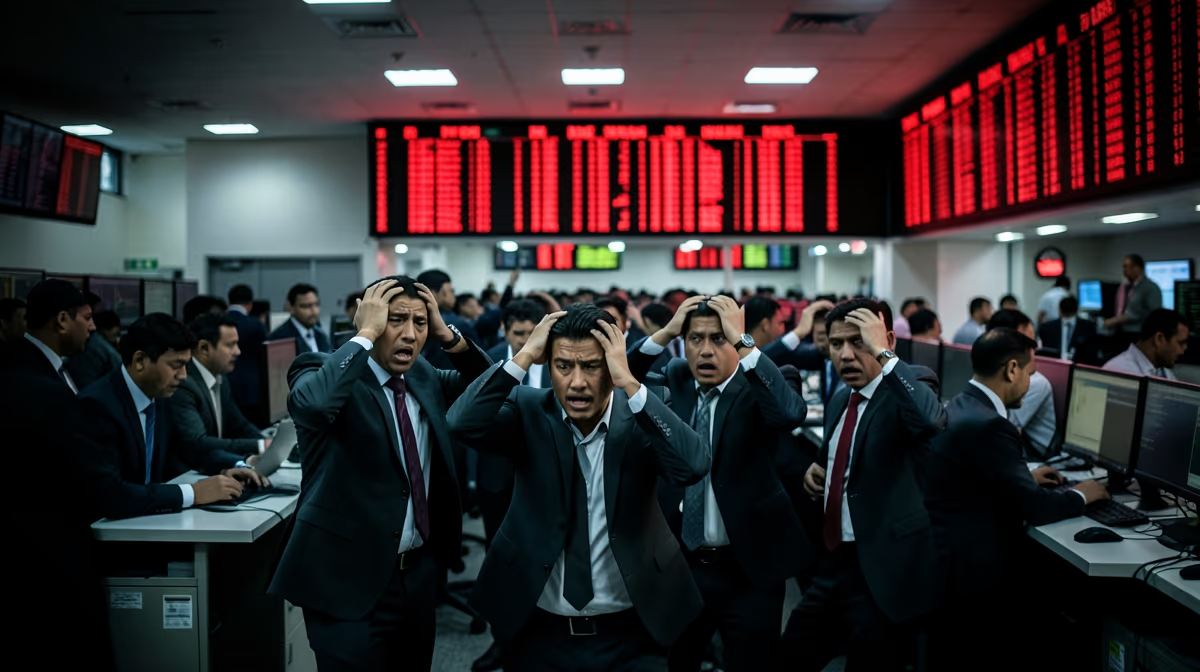
A sudden wave of intense selling tore through Dalal Street, shattering recent trading ranges within mere hours of the opening bell. The Indian stock market crash today wiped out an estimated Rs 4 lakh to Rs 5 lakh crore in investor wealth as benchmark indices plummeted sharply across the board.
An aggressive sell-off led by persistent foreign portfolio investor outflows and sliding bank stocks wiped out up to Rs 5 lakh crore in investor wealth in a single trading session.
The benchmark BSE Sensex tumbled between 900 and 1,020 points during intraday trading, while the NSE Nifty50 dropped below the psychologically vital 22,900 threshold. The speed and scale of the downturn triggered widespread alarm among retail participants and institutional desks, prompting immediate reassessments of exposure to Indian equities amid sustained institutional pressure.
Inside the Intraday Rout
Trading on Monday, October 19, 2026, began under visible strain before deteriorating into an outright rout. Selling momentum intensified rapidly through the morning, forcing both primary indices to break key technical support zones.
| Metric | Recorded Level / Range |
|---|---|
| Sensex Intraday Plunge | 900 to 1,020 points |
| Nifty50 Key Threshold Breached | Fell below 22,900 |
| Estimated Investor Wealth Lost | Rs 4 lakh to Rs 5 lakh crore |
| Primary Hit Sectors | Banking equities, heavyweight shares |
Early trading indicators first registered steep intraday losses as the Sensex dropped over 900 points, sending the Nifty50 below the 22,900 level. Intraday losses subsequently widened to 1,020 points on the Sensex. The erosion of market capitalization occurred across multiple sectors, with large-cap banking heavyweights bearing the initial brunt of the liquidation wave.
Core Catalysts Behind the Fall
Market analysts and reporting point to a confluence of institutional selling and structural headwinds rather than a single isolated trigger.
- Persistent foreign portfolio investor (FPI) selling: Heavy and continuous net outflows by overseas funds created prolonged supply overhangs that domestic buying could not fully absorb.
- Banking sector weakness: Heavy selling in major bank stocks exerted disproportionate downward leverage on both benchmark indices, driving broader market indices lower.
- Liquidity squeezes: Rapid capital withdrawals prompted short-term liquidity contractions, accelerating price drops across heavyweight equities.
When large institutional investors pull capital out simultaneously, the resulting downward momentum often creates a domino effect. The retreat of institutional bids forced intraday stop-losses to trigger, transforming targeted profit-booking into a broader market downturn.
Wealth Erosion and Economic Implications
The immediate consequence of the sharp drop was the direct loss of Rs 4 lakh to Rs 5 lakh crore in overall market capitalization. This severe reduction in portfolio values touches multiple tiers of market participants.
Retail stock investors and mutual fund unitholders experienced sharp portfolio drawdowns within a single trading session. Beyond direct equity holders, severe market corrections carry broader economic significance. Sharp declines can dampen consumer confidence, reduce household wealth sentiment, and impact overall economic momentum. For market participants focused on short-term gains, the session served as a stark demonstration of the inherent volatility within equity instruments.
Regulatory Pressure and the Macro Landscape
The sudden plunge highlights shifting institutional dynamics that extend beyond short-term technical patterns. Sustained FPI outflows point toward broader macroeconomic considerations, including global risk-off sentiment and shifting foreign capital allocation across emerging markets.
Broader macroeconomic shifts, global risk-off sentiment, and foreign capital reallocations directly dictate liquidity conditions across domestic equity markets.
Analysts observing capital flows note that persistent overseas selling may signal foreign funds reallocating capital toward recovering developed markets or hedging against global monetary tightening, rather than reflecting domestic policy shifts alone. Domestically, severe market disruptions increase the scrutiny on regulatory bodies such as the Securities and Exchange Board of India (SEBI) and the central government. As domestic retail participation through systemic mutual fund investments has expanded into a critical pillar of market stability, regulatory authorities face heightened demands to safeguard orderly market conduct and preserve retail investor confidence.
Historically, sharp institutional liquidations mirror previous market shocks, such as the 2008 global financial crisis and subsequent sharp downturns, where sudden institutional capital flight generated acute short-term liquidity shocks before broader economic fundamentals eventually stabilized.
Short-Term Trajectory and Extended Outlook
Market participants now face a fragmented technical landscape as indices search for viable support zones following the breach of major levels.
The Next 24 to 72 Hours
Over the next 24 hours, market observers anticipate continued high volatility and consolidation attempts as participants digest the drivers of the steep drop in the Sensex and Nifty. Over the subsequent 72-hour window, market analysts will closely monitor institutional investor flows, the stability of banking counters, and recovery attempts to gauge whether benchmark indices can form a reliable floor or face extended downward pressure.
Scenario Assessment
- Best-case scenario: Benchmark indices locate firm technical support around current levels, prompting bargain-hunting interest that stabilizes sentiment as foreign institutional selling pressure abates.
- Worst-case scenario: Sustained FPI outflows combined with continued selling across banking stocks trigger additional panic selling, breaching further support levels and deepening capital erosion across exchanges.
Market analysts broadly expect short-term volatility to persist under the weight of institutional reallocations and sector-specific weakness, while medium-term equilibrium will ultimately depend on corporate earnings performance and broader macroeconomic fundamentals.
Frequently Asked Questions
How much wealth was lost in the Indian stock market crash?
Investors lost between Rs 4 lakh crore and Rs 5 lakh crore in market capitalization during the single-session market downturn.
How far did the Sensex and Nifty fall?
The BSE Sensex dropped by 900 to 1,020 points intraday, while the NSE Nifty50 fell below the key 22,900 level.
What were the primary causes of the market crash?
The crash was driven primarily by sustained foreign portfolio investor (FPI) selling, weakness across major banking stocks, and sector-wide profit-taking.
Conclusion
The sharp downturn across Indian exchanges on October 19, 2026, resulted in significant wealth erosion, pulling the Sensex down by over 1,000 points intraday and driving the Nifty50 below the 22,900 threshold. Driven by heavy foreign portfolio investor outflows and severe pressure on banking equities, the single-day sell-off wiped out up to Rs 5 lakh crore in investor value. Market participants are now focused on institutional capital flow data and the stability of core banking stocks to determine whether benchmark indices will establish immediate support or face extended volatility.
Sources
- Stock Market Crash: Investors Lose Rs 5 Lakh Crore As Sensex, Nifty Tank. 3 Reasons Why Market Are Falling Today — NDTV
- Stock market crash today: Sensex plunges over 900 points, Nifty50 below 22,900 - top reasons for fall — The Times of India
- Sensex tanks 1020 pts intraday: Bank stocks, FPI selling among key factors — Business Standard
- Sensex, Nifty crash: Why is stock market down today? Massive wealth eroded; investors lose ₹4 lakh crore - Top 3 reasons — Livemint
- Indian investors lose nearly ₹5L crore in stock market crash — NewsBytes
- The Lost Decades: When Countries' Stock Indices Took Years to Recover From A Crash — NDTV Profit


