
Anduril Defense Technology Signals a Major Shift in Naval Warfare
Introduction
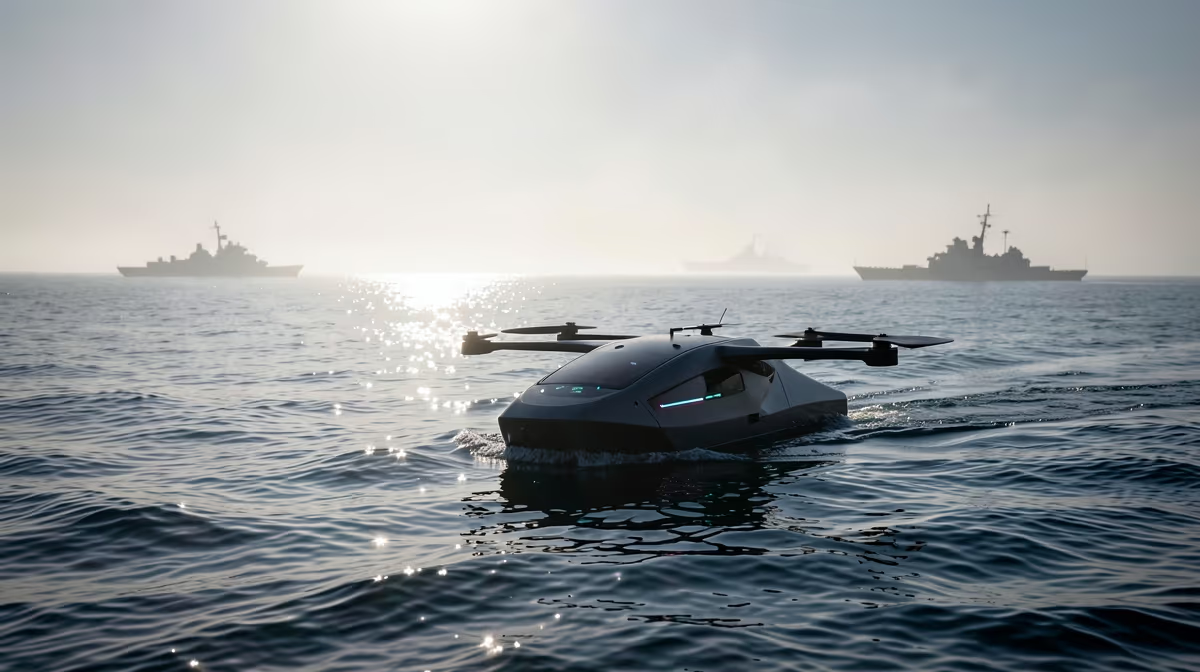
A quiet revolution is unfolding along the Southern California coastline as the traditional foundations of military procurement begin to tremble under the weight of Silicon Valley innovation. Anduril defense technology is rapidly reshaping naval operations, with new reports linking the firm’s autonomous systems to testing initiatives near Naval Base Coronado and the USS Carl Vinson. This pivot toward agile, software-defined hardware represents more than a technological upgrade; it is a fundamental reconfiguration of how the United States military intends to project power in an era of rapid, distributed, and highly contested warfare.
What Happened
Anduril Industries, the California-based defense technology firm, has secured a significant 1.5 billion dollar contract to accelerate the production of its autonomous weaponry and aerial systems, marking a major shift in how the U.S. Department of Defense procures modern military hardware. The Pentagon's decision to lean into Anduril’s software-first approach signals a move away from traditional long-cycle acquisition processes. By focusing on rapid iterations of drones and autonomous surveillance platforms, Anduril has positioned itself as a critical player in the military's ongoing modernization strategy to counter peer competitors.
The funding is specifically intended to scale manufacturing facilities and shorten the time from prototype to field deployment. This procurement strategy reflects the Defense Department's Replicator initiative, which aims to field thousands of attritable autonomous systems across multiple domains within a two-year timeframe. Recent activity has seen these platforms integrated into operations near Naval Base Coronado, providing a testing ground for the synchronization of maritime autonomous vehicles with legacy assets like the USS Carl Vinson fleet. This move highlights a clear transition from experimental prototyping to large-scale, operational integration.
Key Facts
Anduril Industries was founded in 2017 by Palmer Luckey, the inventor of the Oculus VR headset. Headquartered in Costa Mesa, California, the company specializes in autonomous drones, underwater vehicles, and AI-powered surveillance towers. Unlike traditional defense primes, the firm utilizes a software-defined architecture, allowing systems to receive remote updates much like a smartphone app. Their flagship platform, Lattice OS, serves as a digital nervous system, integrating data from sensors and hardware to provide operators with a real-time view of the battlespace. The name Anduril itself is a nod to J.R.R. Tolkien mythology, symbolizing a shift toward decisive, modern tools of defense.
Why It Matters
The ascent of companies like Anduril represents a major structural shift in the US military landscape. By proving that tech-first entities can supply the military with AI-driven gear, they are forcing traditional, slower defense contractors to innovate at a higher velocity. This creates a competitive market where military technology advances at the speed of software development rather than the speed of older, decade-long manufacturing processes. For military personnel, this means access to systems that replace manual, high-risk surveillance with digital eyes that never fatigue. For the broader defense industrial base, it signifies an urgent move away from stagnation and toward modular, cost-effective systems designed to survive high-attrition environments.
Expert Analysis
The root cause of this transition is the stagnation of traditional defense primes combined with the urgent necessity for software-defined, autonomous, and cost-effective modular systems to counter near-peer attrition rates. Analysts observe that Anduril’s trajectory is a vital test case for whether the Pentagon can truly embrace Silicon Valley speed in a high-stakes geopolitical environment. The shift here is not merely one of hardware, but of economic model; by disrupting the cost-plus contracting paradigm in favor of venture-backed scaling, the firm is lowering the barrier to entry for dual-use technology. However, this aggressive vertical integration creates a walled garden of interoperability that poses long-term challenges for legacy system compatibility, a factor that remains a central point of scrutiny for strategic planners.
Political And Geopolitical Implications
The geopolitical angle is defined by a strategic pivot toward decentralized, low-cost distributed lethality. These systems are specifically intended to complicate Anti-Access and Area Denial strategies in the Indo-Pacific, forcing adversaries to contend with massive numbers of smaller, cheaper, and more agile autonomous assets. Politically, this represents a shift from Big Prime lobbying dominance to a more integrated Silicon Valley defense industrial base, challenging the long-standing revolving door policies of the traditional Pentagon procurement cycle. While demand from the military branches remains at an all-time high, the firm continues to face scrutiny regarding the ethics of autonomous combat systems and the broader transition toward algorithmic warfare.
What Happens Next
In the next 24 hours, expect increased public discussion regarding Anduril's integration into the Replicator initiative following recent Department of Defense budget disclosures. Looking toward the 72-hour window, industry watchers anticipate speculation regarding potential new contract wins for autonomous systems and counter-UAS technology to address emerging geopolitical threats in the Middle East and the Pacific. Experts predict that Anduril is positioned to shift from a disruptor to a primary prime contractor, likely securing long-term sustainment contracts. The best-case scenario involves the successful large-scale deployment of autonomous swarms, demonstrating cost-savings and operational superiority, while the worst-case scenario points to potential technical failures during high-stakes field tests that could trigger intense congressional scrutiny and procurement delays.
Frequently Asked Questions
Q: What does Anduril Industries do?
A: Anduril Industries is a defense technology company that develops advanced autonomous systems, software, and hardware for the military and government. They specialize in using artificial intelligence to build modern defense solutions like drones, sensor towers, and counter-UAS systems.
Q: Is Anduril a government contractor?
A: Yes, Anduril is a private defense company that frequently secures contracts with the U.S. Department of Defense and other government agencies to deliver rapid, iterative technological advancements.
Q: Who is the founder of Anduril?
A: Anduril Industries was founded in 2017 by Palmer Luckey, a technology entrepreneur known for also founding Oculus VR.
Q: What is the meaning of the name Anduril?
A: The name Anduril is a reference to the mythical sword Anduril from J.R.R. Tolkien's The Lord of the Rings. It translates to Flame of the West and represents the company's focus on powerful, decisive technological tools.
Q: Where is Anduril Industries headquartered?
A: Anduril Industries is headquartered in Costa Mesa, California, with several facilities across the United States to support research and manufacturing.
Q: What is the Lattice OS by Anduril?
A: Lattice OS is an artificial intelligence-powered software platform that acts as a digital nervous system for defense hardware, integrating data from various sensors to provide operators with a comprehensive view of the battlespace.
Conclusion
Anduril Industries has firmly transitioned from a niche innovator to a central pillar of the modern US defense strategy. Through the deployment of autonomous aerial and maritime platforms and the continued expansion of the Lattice OS framework, the company is fundamentally altering the procurement and operational landscape of the Department of Defense. While the transition toward software-defined, attritable hardware offers significant promise for military efficiency and strategic deterrence, the long-term impact remains subject to field performance, congressional oversight, and the ability of these new systems to integrate effectively with legacy platforms. As the company scales its production capabilities, its trajectory will continue to serve as the definitive benchmark for the integration of Silicon Valley speed into the national security apparatus.


