
EU Entry-Exit System Delay Creates Major Uncertainty for UK Travel
Introduction
The digital transformation of international borders is poised to redefine the travel experience for millions as the European Union prepares to launch a new, highly automated security regime. The upcoming implementation of the EU Entry-Exit System is set to change how British citizens cross the borders into the Schengen area, shifting the landscape from manual processing to a rigorous digital verification framework.
What Happened
The European Union has officially announced a delay to the launch of the Entry-Exit System, a new automated digital border control scheme originally slated for November 2024. The project is now expected to go live in 2025, a decision prompted by persistent concerns from British authorities and cross-channel transit operators regarding the technical readiness of major hubs.
Transit points such as the Port of Dover and the Eurostar terminal at St Pancras have faced significant challenges in integrating the complex biometric registration hardware required by the new system. European Home Affairs Commissioner Ylva Johansson confirmed the shift in timeline, acknowledging that the European Commission and various member states were not currently on track to meet the original November deadline. This postponement is intended to provide the necessary window for ports and terminals to refine their infrastructure and avoid the severe bottleneck scenarios that industry leaders warned could lead to extensive passenger delays.
Key Facts
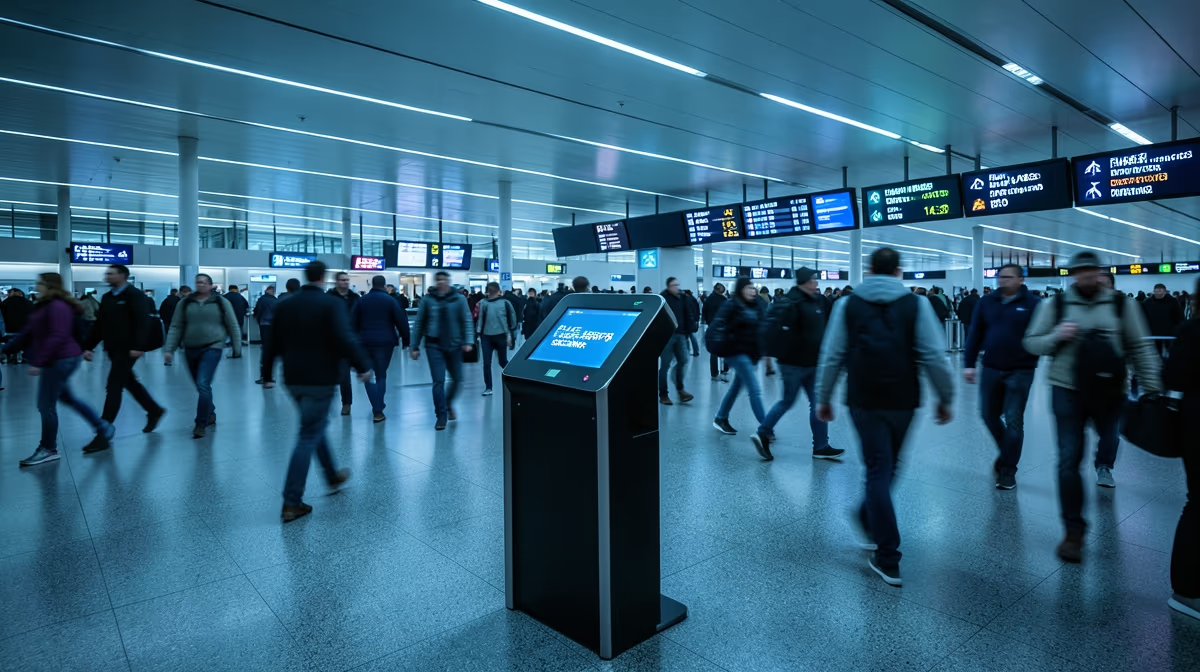
The Entry-Exit System is a digital border management tool designed to track non-EU travelers entering the Schengen Area. It moves away from the traditional practice of manual passport stamping, replacing it with an automated database that records the name, travel document type, fingerprints, and facial images of visitors.
The system applies to all non-EU nationals, including UK citizens, who will be required to provide biometric data upon their first entry. This data remains valid for three years, after which a fresh registration is required. The primary objective is to log the exact date and place of entry and exit to ensure that travelers do not exceed the authorized 90-day limit within any 180-day period. By automating this process, the European Commission intends to improve security and more effectively manage migration flows.
Why It Matters
For British travelers, this transition marks a definitive shift in the nature of cross-border movement. Popular destinations such as France, Spain, and Italy will now require a more systematic engagement with biometric technology at the point of entry. While the long-term goal is to secure borders and eventually streamline passenger flow through digital efficiency, the immediate impact for tourists and business travelers alike will be a more involved registration process at the border.
The implications extend beyond individual convenience. For travel operators, the burden of data collection and the physical installation of biometric kiosks represent a substantial logistical and financial undertaking. There is a tangible risk that, without seamless cooperation between French and UK border authorities, the physical throughput at transit hubs could be significantly restricted, affecting everything from leisure tourism to the reliability of just-in-time supply chains.
Expert Analysis
The root cause of this transition is the fundamental shift of the United Kingdom from an internal market partner to a third-country status, necessitating a move toward digital biometric authentication. This evolution mirrors the historical post-Cold War re-imposition of border controls across Central Europe, where the collapse of previous transit frameworks required the creation of complex, new bureaucratic layers.
Economically, the system introduces a potential surge in dwell times at vital gateways like Dover and Folkestone. This represents a hidden strain on private logistics operators who must manage these infrastructure upgrades without state-subsidized cost offsetting. Analysts suggest that the initial phase will likely be characterized by friction, as both travelers and operators adjust to the mandatory digital kiosks. Stabilization is expected to occur only once these biometric processes become standardized and integrated into the regular rhythm of cross-border transit.
Political And Geopolitical Implications
The Entry-Exit System underscores the post-Brexit reality of a hard digital border, which continues to complicate diplomatic efforts to harmonize relations and security cooperation. The UK government currently faces the dual pressure of maintaining frictionless travel for its citizens while the EU pushes for uniform, hardening border standards. This dynamic creates a visible perception of sovereignty costs, as the practical requirements of the EU framework begin to manifest in the daily lives of British travelers. The strain on diplomatic channels is compounded by the practical necessity for the UK Home Office and the European Commission to maintain high levels of technical coordination to prevent total disruption at the Channel, highlighting the ongoing tension between national policy independence and regional security integration.
What Happens Next
In the next 24 hours, stakeholders expect increased communication between the European Commission, the UK Home Office, and the Department for Transport regarding the revised phased rollout strategy. Over the next 72 hours, we can expect heightened public awareness campaigns and a concerted effort at cross-channel transport hubs to adjust logistical operations in light of the delay.
Industry experts offer two potential scenarios for the eventual launch. A best-case outcome involves smooth implementation, supported by effective pre-registration tools and seamless cooperation between border authorities, resulting in minimal wait times. Conversely, a worst-case scenario involves prolonged physical queues exceeding four hours at major ports and terminals, which could disrupt supply chains and lead to a decline in cross-border travel bookings.
Frequently Asked Questions
What is the EU Entry-Exit System and how does it affect UK travelers?
The Entry-Exit System is an automated IT system for registering travelers from non-EU countries each time they cross an EU external border. For UK citizens, this means providing biometric data, such as fingerprints and a facial image, during their first entry into the Schengen Area.
When does the EU Entry-Exit System officially launch?
The launch has been pushed back from November 2024 to an unspecified date in 2025. Travelers should monitor official government updates for further information.
Do British citizens need to provide fingerprints for the new EU border system?
Yes, as non-EU nationals, British citizens will be required to provide biometric data, including fingerprints and a facial photograph, upon their first entry into the EU. This information will be stored for three years.
Will EES change the way I travel by ferry or train from the UK to the EU?
Yes, EES will require biometric registration at border crossing points. Passengers are advised to allow extra time at ports such as Dover, Folkestone, and St Pancras, as the registration process may increase processing times.
Is the EU Entry-Exit System the same thing as the ETIAS visa waiver?
No, they are separate systems. EES is for logging entry and exit through biometrics, while ETIAS is a pre-travel authorization system requiring an application and fee before departure.
Do I need to register for the EU Entry-Exit System before I travel?
You cannot register in advance. The biometric registration process must be completed in person at the border when you arrive at an EU entry point.
Conclusion
The delay of the EU Entry-Exit System to 2025 provides a temporary respite for transit operators and travelers, yet the fundamental requirement for biometric border control remains unchanged. As the European Commission and UK authorities continue to navigate the technical and diplomatic challenges of this transition, the focus will remain on refining infrastructure to mitigate potential bottlenecks. British travelers should prepare for a new, digitally-verified reality at the Schengen border, where efficiency will depend on the successful synchronization of European security policy and cross-channel logistics.


