
Federal Reserve Digital Dollar Ban Gains Crucial Momentum in D.C.
Introduction
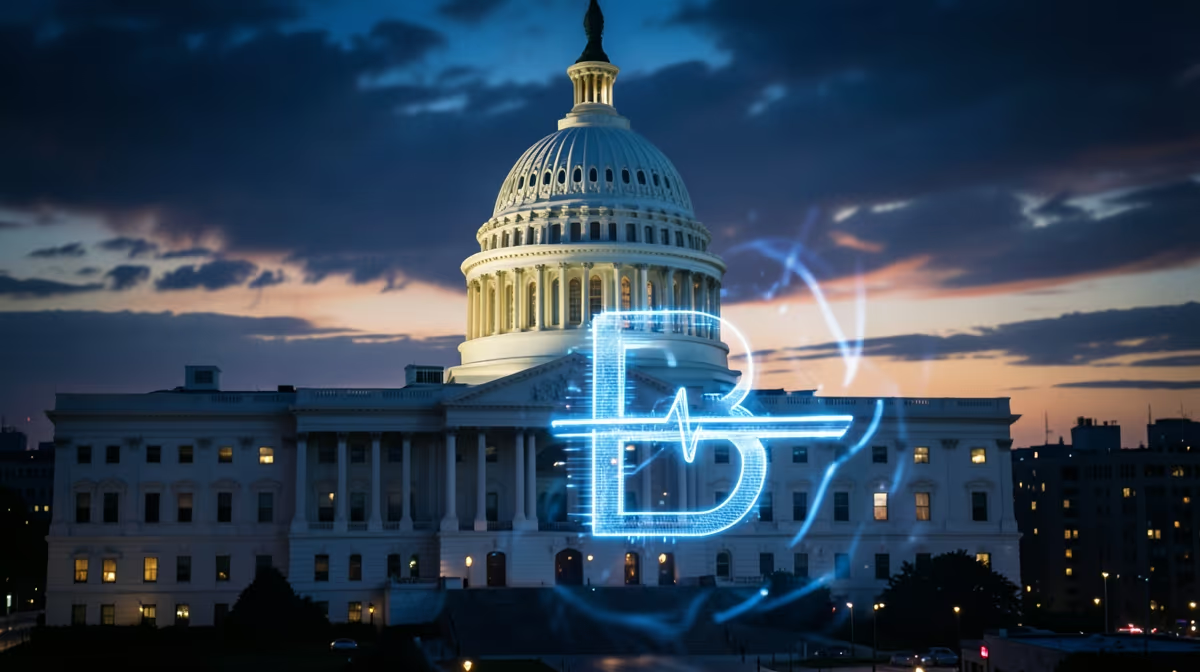
The architecture of American finance stands at a pivotal crossroads as lawmakers weigh the fundamental privacy rights of citizens against the potential evolution of sovereign digital money. The ongoing debate over a federal reserve digital dollar ban has intensified in Washington, with lawmakers weighing the risks of a potential central bank digital currency against financial privacy concerns.
What Happened
On Thursday, the U.S. House of Representatives passed the CBDC Anti-Surveillance State Act in a 216-192 vote, a legislative milestone aimed at restricting the Federal Reserve from issuing a Central Bank Digital Currency directly to individuals. The bill, led by House Majority Whip Tom Emmer, serves as a preemptive barrier against a retail-facing digital dollar, citing deep concerns over government surveillance and the potential for programmable money.
While the Federal Reserve has consistently stated it has no formal plans to issue a retail CBDC without explicit authorization from Congress, the act seeks to codify this restriction into law. Under this proposal, the central bank would be prohibited from using a digital dollar as a tool for monetary policy or tracking individual transaction data. The legislation now heads to the Senate, where its future remains uncertain as the Biden administration has already issued a formal statement of opposition, arguing that such constraints could hinder financial innovation and the long-term competitiveness of the U.S. dollar on the global stage.
Key Facts
A Central Bank Digital Currency (CBDC) is a digital form of fiat currency that is directly issued and regulated by the central bank, rather than through the traditional two-tier commercial banking system. The CBDC Anti-Surveillance State Act specifically targets the Federal Reserve's authority to issue a retail digital dollar, preventing the institution from creating a direct link between its ledger and individual consumer wallets. Proponents of the legislation argue that this is essential to protect financial privacy and ensure that the government does not gain the power to monitor or influence the spending habits of American citizens. Despite the intense focus, the Federal Reserve currently maintains no official plan to implement a retail digital currency, and current discussions revolve around hypothetical research. The legislation passed the House with a 216-192 vote, but it currently lacks the mandate required to become law, pending Senate action and a potential presidential veto.
Why It Matters
This debate is not merely technical; it touches upon the future of civil liberties and the fundamental nature of privacy in a digitized economy. If a ban is enacted, it would prevent the creation of a programmable dollar, effectively ensuring that the government cannot track or restrict private financial transactions. For everyday consumers, this represents a safeguard against a potential surveillance state. For private banks, it protects the existing deposit-based credit system from disintermediation, where a direct Fed-to-consumer account structure could lead to credit contraction and a shift away from commercial banking infrastructure. The conflict highlights the tension between the push for modern financial efficiency and the public desire for anonymity, creating significant uncertainty for tech-savvy investors and financial institutions alike.
Expert Analysis
The root cause of this conflict is a fundamental tension between decentralized, censorship-resistant financial systems and the state's traditional requirement for monetary oversight. From a political perspective, the push to restrict the Federal Reserve is part of a populist movement to check executive authority, specifically aimed at preventing the implementation of a centralized system that could function as a digital social credit mechanism. Economically, the threat of a retail CBDC lies in its ability to disintermediate commercial banks by stripping them of their deposit bases, which would disrupt the current monetary policy plumbing. While the Federal Reserve aims to maintain control over economic levers, private sector innovators and blockchain advocates are lobbying for protections against state-monopoly encroachment. The situation reflects a broader historical struggle over the control of monetary instruments, reminiscent of the debates surrounding the 1933 Gold Reserve Act, albeit adapted for the digital age.
Political And Geopolitical Implications
The geopolitical landscape adds another layer of complexity. The United States faces pressure to maintain dollar hegemony as global competitors test their own digital currencies to potentially circumvent the SWIFT network. However, there is a distinct risk that a U.S. CBDC could make the nation more vulnerable to digital statecraft by foreign adversaries. The Biden administration maintains that restricting research into these technologies could hurt U.S. leadership in developing international standards for digital finance. Meanwhile, anti-CBDC factions argue that the U.S. must lead by innovation that respects privacy rather than adopting models that mirror foreign state control, creating a delicate balance between national security and institutional influence.
What Happens Next
In the next 24 hours, expect increased legislative advocacy from factions opposing the CBDC, alongside renewed public statements from House leadership reaffirming their stance. Over the next 72 hours, media coverage will likely intensify, focusing on the potential for lawmakers to attach these digital dollar restrictions to broader appropriations bills to increase their legislative leverage. Expert predictions suggest that this sustained pressure will force the Federal Reserve to pivot exclusively toward wholesale-only digital currency research, strictly distancing itself from any retail-facing CBDC. In the best-case scenario, a legal framework will emerge that preserves consumer anonymity while allowing for innovation in wholesale bank settlement. Conversely, the worst-case scenario involves prolonged policy gridlock that could foster institutional distrust, induce market volatility in the stablecoin sector, and risk a loss of U.S. competitive advantage in global financial technology.
Frequently Asked Questions
Is the Federal Reserve planning to ban a digital dollar?
The Federal Reserve has not announced plans to ban a digital dollar; in fact, they have been researching the potential for a Central Bank Digital Currency (CBDC). However, there is significant legislative debate in the U.S. regarding whether such a currency should ever be authorized due to privacy concerns.
Why do some lawmakers want to ban a Federal Reserve digital dollar?
Some lawmakers seek to ban a Federal Reserve digital dollar out of fear that it could lead to government surveillance of individual financial transactions. They argue that a CBDC might grant the government excessive control over personal spending and undermine the privacy currently offered by cash.
Has the U.S. government officially banned a CBDC?
As of now, there is no federal ban on the development of a CBDC in the United States. While several bills have been introduced in Congress to restrict or prohibit a retail digital dollar, none have been signed into law at the federal level.
How would a digital dollar ban affect cryptocurrency?
A ban on a government-issued digital dollar would likely be viewed as a positive development by many in the cryptocurrency community who value decentralized finance. It could shift the focus back toward private digital assets and prevent direct competition from a state-controlled electronic currency.
What is the status of the CBDC Anti-Surveillance State Act?
The CBDC Anti-Surveillance State Act is a legislative effort aimed at preventing the Federal Reserve from issuing a retail digital dollar directly to individuals. Proponents of the bill argue it is necessary to protect financial privacy and prevent the government from tracking citizen expenditures.
Will a digital dollar replace physical cash in the U.S.?
The Federal Reserve has repeatedly stated that a digital dollar would be intended to complement, not replace, physical cash. Most proposals emphasize that the U.S. banking system would continue to provide cash options for consumers regardless of any potential future digital currency development.
Conclusion
The passage of the CBDC Anti-Surveillance State Act through the House underscores a defining ideological shift in American monetary policy, signaling a strong legislative resistance to state-controlled digital currency. While the Federal Reserve remains in the research phase regarding a potential CBDC, the current political environment makes any retail implementation increasingly unlikely without significant congressional oversight. As the bill moves toward the Senate, the debate will continue to focus on the balance between technological advancement and the preservation of financial privacy. For now, the future of the digital dollar remains tethered to these legislative maneuvers, keeping the financial sector and privacy advocates in a state of watchful anticipation.
" } ]


