
Iran Israel War Ceasefire Talks Signal a Shifting Regional Power Balance
Introduction
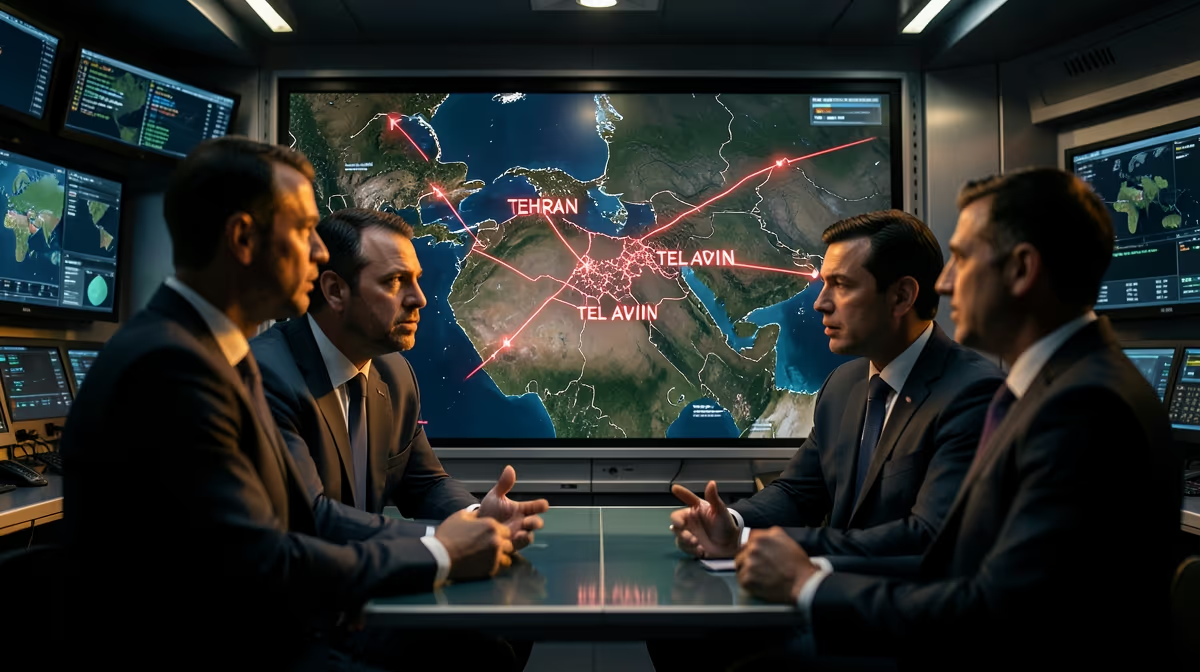
A fragile equilibrium currently dictates the course of Middle Eastern stability as silent back-channels work to prevent a direct, full-scale regional confrontation. Diplomatic efforts to reach an iran israel war ceasefire have intensified as international mediators seek to prevent further regional escalation. While the shadow war that has defined relations between Tehran and Tel Aviv for decades has transitioned into a more dangerous phase of direct kinetic exchanges, the international community is racing to secure a diplomatic off-ramp before miscalculation leads to irrevocable disaster.
What Happened
The current landscape of hostilities was fundamentally altered in April 2024, when the first direct Iranian drone and missile attack on Israeli soil effectively dismantled the long-standing doctrine of proxy-based shadow warfare. This shift marked a transition from indirect conflict to direct state-on-state confrontation, forcing an immediate international response. U.S. Secretary of State Antony Blinken and senior White House advisors are currently engaged in high-stakes negotiations to manage the fallout from these recent exchanges. Washington is utilizing intelligence reports to pressure regional stakeholders, aiming to establish a cessation of cross-border attacks that threaten to draw the United States into a direct military commitment.
Despite these intensive efforts, the gap between the proposed terms and the hardened security postures of both nations remains significant. Israel insists on maintaining its right to strike targets to ensure the safety of its citizens, while Tehran continues to provide support for regional armed groups as a deterrent against perceived threats. The U.S. military has bolstered its presence in the region as a deterrent measure, though the specific details of any potential agreement remain shielded by the nature of private diplomatic discourse.
Key Facts
- The conflict between Israel and Iran is characterized by a cycle of direct missile and drone exchanges, a departure from their historical reliance on proxy forces.
- The United States is playing a lead role in diplomatic mediation, shuttle diplomacy, and intelligence sharing to prevent a wider conflagration.
- There is no formal, direct communication channel between the Israeli government and the Iranian leadership, making mediation through third parties a necessity.
- A ceasefire, should one be reached, would aim to halt immediate military strikes and lower the regional temperature, providing a buffer for humanitarian and strategic concerns.
- Global markets remain highly sensitive to these developments, particularly regarding energy prices and the security of maritime shipping lanes.
Why It Matters
For the average citizen in the United States and abroad, this conflict carries profound economic and security implications. The potential for disruption to Middle East maritime shipping lanes and the instability of global crude oil supply chains presents a clear risk of rising inflation and increased energy costs. Beyond economics, the conflict poses a national security concern for the U.S.; as a key strategic ally of Israel, the United States faces the constant risk of being pulled into a direct military confrontation. The regional volatility impacts not only the civilians living in Israel, Iran, and surrounding nations like Lebanon and Syria, but also the U.S. military personnel stationed across the region, whose roles are being re-evaluated in light of these shifting threats.
Expert Analysis
The root cause of this instability is the structural failure of the regional deterrence equilibrium and the transition from proxy warfare to direct state-on-state kinetic confrontation. Analysts suggest that the historical precedent of the 1973 Yom Kippur War serves as a modern warning, where rapid kinetic escalation forced external intervention. Currently, the conflict remains in a state of controlled tension, where both sides seek to maintain deterrence through limited actions while avoiding the catastrophic consequences of a full-scale regional war. The primary concern is that the lack of a formal backchannel forces reliance on secondary intermediaries like Oman or Switzerland to prevent accidental escalation. This intelligence-sharing process is currently the only barrier preventing a cycle of retaliatory strikes that would move beyond the current threshold of limited conventional engagement.
Political And Geopolitical Implications
The situation presents a difficult political balancing act for the Biden administration, which must manage domestic election-cycle pressures while navigating the regional push for multi-polar security guarantees. Washington is attempting to project influence and contain Iran without triggering a broader regional energy crisis that would destabilize the U.S. economy. This is complicated by the erosion of U.S. hegemony, as regional actors increasingly seek their own security arrangements, forcing the White House to balance its unconditional support for Israel with the necessity of maintaining regional stability. The economic angle remains a primary driver of policy, as the threat of an escalation involving the Strait of Hormuz could cause global oil prices to spike, directly impacting U.S. inflation metrics.
What Happens Next
In the next 24 hours, experts expect an increase in diplomatic back-channel communication via regional intermediaries to contain the fallout from recent regional exchanges. Within the next 72 hours, the region will likely see a consolidation of military postures, with high-alert air defense systems active in Israel and continued positioning of U.S. naval assets in the Eastern Mediterranean. The consensus among experts is that the situation will likely remain in a state of controlled tension. In the best-case scenario, a tacit, unofficial de-escalation agreement brokered by third parties leads to a reduction in border hostilities. Conversely, the worst-case scenario involves a miscalculation leading to a cycle of direct cross-border missile strikes that could force the United States into a broader military conflict.
Frequently Asked Questions
Q: Is there currently a ceasefire between Israel and Iran?
A: There is no formal ceasefire agreement between Israel and Iran, as they are not currently in a state of declared conventional war. While tensions remain high and periodic direct and indirect military exchanges occur, diplomatic efforts continue to focus on preventing a full-scale regional escalation.
Q: What is the status of ceasefire negotiations regarding the Iran-Israel conflict?
A: Direct negotiations for a ceasefire between Israel and Iran do not exist because the two nations do not maintain formal diplomatic relations. International mediators, including the United States and various regional partners, work through back-channels to de-escalate specific flashpoints and manage ongoing friction.
Q: Why is it difficult to reach a ceasefire between Israel and Iran?
A: The difficulty stems from deep-seated ideological differences and the proxy-based nature of the conflict across the Middle East. Because Israel views Iranian-backed militias as an existential threat and Iran views Israel as an illegitimate state, finding common ground for a lasting agreement remains complex.
Q: Could a ceasefire in Gaza lead to a de-escalation between Israel and Iran?
A: Many international analysts believe that a ceasefire in Gaza would significantly reduce regional tensions, potentially leading to a decrease in attacks from Iranian-backed proxies. A pause in hostilities could create space for broader diplomatic discussions aimed at cooling regional volatility.
Q: What role does the US play in preventing an all-out war between Iran and Israel?
A: The United States plays a critical role as an intermediary, utilizing both military posturing and intense diplomatic pressure to discourage direct conflict. By reinforcing regional defense alliances and communicating directly with partners in the Middle East, the U.S. aims to contain the conflict and avoid regional spillover.
Q: Have there been any recent proposals for a long-term truce between Israel and Iran?
A: While there have been no public, formal proposals for a truce, international powers frequently push for de-escalation frameworks to prevent retaliatory cycles. These efforts generally prioritize the containment of specific military actions rather than a comprehensive peace treaty between the two nations.
Conclusion
The path toward stability in the Middle East remains fraught with uncertainty as the international community seeks to navigate the transition from a long-standing shadow war to a modern, direct-conflict reality. While diplomatic efforts are ongoing and high-stakes negotiations continue, the absence of formal communication channels between the primary belligerents necessitates a reliance on secondary mediators. The immediate future will likely be defined by a state of controlled tension, where tactical military posturing and behind-the-scenes diplomacy will continue to play off one another. Whether these efforts can produce a lasting de-escalation or merely pause the cycle of violence remains the most critical question for regional and global security.
" }


