
Israel Iran War Escalation Signals a Major Shift in Global Security
Introduction
The Middle East stands at a precarious juncture where decades of clandestine hostility have suddenly transitioned into an overt and direct confrontation. The escalating israel iran war has sent shockwaves through international markets, raising urgent questions regarding middle east regional stability as traditional deterrence models crumble in real time.
What Happened
The current shift from a shadow war to direct state-on-state confrontation follows an extensive drone and missile barrage launched by Iran toward Israeli territory. Tehran described this operation as a direct retaliation for a suspected Israeli strike on its consulate in Damascus on April 1. In response, Israel, bolstered by a coalition of regional and Western allies, executed a comprehensive air defense operation.
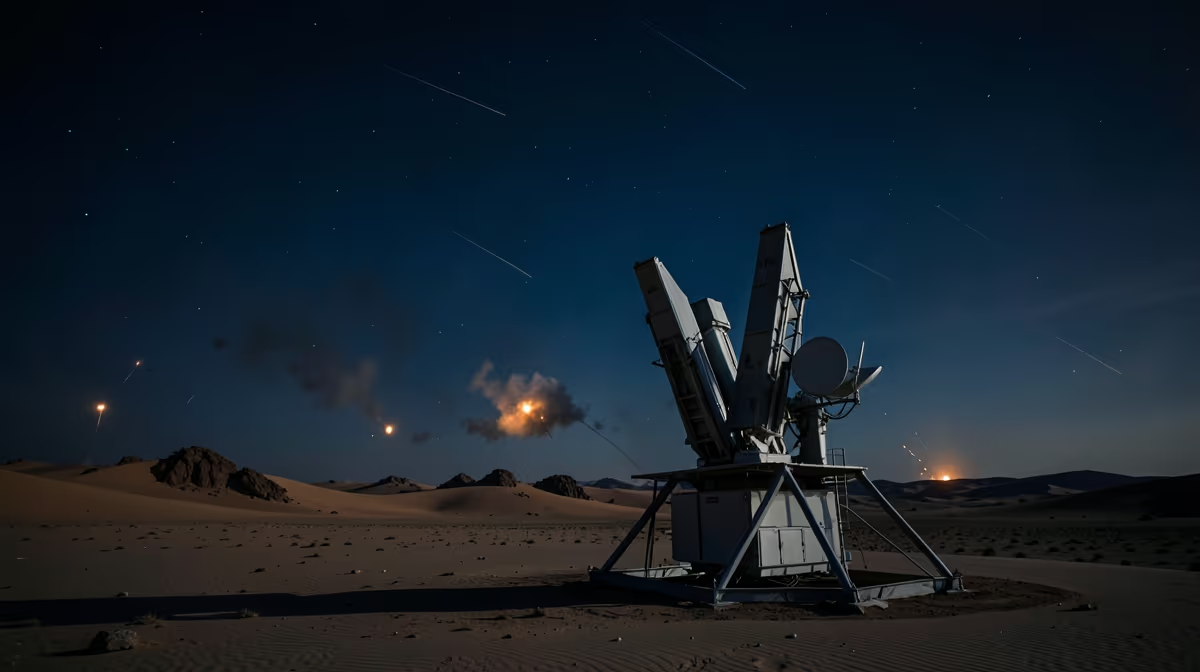
The military exchange involved more than 300 drones and missiles directed at Israel. Defense systems successfully intercepted approximately 99 percent of the incoming projectiles, with limited damage reported at a military installation in the Negev desert. While Israel has publicly vowed to respond to the offensive, its security cabinet continues to deliberate on the scope, timing, and strategic necessity of a counter-strike, balancing the need for sovereign deterrence against intense international pressure to prevent a cycle of violence.
Key Facts
The core of this conflict lies in the transition from indirect proxy warfare to direct military engagement. For decades, the two nations maintained a rivalry largely mediated through groups like Hezbollah in Lebanon and various militias in Syria, alongside persistent cyber warfare.
Key verified facts include the specific timing of the Iranian attack on April 13-14 and the direct logistical and defensive support provided by the United States, the United Kingdom, and Jordan to mitigate the incoming fire. While both nations have signaled their current positions, Israel maintains the right to respond to the attacks, ensuring that the potential for further kinetic military action remains open as diplomatic channels attempt to manage the fallout.
Why It Matters
The potential for a full-scale war between Israel and Iran threatens to destabilize a region that serves as the central artery for global energy supplies and maritime trade. A primary concern for policy makers and investors is the security of the Strait of Hormuz, a maritime chokepoint through which 20 to 30 percent of global oil transits daily.
Beyond energy security, the conflict carries significant economic risks. Market analysts have observed heightened volatility in global oil prices and financial indices as investors weigh the possibility of further military retaliation. The humanitarian implications are equally severe, as any expansion of the conflict into neighboring Lebanon or Syria could trigger widespread displacement and crisis, forcing global powers to navigate the risks of being pulled into a direct military engagement.
Expert Analysis
The root cause of this volatility is found in the existential ideological incompatibility between the Islamic Republic's revolutionary mandate to dismantle Israel and Israel's doctrine of preemptive containment against regional nuclear proliferation. This deep-seated friction has evolved over time, moving from the 1979 Iranian Revolution and the subsequent severing of diplomatic ties to the 2010 Stuxnet cyber-sabotage, which marked the initial transition to sophisticated asymmetric warfare.
Technologically, the proliferation of low-cost drone and ballistic technology has democratized high-intensity conflict. This shift has rendered traditional air superiority models increasingly difficult to maintain, forcing a focus on saturation tactics that threaten to overwhelm conventional missile defense systems. Historical parallels suggest the current moment mirrors the escalation patterns observed prior to the 1973 Yom Kippur War, where miscalculations of regional intent created a pathway for global super-power entrapment.
Political And Geopolitical Implications
The transition to direct confrontation undermines the credibility of the Abraham Accords and forces Arab Gulf states to navigate a precarious path between security dependence on the United States and essential economic ties with Tehran. Geopolitically, this conflict accelerates the bifurcation of the global order. Iran remains deeply embedded in a strategic alignment with China and Russia, effectively transforming the Middle East into a primary theater for the broader containment of Western influence. This environment limits the diplomatic maneuverability of regional actors who are attempting to avoid choosing sides in a sharpening global divide.
What Happens Next
In the next 24 hours, the intelligence community expects increased diplomatic backchannel activity aimed at de-escalation, alongside heightened readiness of air defense systems and intensified surveillance of proxy militant group movements. Looking toward the 72-hour horizon, the risk remains focused on targeted cyber operations or limited shadow-war strikes rather than an immediate full-scale invasion.
Expert predictions suggest that strategic signaling will dominate the near term, with both sides favoring asymmetric warfare to avoid a total war that would trigger inevitable Western military intervention. The best-case scenario involves a ceasefire or temporary de-escalation facilitated by third-party mediators. Conversely, the worst-case scenario remains a miscalculation leading to a direct missile exchange, which could trigger a wider regional conflict and massive disruption to global energy supplies.
Frequently Asked Questions
Is there currently a direct war between Israel and Iran?
While Israel and Iran have been engaged in a long-standing shadow war involving cyberattacks, maritime sabotage, and proxy conflicts, they are not in a state of declared total war. However, recent escalations have significantly heightened tensions and concerns regarding a broader regional conflict.
Why are Israel and Iran enemies?
The animosity stems from the 1979 Iranian Revolution. Israel views Iran's nuclear program and its regional influence as an existential threat, while Iran characterizes Israel as an illegitimate occupying power.
What is the role of proxies in the Israel-Iran conflict?
Proxies allow Iran to challenge Israel without engaging in direct, full-scale warfare. Groups like Hezbollah and various militias receive support to pressure Israel on its borders.
Could the Israel-Iran conflict lead to World War 3?
Geopolitical analysts warn that an uncontrolled escalation could trigger a wider regional war involving other nations and global superpowers. While international actors are working to de-escalate, the complexity of alliances makes the region volatile.
What is the current status of the Iran nuclear program?
Iran continues to enrich uranium to levels nearing weapons-grade capability. Israel has maintained that it will take necessary measures to prevent Iran from developing a nuclear weapon.
How do other countries perceive the tensions between Israel and Iran?
The international community is divided. Western allies generally support Israel's right to self-defense, while countries like Russia and China maintain ties with Iran and advocate for restraint.
Conclusion
The confrontation between Israel and Iran represents a historic shift in Middle Eastern security dynamics, moving from covert operations to direct, high-stakes military engagement. While international diplomatic efforts are currently focused on preventing a wider regional catastrophe, the situation remains highly volatile. The reliance on strategic signaling and the threat of maritime and energy disruptions underscore the fragile nature of the current status quo. Stakeholders must monitor for further kinetic responses as the region remains on the precipice of potential escalation.


