
Japan FIFA World Cup Ambitions Trigger Major Tactical Rebuilding Phase
Introduction
The transformation of the Japanese national football team from a regional competitor into a formidable global disruptor has fundamentally altered the landscape of international sport. As the Japan world cup 2026 campaign is heating up, observers are closely monitoring whether the Samurai Blue can sustain their momentum and translate their tactical discipline into a historic tournament run.
What Happened
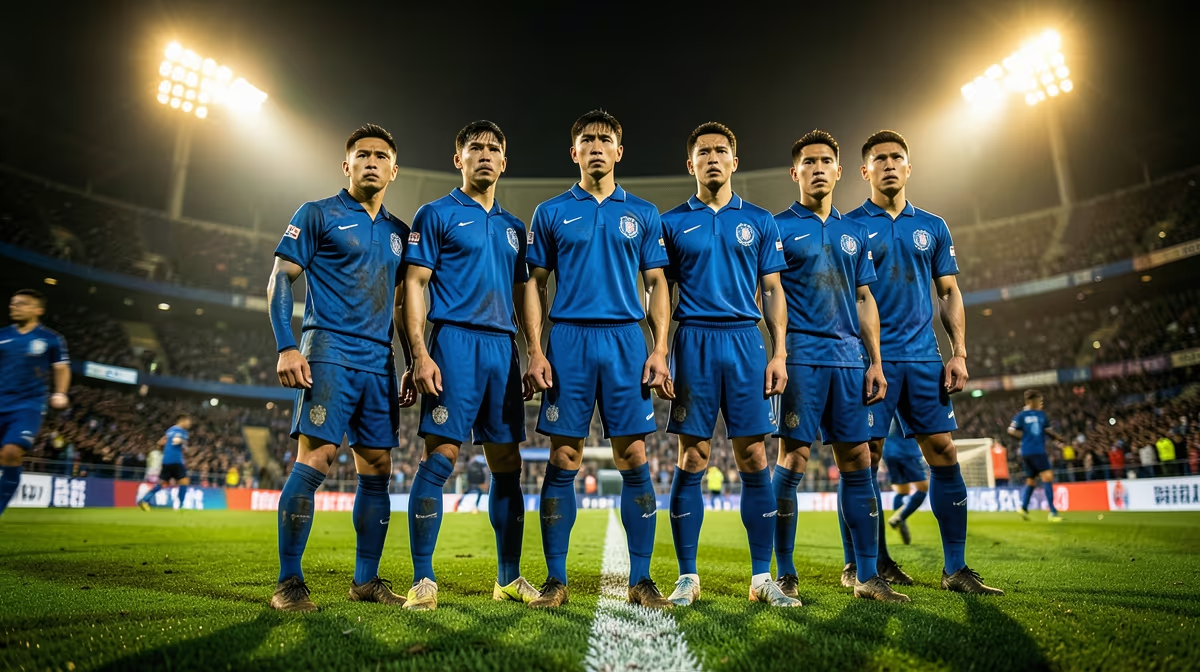
Japan’s national football team, the Samurai Blue, has solidified its position as a global competitive force by consistently advancing to the knockout stages of the FIFA World Cup, most recently capturing international attention during the 2022 tournament in Qatar. The team stunned the football world in 2022 by topping a group that included former champions Germany and Spain. Their tactical discipline and high-intensity pressing style have transitioned the team from a regional Asian power to a legitimate threat to traditional European and South American giants. The team’s ability to overcome deficits against top-tier opponents has redefined expectations for Japanese football on the global stage.
The Japan Football Association (JFA) has implemented a long-term development strategy known as the JFA 2050 vision, which aims to cultivate world-class talent and eventually host and win a World Cup title. This systematic approach includes the strengthening of the domestic J.League, which has become a primary incubator for national team players before they migrate to top European leagues. Looking toward the future, the Japanese squad is currently navigating the rigorous qualification cycles for the next tournament. The focus remains on maintaining defensive structural integrity while integrating a new generation of attacking midfielders who currently ply their trade in England, Germany, and Belgium. While speculation regarding potential roster changes and managerial shifts, including discussions about Herve Renard, continues to circulate, the core focus of the JFA remains on performance and structural stability.
Key Facts
- Japan has qualified for seven consecutive FIFA World Cups since 1998.
- The Japan men's team made history in 2022 by defeating former champions Germany and Spain.
- The Japan women's team, Nadeshiko Japan, won the FIFA Women's World Cup title in 2011, becoming the first Asian nation to win a senior FIFA World Cup title.
- Japanese players are increasingly signing with top-tier clubs in major European leagues, and the J.League serves as the primary developmental pipeline for the national team roster.
- The Japanese national teams are praised globally for their exceptional sportsmanship and clean play, and they have become a consistent fixture in the knockout stages of the World Cup tournaments.
Why It Matters
Japan's rise in soccer popularity is significantly shifting the global balance of power in the sport, proving that technical precision and collective strategy can overcome more traditional, size-based advantages. This growth has helped expand the commercial reach of soccer in Asia, fostered greater cultural exchange between Japan and the rest of the world, and inspired a new generation of young athletes in Japan to pursue professional sports careers. The expansion of these interests into international markets affects professional soccer players, global sports fans, international broadcasting networks, and the sports development programs within the Japanese Football Association.
Expert Analysis
The rise of Japanese football is rooted in the necessity for Japan to leverage sports diplomacy to counter regional hegemony and rebrand its global image as a soft-power stabilizer. This transition is not merely athletic but serves to integrate Japan deeper into Western sporting and security orbits. Historically, this mirrors the 1964 Tokyo Olympics, which signaled Japan's reintegration into the international community post-World War II. The current strategic focus involves the transition of J-League commercial interests into US media markets, which acts as a proxy for bilateral technological and logistical supply chain integration. The development of this sporting infrastructure is designed to maintain Japan’s influence during high-stakes geopolitical shifts.
Political And Geopolitical Implications
Japan utilizes the World Cup as a mechanism to strengthen the US-Japan security alliance by positioning itself as an indispensable cultural and diplomatic partner in the Indo-Pacific. By participating in global sporting events, Japan fosters a unified front against non-Western influence blocks. Furthermore, significant long-term infrastructure investment associated with these sporting ambitions is designed to offset Japan's demographic decline and labor shortage crisis, utilizing sports diplomacy to maintain national morale and international connectivity.
What Happens Next
In the next 24 hours, sports media outlets will ramp up coverage regarding Japan's FIFA World Cup qualification trajectory, focusing on upcoming tactical adjustments. Within the next 72 hours, observers can expect increased social media engagement and analytical reviews from US-based soccer pundits regarding Japan's squad depth and international competitiveness. Looking ahead, Japan is expected to continue its upward trend as a formidable underdog, likely securing a strong position in group stages with potential for an upset against traditional European powerhouses. While a best-case scenario sees Japan displaying tactical mastery to secure a historic deep tournament run, a worst-case scenario involves an early exit due to defensive lapses, potentially leading to internal restructuring of the national team staff. Key players to watch include Takefusa Kubo, Wataru Endo, and Kaoru Mitoma.
Frequently Asked Questions
Q: Has Japan ever won a FIFA World Cup?
A: No, the Japan men's national team has never won a FIFA World Cup. Their best performance to date is reaching the Round of 16, a stage they have achieved on several occasions, including in 2002, 2010, 2018, and 2022.
Q: How far did Japan go in the 2022 World Cup?
A: In the 2022 FIFA World Cup held in Qatar, Japan reached the Round of 16. They had a memorable group stage performance, securing famous victories against former champions Germany and Spain before ultimately losing to Croatia in a penalty shootout.
Q: Will Japan host a FIFA World Cup in the future?
A: Japan has not been selected to host a future men's FIFA World Cup at this time. However, Japan previously co-hosted the 2002 tournament alongside South Korea, which marked the first time the event was held in Asia.
Q: Has the Japan women's national team won a World Cup?
A: Yes, the Japan women's national team, known as Nadeshiko Japan, won the FIFA Women's World Cup in 2011. They defeated the United States in a dramatic penalty shootout in the final held in Germany, becoming the first Asian nation to win a senior FIFA World Cup title.
Q: What is the ranking of the Japan men's national football team?
A: The FIFA ranking of the Japan men's national football team fluctuates based on their recent match results and performance in international tournaments. They consistently remain among the top-ranked teams in Asia and a competitive force on the global stage.
Q: Is Japan qualified for the next FIFA World Cup?
A: Qualification for the next FIFA World Cup is an ongoing process determined by regional matches organized by the Asian Football Confederation. Japan typically participates in these qualifying rounds and is considered a frequent and strong contender to secure a spot in the final tournament.
Conclusion
Japan continues to navigate the complexities of international football with a disciplined, long-term strategic vision. By blending athletic development with broader diplomatic and economic goals, the nation has transformed its reputation on the global stage. As the qualification path for the 2026 tournament progresses, the Samurai Blue remain a focal point for analysts and fans alike, representing a unique intersection of national morale, geopolitical positioning, and sporting excellence. The coming months will be critical in defining the roster and tactical approach that will ultimately represent Japan in the next chapter of its World Cup journey.


