
KOSPI Index Signals a Global Shift That Investors Are Ignoring
Introduction
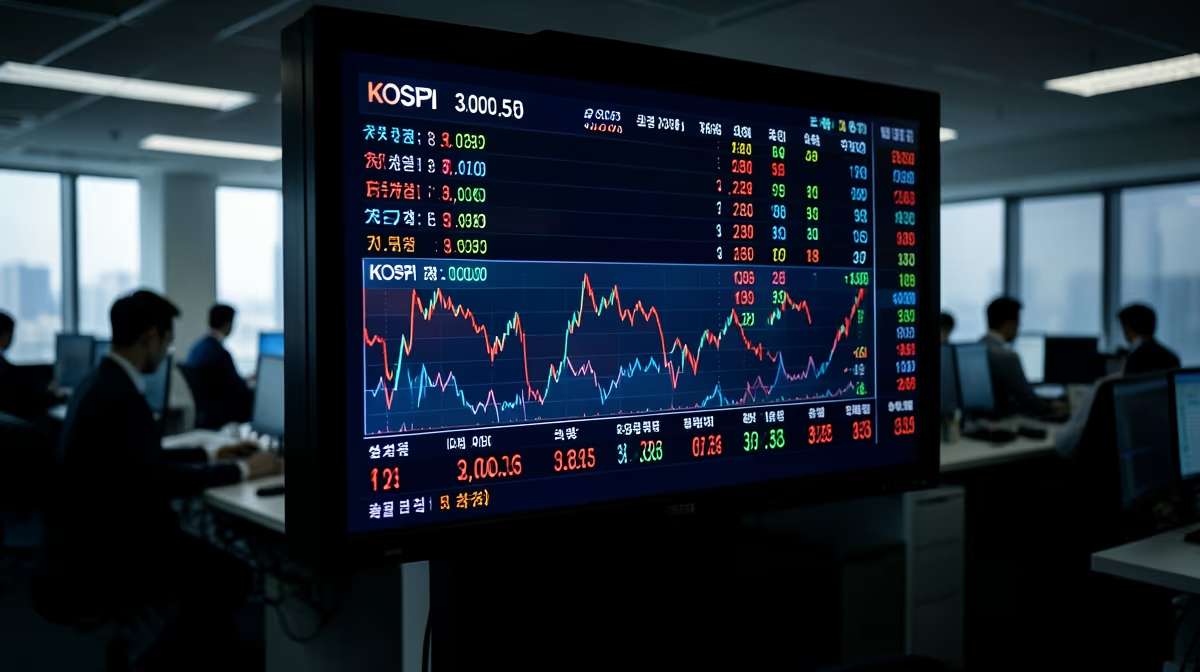
A subtle tremor in the Seoul trading floor is currently sending ripples across the global tech-manufacturing supply chain, raising questions about the durability of the current electronics super-cycle. As the kospi index remains a critical indicator for Asian financial stability, it continues to serve as a high-fidelity proxy for identifying potential cooling in the world’s most vital industrial arteries. For institutional investors and geopolitical analysts alike, the movements observed in the South Korea stock market are not merely local fluctuations but are instead early warning signals for global commerce and international market performance.
What Happened
The South Korean market experienced a notable downturn during the most recent session in Seoul, tracking broader regional losses as investor sentiment soured over concerns regarding global monetary policy and persistent inflationary pressures. The benchmark index closed lower, pressured heavily by a widespread sell-off in the technology and semiconductor sectors. Market data confirms that both domestic institutions and foreign investors remained net sellers throughout the day, effectively weighing down blue-chip stocks.
While certain defense and energy-related equities showed brief moments of resilience, the overall market breadth remained firmly negative. This decline reflects a broader trend across Asia-Pacific markets, where investors are actively reassessing equity valuations in a macroeconomic climate defined by the expectation that central banks may maintain higher interest rates for longer than previously anticipated. Market participants are now monitoring signals from the Bank of Korea to determine how potential local interest rate adjustments might impact the earnings outlook for major conglomerates.
Key Facts
The KOSPI, which stands for the Korea Composite Stock Price Index, acts as the primary benchmark for the Korea Exchange in Seoul. Established in 1983 during the period of rapid industrialization in South Korea, it has evolved from a domestic focus into a major global entity. The index is heavily weighted toward massive technology and manufacturing conglomerates, commonly referred to as chaebols, which include giants like Samsung Electronics and SK Hynix. Because of this composition, the index functions as a fundamental barometer for the health of the South Korean economy and is widely considered one of the most significant economic indicators in the Asian region.
Why It Matters
The importance of the KOSPI extends far beyond the borders of Seoul, particularly for Indian investors and business observers monitoring the Asian tech and manufacturing sectors. Because South Korea functions as a global hub for electronics and semiconductor production, a sharp decline in this index often signals a cooling of demand for essential tech components. Such a shift can have tangible consequences for Indian tech firms, export-import logistics, and broader emerging market sentiment. For global supply chain managers and international institutional investors, the index serves as a real-time pulse of global trade cycles, meaning that volatility in the Korean market is frequently the first indicator of systemic changes in the availability and pricing of essential high-tech goods.
Expert Analysis
The root cause of recent market behavior is the structural dependency of the KOSPI on semiconductor export cycles, particularly the demand for memory chips. This underlying sensitivity is exacerbated by the volatility of the Won currency relative to the US Dollar and shifting Chinese industrial demand. Market strategist Kim Min-ji of Seoul Securities notes that the current pullback is a reflection of collective anxiety regarding interest rate paths, suggesting that until there is stabilization in US bond yields, the index will struggle to find a definitive floor. Furthermore, the market is witnessing the influence of domestic retail traders, known as Ant Investors, whose activities sometimes decouple from foreign institutional sentiment, signaling a shift in the democratization of the Korean financial landscape. These factors, combined with historical lessons from the 1997 Asian Financial Crisis, underscore the complex pressures currently facing the exchange.
Political And Geopolitical Implications
The KOSPI is heavily influenced by what is known as the Korea Discount, a valuation gap driven by geopolitical tensions on the Korean Peninsula, opaque corporate governance structures, and ongoing challenges regarding shareholder rights. Beyond these internal factors, the index acts as a frontline barometer for the escalating US-China tech war. Restrictions on semiconductor exports to China directly impact the revenue models of Korean tech heavyweights, forcing the nation to navigate a delicate balancing act between Washington’s security requirements and Beijing’s status as a massive consumer market. Consequently, the index serves as a proxy for South Korean political stability and its ability to maintain its position within the global semiconductor hierarchy.
What Happens Next
In the next 24 hours, the KOSPI is expected to remain cautious, mirroring movements in global tech indices while digesting potential volatility in the South Korean Won, with trading likely to hover around current support levels. Looking toward the next 72 hours, consolidation is likely as investors monitor macroeconomic data releases and shifts in foreign investor sentiment regarding the semiconductor sector. A slight upward bias remains possible, but this is entirely contingent on stabilizing currency flows. Analysts anticipate a period of choppy trading with a focus on earnings guidance for tech heavyweights, expecting the index to trade within a range of 2,550 to 2,650 points. A best-case scenario involves a rebound in AI-driven chip demand triggering strong buying, while a worst-case scenario involves persistent inflationary pressures or geopolitical tensions triggering a liquidity crunch and a breakdown below key support levels.
Frequently Asked Questions
Q: What is the KOSPI index?
A: The KOSPI, or Korea Composite Stock Price Index, is the benchmark stock market index of all common stocks traded on the Korea Exchange. It represents the overall performance of the South Korean stock market and is a key indicator of the country's economic health.
Q: How can I invest in the KOSPI from India?
A: Indian investors can gain exposure to the KOSPI by investing in international mutual funds or Exchange Traded Funds that track South Korean indices. You may also access global markets through brokerage platforms that offer international trading accounts, provided they comply with the Liberalised Remittance Scheme of the RBI.
Q: What is the difference between KOSPI and KOSDAQ?
A: The KOSPI primarily consists of large-cap, established companies, similar to the Nifty 50 in India. In contrast, the KOSDAQ focuses on small-cap stocks, growth-oriented companies, and startups, functioning similarly to the NASDAQ in the United States.
Q: Why does the KOSPI index matter to global investors?
A: The KOSPI is highly significant because it includes major global technology and manufacturing giants. Because South Korea is a major exporter of electronics and semiconductors, the KOSPI often serves as a barometer for global demand and trade cycles.
Q: Is the KOSPI index currently performing well?
A: KOSPI performance fluctuates based on global semiconductor demand, geopolitical tensions in the region, and domestic monetary policies. Investors typically check real-time financial news portals for the most recent updates on index trends.
Q: What are the trading hours for the KOSPI index?
A: The KOSPI market operates from Monday to Friday, with the standard trading session running from 9:00 AM to 3:30 PM Korea Standard Time. Indian investors should note that this corresponds to early morning hours in India.
Conclusion
The KOSPI index remains in a phase of heightened sensitivity, reflecting the broader uncertainties currently facing global tech-manufacturing supply chains. While the most recent session confirmed a downward trend driven by semiconductor sector weakness and investor caution regarding interest rates, the index continues to function as a vital, if volatile, gauge of Asian market health. Moving forward, participants will be closely watching the intersection of semiconductor export demand and macroeconomic stability to determine the index’s direction. Market participants should remain focused on earnings guidance and currency fluctuations as the primary indicators for potential volatility in the coming days.
" }


