
KOSPI Index Market Slump Signals Deeper Economic Warning Signs Ahead
Introduction
A subtle tremor in the heart of Seoul’s financial district is currently sending ripples through the global tech supply chain. The kospi index experienced significant volatility during today’s trading session, reflecting broader concerns regarding international trade and industrial output that extend far beyond the Korean Peninsula.
What Happened
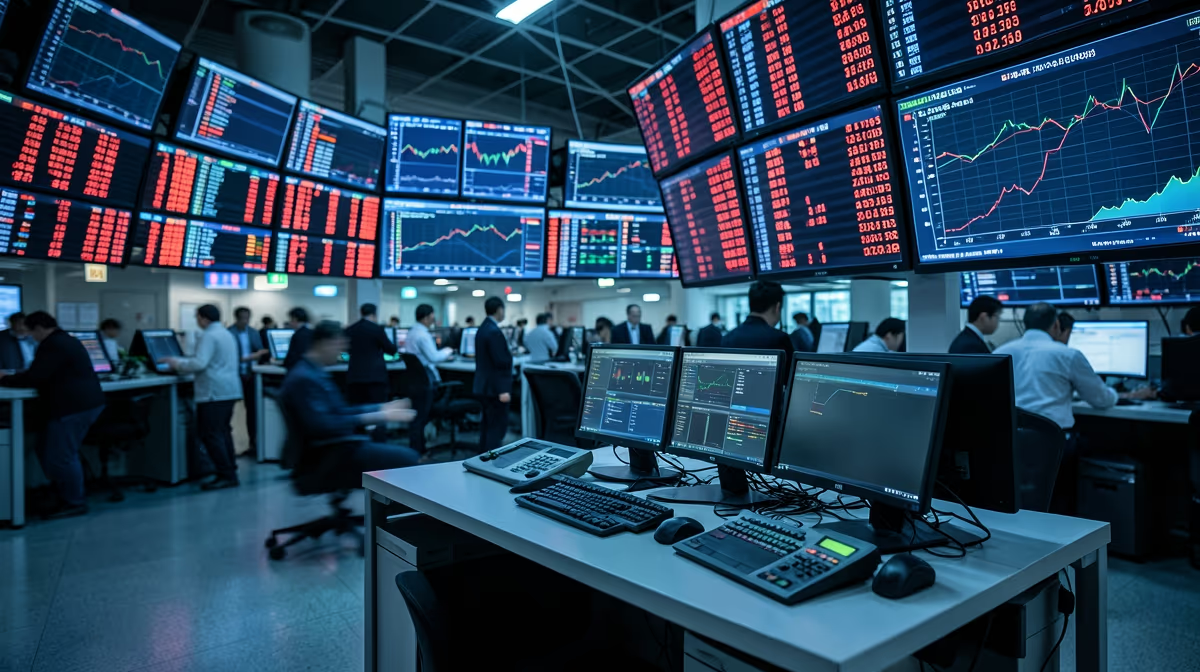
The KOSPI index retreated by 0.52 percent on Wednesday, closing at 2,568.55 points as institutional investors offloaded shares amid heightened caution regarding global semiconductor demand and domestic economic policy shifts. After beginning the session with potential for growth, the market saw selling pressure intensify in the final hours of trading. Key technology heavyweights, which serve as the backbone of the index, struggled to maintain momentum following mixed sentiment across broader Asian markets. Foreign investors remained net sellers for the third consecutive session, citing ongoing concerns over the volatility of the won and shifting interest rate expectations from the Bank of Korea. While domestic retail investors—often referred to locally as the ants—attempted to cushion the decline by purchasing shares in the manufacturing and battery sectors, overall market liquidity remained suppressed as participants braced for upcoming quarterly earnings reports.
Key Facts
The KOSPI, or Korea Composite Stock Price Index, is the primary benchmark for the Korea Exchange in Seoul and serves as a market-capitalization-weighted index. This structure means that larger corporations exert a disproportionate influence on the overall value of the index. Because technology and semiconductor companies constitute a significant portion of this weight, the index functions as a reliable barometer for the health of the global electronics industry. The index was officially launched in 1983 to provide a comprehensive view of South Korea’s industrialized economy and has since evolved into a critical indicator for international investors monitoring Asian markets.
Why It Matters
The KOSPI index is much more than a collection of stock tickers; it is a global diagnostic tool. South Korea acts as a central hub in the international electronics and automotive supply chain. Consequently, significant movements in this index signal potential shifts in consumer demand and manufacturing costs for goods utilized globally. When the KOSPI experiences a downturn, it often reflects a broader economic uncertainty or a negative sentiment regarding the high-tech industrial output that powers the modern world. For international investors, the index provides a snapshot of how global trade cycles are performing in real time, making it an essential instrument for those managing portfolios exposed to Asian markets or relying on South Korean component manufacturing.
Expert Analysis
The current market weakness is rooted in a structural dependence on global semiconductor cycles and high sensitivity to external export-import volatility. According to Lee Sang-hoon, a senior strategist at Hana Securities, the current market weakness is less about domestic fundamentals and more about a global recalibration of tech-heavy portfolios. This consolidation phase is exacerbated by the Korea Discount, a phenomenon characterized by low dividend payout ratios and opaque corporate governance structures that traditionally discourage some foreign institutional investment. While the downside pressure persists due to these global macroeconomic headwinds, the attractive valuation of major tech firms suggests that there is a limit to the current decline. The market is effectively caught between optimistic projections for artificial intelligence supply chains and fears of a slowdown in consumer spending.
Political And Geopolitical Implications
The trajectory of the KOSPI is inextricably linked to both domestic and international pressures. On the domestic front, the nation is navigating the influence of chaebol governance reforms and an aging workforce that threatens long-term capital accumulation and labor productivity. These factors are compounded by the geopolitical reality of the Korean Peninsula, where US-China trade tensions directly impact manufacturing supply chains and regional defense expenditures. Efforts like the recent Corporate Value-up program have been introduced to address these systemic issues and mitigate the persistent volatility that has historically deterred long-term foreign capital.
What Happens Next
In the next 24 hours, the KOSPI is expected to exhibit continued volatility as investors digest overnight U.S. tech sector movements and the latest domestic semiconductor export data. A cautious opening is anticipated, though there is potential for an intraday rebound if bargain hunting emerges for oversold large-cap stocks. Looking ahead to the next 72 hours, market sentiment is likely to stabilize as the focus shifts to upcoming Bank of Korea policy commentary and global risk appetite. The index is expected to oscillate within a narrow band as it tests technical resistance levels. In the best-case scenario, a strong rebound could occur if semiconductor stocks rally and the Korean Won strengthens, potentially pushing the index above its 20-day moving average. Conversely, a worst-case scenario involves heightened geopolitical tensions or a sharp increase in U.S. Treasury yields, which could trigger a massive foreign sell-off and force the index to test critical psychological support levels.
Frequently Asked Questions
Q: What is the KOSPI index?
A: The KOSPI, or Korea Composite Stock Price Index, is the representative stock market index of all common stocks traded on the Korea Exchange. It serves as the primary benchmark for the South Korean equity market, reflecting the overall performance of the country's largest and most influential companies.
Q: How is the KOSPI index calculated?
A: The KOSPI is a market-capitalization-weighted index, meaning companies with higher total market values have a greater impact on the index's movement. It is calculated by dividing the total market capitalization of all listed stocks by the market capitalization from the base year of 1980.
Q: What is the difference between KOSPI and KOSDAQ?
A: KOSPI primarily lists large-cap, established companies, often including many of South Korea's major conglomerates known as chaebols. In contrast, the KOSDAQ is a separate exchange focused on smaller companies, startups, and tech-oriented firms, similar to the Nasdaq in the United States.
Q: Can foreign investors trade KOSPI stocks?
A: Yes, foreign investors can trade stocks listed on the KOSPI index through the Korea Exchange. While there are some regulatory requirements and registration processes involved, the South Korean market is generally accessible to international institutional and retail investors.
Q: What factors influence the KOSPI index?
A: The KOSPI is heavily influenced by the performance of South Korea's export-driven economy, global semiconductor demand, and foreign investment flows. Additionally, geopolitical developments on the Korean Peninsula and the strength of the Korean Won against major currencies significantly impact investor sentiment.
Q: How can I track the KOSPI index in real time?
A: You can track the KOSPI index in real time through major financial news websites like Bloomberg, Reuters, or Yahoo Finance. Additionally, most brokerage platforms provide live streaming data for the Korea Exchange, allowing investors to monitor market performance throughout the trading day.
Conclusion
The KOSPI index currently stands at a crossroads, reflecting a wider global recalibration of tech-heavy investments and semiconductor manufacturing cycles. With a 0.52 percent decline on Wednesday and persistent institutional selling, the index is navigating a period of uncertainty driven by both domestic policy transitions and broader international economic volatility. As the market looks toward upcoming earnings reports and central bank policy updates, participants should prepare for continued oscillation. The path forward remains dependent on the stability of semiconductor demand and the capacity of major South Korean conglomerates to navigate the evolving geopolitical and economic landscape. Investors are advised to monitor technical support levels and broader macroeconomic indicators as the market seeks a new directional trend.


