
Ukrainian Drones Are Rapidly Changing the Future of Global Warfare
Introduction
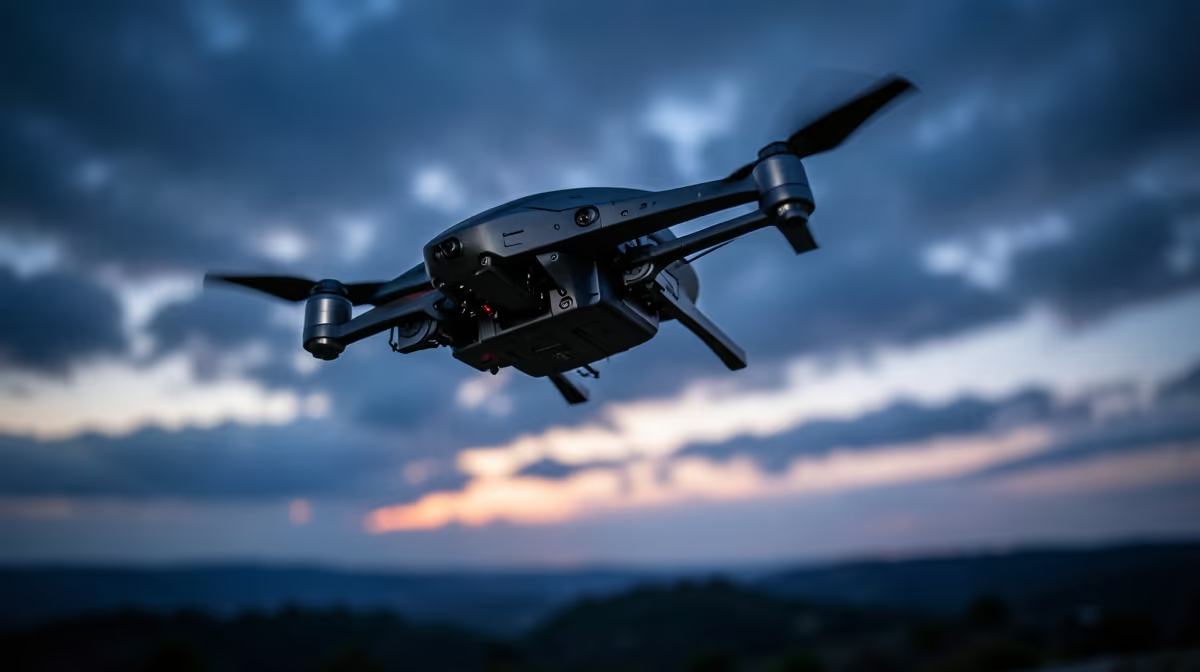
Small, remote-controlled devices are fundamentally rewriting the manual of modern warfare, turning the skies over Eastern Europe into a laboratory for tactical innovation. The deployment of ukrainian drones has become a defining characteristic of the ongoing conflict, reshaping traditional battlefield strategies through rapid technological adaptation.
What Happened
The United Kingdom has intensified its military support for Ukraine, pledging a significant surge in the delivery of advanced unmanned aerial systems to bolster Kyiv's defense capabilities against ongoing Russian aggression. The UK Ministry of Defence confirmed this week that it will facilitate the procurement and supply of thousands of first-person view, or FPV, drones to the Ukrainian Armed Forces. This initiative marks a strategic shift towards providing low-cost, high-impact technology that has become central to current frontline tactical operations.
These drones are intended to enhance Ukrainian surveillance and precision-strike capabilities, providing a necessary counter to entrenched Russian positions. Defense Secretary Grant Shapps emphasized that these systems are vital for maintaining an asymmetric advantage on the battlefield. By investing in the rapid deployment of these assets, the UK seeks to fill critical equipment gaps that have hampered Ukrainian maneuvers in recent months. The funding for this package is part of a broader multi-year security commitment designed to ensure long-term stability for the Ukrainian military. International military analysts suggest that the British-led initiative could serve as a template for other NATO members to standardize the integration of commercial off-the-shelf drone technology into conventional warfare. As the conflict enters a period of static attritional fighting, the emphasis on mass-produced, expendable tactical drones is expected to play a decisive role in regional combat dynamics through the coming winter months.
Key Facts
Ukraine is deploying long-range kamikaze drones to strike targets hundreds of miles from the border, including oil refineries, fuel depots, and military airfields within Russia. Many of these drones are homemade or modified commercial models, making them significantly cheaper than traditional missiles. This use of technology represents a strategic shift toward targeting Russia's industrial and economic backbone. Furthermore, Russian air defenses are being tested as they struggle to track and intercept these small, low-flying devices. The UK government has pledged a new package of thousands of FPV drones for Ukraine, a procurement effort involving both military-grade and commercial-modified systems, supported by the ongoing training of Ukrainian personnel in the UK.
Why It Matters
This strategy creates significant economic and military pressure on Moscow by forcing them to divert air defense systems away from the front line to protect domestic assets. It also creates psychological pressure, bringing the reality of the war to the Russian population and complicating the Kremlin’s ability to conduct business as usual. The impact extends to the Russian military, domestic energy companies, and civilians living in border regions or near critical industrial infrastructure. At the start of the full-scale invasion in 2022, Ukraine relied heavily on Western-supplied weapons, but as the war progressed, it invested heavily in its own domestic drone industry to overcome ammunition shortages and gain greater independence in its strategic targeting capabilities.
Expert Analysis
The root cause of this technological pivot is the necessity to compensate for conventional ammunition shortages and asymmetric naval disadvantages through low-cost, high-precision autonomous attrition systems. Historically, this mirrors the development and deployment of the V-1 flying bomb and early guided missiles in World War II, which similarly forced rapid shifts in defensive doctrine and air superiority tactics. The shift toward AI-integrated swarm capabilities is accelerating ethical debates on autonomous lethality, often overshadowed by immediate battlefield tactical reporting. Ukraine’s timeline shows a clear progression, beginning in 2022 with the initial deployment of commercial-grade FPV drones for tactical reconnaissance and improvised aerial strikes. By 2023, the UK-led drone coalition formalized the institutionalization of supply chains for mass production. By 2024, the integration of AI-driven target acquisition and long-range maritime strike capabilities fundamentally altered Black Sea naval control.
Political And Geopolitical Implications
The UK's strategic position as a primary donor of lethal technology serves to project influence within NATO, positioning London as the lead coordinator for the drone coalition to maintain relevance post-Brexit. Economically, the transition from boutique military manufacturing to modular, mass-producible drone architecture is creating a lucrative dual-use export market and stimulating domestic high-tech defense clusters. Geopolitically, these developments are redefining the rules of engagement in naval warfare and regional security, forcing a global re-evaluation of current maritime blockade strategies and the cost-effectiveness of traditional capital ships.
What Happens Next
In the next 24 hours, expect increased intelligence sharing and logistical support coordination between the UK Ministry of Defence and Ukrainian counterparts regarding long-range drone capabilities. Within 72 hours, there may be announcements regarding new funding packages or technical training programs for Ukrainian drone operators in British facilities. Experts predict the UK will continue to prioritize the supply of sophisticated sensor technology and tactical drone systems while deepening integration with NATO-standard command structures. In the best-case scenario, successful deployment of new British-supplied technology leads to significantly improved precision strikes against critical infrastructure, shortening the conflict duration. The worst-case scenario involves an escalation in Russian rhetoric leading to direct cyber-attacks against UK defense contractors or a destabilizing incident involving supply routes.
Frequently Asked Questions
What types of drones is Ukraine using in the war?
Ukraine utilizes a diverse range of drones, including commercial quadcopters for reconnaissance, FPV kamikaze drones for tactical strikes, and larger long-range fixed-wing UAVs for deep-strike missions. Many of these systems are domestically produced or adapted from off-the-shelf hobbyist hardware.
Are Ukrainian drones capable of hitting targets inside Russia?
Yes, Ukraine has deployed long-range domestic drones capable of striking infrastructure, oil refineries, and military airfields deep within Russian territory. These operations aim to disrupt logistics and reduce the capability of Russian forces to launch attacks.
How is Ukraine producing drones on a large scale?
The Ukrainian government has significantly scaled up production through the Army of Drones initiative, which facilitates collaboration between private tech companies and military procurement agencies. This decentralized manufacturing approach allows for rapid innovation and the deployment of thousands of units per month.
What role do FPV drones play in the conflict?
First-person view drones serve as precision-guided, low-cost loitering munitions that allow operators to target specific vehicles, trenches, and personnel. Their ability to deliver high-explosive payloads with pinpoint accuracy has fundamentally changed frontline tactics.
Does the UK supply drones to Ukraine?
The United Kingdom has provided various types of unmanned aerial systems to Ukraine as part of its military aid packages, including reconnaissance drones and loitering munitions. These contributions are intended to enhance Ukrainian situational awareness and offensive precision on the battlefield.
How effective are Ukrainian sea drones?
Ukrainian uncrewed surface vessels have proven highly effective at challenging Russian naval dominance in the Black Sea. These maritime drones have successfully damaged and sunk several Russian warships by exploiting vulnerabilities in naval defenses.
Conclusion
The integration of advanced drone technology has become a cornerstone of Ukraine’s defense strategy, forcing a permanent shift in how modern conflict is conducted. Through the supply of FPV systems and technical support, the UK is helping to standardize a new model of asymmetric warfare. As these technologies evolve from commercial adaptations to sophisticated, mass-produced tools of attrition, the implications for military industrial strategy and regional stability will continue to grow. The focus remains on maintaining the current frontline while expanding the capacity for precision strikes, setting the stage for a prolonged, tech-centric phase of the Ukraine-Russia conflict.
" } ]


