
Mojtaba Khamenei Remains at the Center of Iran’s Succession Mystery
Introduction
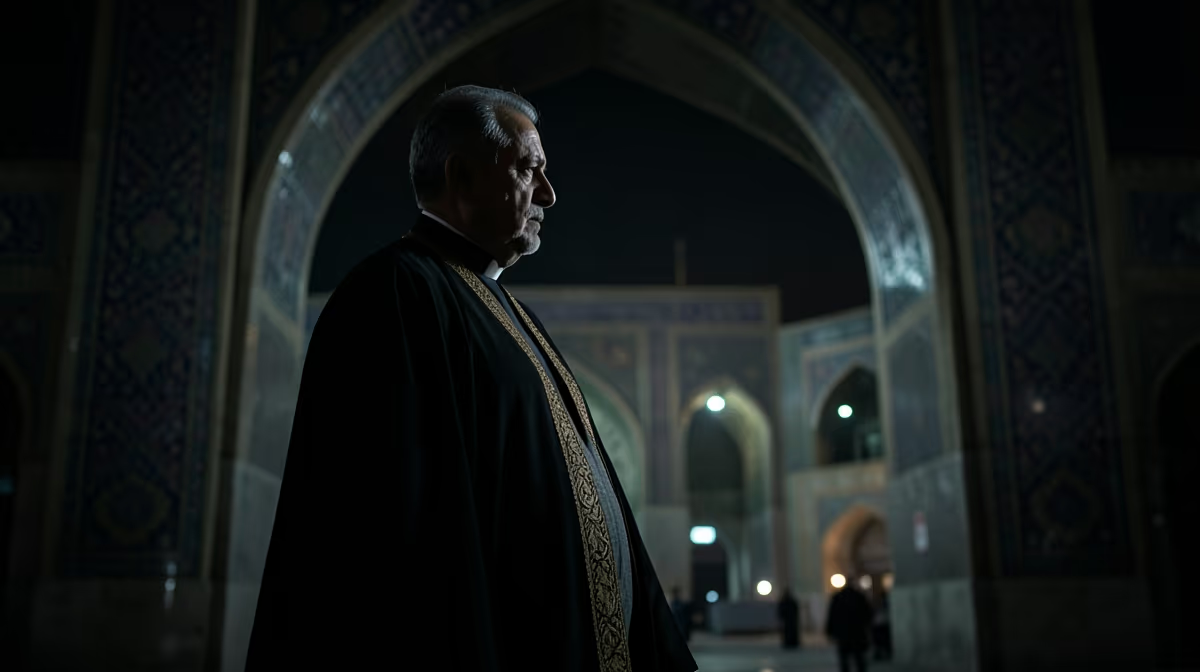
The question of succession in Tehran remains a focal point of global geopolitics, with Mojtaba Khamenei frequently cited by analysts as a key figure in the future of Iran's leadership following his father, Ali Khamenei. As the internal architecture of the Islamic Republic faces inevitable transition, the role of the Supreme Leader's second son has shifted from a behind-the-scenes operative to a central subject of international scrutiny.
What Happened
Mojtaba Khamenei has gradually moved from a shadow operator to the presumptive successor of the Supreme Leader within state media discourse and elite circles. While he holds no formal government title, his decades-long involvement in the security and intelligence apparatus have solidified his status as an influential power broker. Historically, he has maintained a low profile, rarely delivering public speeches or appearing in media, yet his fingerprints have been identified by observers across major security decisions since the 1990s. Notably, he was linked to the 2009 crackdown against the Green Movement, an event that remains a core reference point for his detractors. Throughout 2024, his profile has risen, sparking debate within the Assembly of Experts—the body constitutionally tasked with selecting the next leader—about the trajectory of Iran's leadership following the eventual departure of his father.
Key Facts
Mojtaba Khamenei is the second son of Supreme Leader Ayatollah Ali Khamenei and a mid-ranking cleric who has taught religious studies in the Qom seminary. He does not hold a formal, publicly elected, or high-ranking government executive position. Despite the absence of a title, he exerts significant influence within the IRGC and clerical circles. He has been sanctioned by the United States government for his role in supporting the regime's suppression of dissent. His potential succession is often characterized by critics as a move toward the dynastic evolution of the Iranian state, contradicting the anti-monarchical foundations of the 1979 Revolution.
Why It Matters
The transition of power in Iran is a matter of global stability. As a major regional power, the identity of the next Supreme Leader will dictate whether Tehran maintains its current hardline stance toward the West or pivots in its foreign policy. The succession is particularly critical for regional neighbors, international diplomatic bodies, and global powers like the United States and EU. Any internal power struggle or controversial appointment could lead to domestic unrest within Iran and cause immediate ripple effects across international markets and diplomatic relations. Furthermore, the Iranian general population remains deeply affected by the outcome, as the transition influences the nation's economic hegemony and the control of multi-billion dollar semi-state foundations known as Bonyads.
Expert Analysis
The root cause of the current focus on succession is the imperative of systemic survival for the Islamic Republic amidst transition risks and internal fractionalization. Analysts observe a shift from an ideological theocracy to a hereditary-adjacent autocracy, aimed at centralizing power within the Office of the Supreme Leader to bypass institutional oversight by the Assembly of Experts. The IRGC’s economic hegemony and its control over semi-state foundations serve to secure loyalty from the military-industrial complex, ensuring the status quo remains intact. However, a profound internal opposition exists among high-ranking clerics in Qom who view a clerical dynasty as a betrayal of the revolutionary mandate and a potential source of legitimacy collapse. This mirrors the historical transition from Ruhollah Khomeini to Ali Khamenei, shifting from a charismatic, revolutionary-based authority to a bureaucratic, institutional-based control mechanism.
Political And Geopolitical Implications
The potential solidification of the Axis of Resistance signals a likely continuation of current foreign policy trajectories under a successor. If Mojtaba Khamenei assumes a leadership role, it may lead to increased friction with Western and regional powers who are already wary of the current trajectory. The primary geopolitical implication is the possible tightening of ties between the clerical establishment and the IRGC to prevent internal fractures, potentially creating a more monolithic, albeit controversial, leadership structure. While the Assembly of Experts holds the constitutional mandate to select the leader, the behind-the-scenes influence of the Khamenei family continues to challenge the transparency of this process, creating a significant point of tension in Iran’s long-term stability.
What Happens Next
In the next 24 hours, analysts anticipate increased speculative reporting in Persian-language media regarding Mojtaba Khamenei’s potential role as a successor following recent internal clerical discussions. Over the next 72 hours, monitoring will focus on IRGC-affiliated channels for signals that confirm or deny shifts in his public visibility or behind-the-scenes influence. Looking ahead, experts expect him to remain a central, albeit cautious, figure in the debate, with his influence mediated by the IRGC. The best-case scenario for the region would be a transparent or orderly succession process that minimizes internal power struggles, while the worst-case involves a succession crisis triggered by a leadership vacuum, leading to a violent internal power struggle between the clerical establishment and the military wing.
Frequently Asked Questions
Q: Who is Mojtaba Khamenei?
A: Mojtaba Khamenei is an Iranian Shia cleric and the second son of Supreme Leader Ali Khamenei. He is often considered one of the most influential figures behind the scenes in Iranian politics, though he holds no official government position.
Q: Is Mojtaba Khamenei a potential successor to his father?
A: Many political analysts and observers consider Mojtaba Khamenei a strong candidate to succeed his father as Supreme Leader. While his potential succession has been the subject of long-standing speculation, it remains a controversial topic within Iran's political establishment.
Q: Does Mojtaba Khamenei hold an official position in the Iranian government?
A: Mojtaba Khamenei does not hold any formal government or state position. Despite his lack of an official title, he is widely believed to wield significant influence over the country's security and intelligence apparatus.
Q: What is Mojtaba Khamenei's role in Iranian politics?
A: He is frequently described as a key power broker within the conservative faction of the Iranian regime. Reports often suggest that he plays a significant role in managing the affairs of the Supreme Leader's office and influencing high-level political decisions.
Q: Why is Mojtaba Khamenei considered a controversial figure?
A: His influence is often criticized by reformists and opposition groups who view his potential rise to power as a move toward a hereditary monarchy within the Islamic Republic. Additionally, he has faced sanctions from the United States and other Western nations regarding his alleged role in suppressing political dissent.
Q: What is the educational background of Mojtaba Khamenei?
A: Mojtaba Khamenei pursued traditional Islamic studies at the seminary in Qom, following in the footsteps of his father. He studied under high-ranking clerics, which is the standard path for attaining the religious credentials necessary for political influence in Iran.
Conclusion
Mojtaba Khamenei occupies a singular position in Iranian politics, serving as a focal point for the complex intersection of the clerical establishment, the IRGC, and the future of the Islamic Republic. While his potential succession remains the subject of intense speculation and elite maneuvering, the verified absence of any formal political role ensures that he remains a figure of ambiguity. As Iran navigates the uncertainties surrounding the health of the Supreme Leader, the influence of the Khamenei family continues to shape the discourse on systemic survival. Global observers, policymakers, and intelligence professionals must continue to monitor the interplay between the Assembly of Experts and the security apparatus, as these internal dynamics will dictate the long-term political stability of the region. The transition, whenever it arrives, will be a defining moment for the future trajectory of Tehran’s regional and international relations.


