
Nuclear Program of Iran Shifts as Regional Security Stakes Reach Peak
Introduction
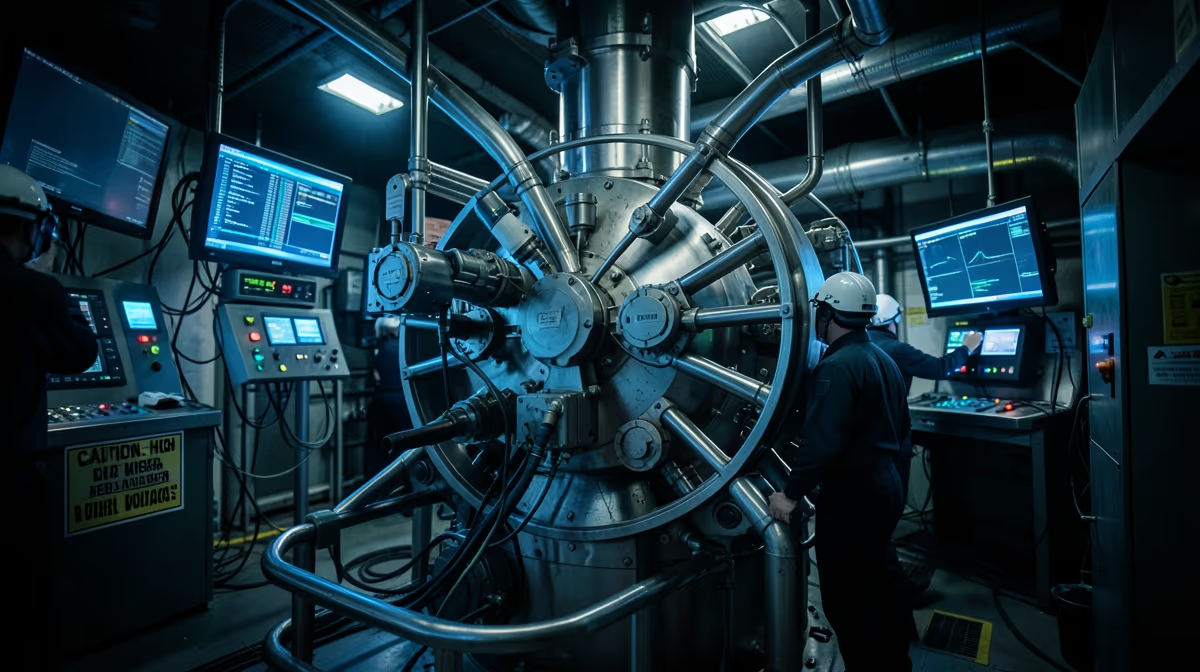
Deep within the fortified centrifuge halls of Natanz and Fordow, a silent shift in technical capacity is redrawing the map of global security. The ongoing development of the nuclear program of iran remains a focal point for international diplomats and US foreign policy experts concerned with middle east security.
What Happened
The landscape of regional non-proliferation has reached a critical juncture, characterized by a steady departure from the constraints established under the 2015 Joint Comprehensive Plan of Action (JCPOA). Following the United States withdrawal from the agreement in 2018, the architecture of oversight began to fracture, leading to a series of escalations that have persisted into the current year.
International Atomic Energy Agency inspectors have reported that Tehran has significantly expanded its centrifuge capacity and is accumulating stockpiles of uranium enriched to 60 percent purity. This level is technical progress far beyond the limits once agreed upon, moving the nation closer to weapons-grade material. Simultaneously, government officials in Tehran have implemented restrictions on IAEA access, limiting the transparency that previously served as the bedrock of global confidence in the program. While the Biden administration has consistently stated its preference for a diplomatic framework, the breakdown of these communications has left the status of the program in a state of flux.
Key Facts
- Iran is currently enriching uranium at higher levels than permitted by previous international deals, with 60 percent purity becoming a concerning baseline for international observers.
- The 2015 JCPOA, intended to extend the time required to develop a nuclear device, has effectively been dormant since the 2018 U.S. withdrawal, which triggered a cycle of renewed economic pressure.
- International inspectors from the IAEA have encountered systematic limitations regarding their access to sensitive nuclear facilities, complicating the verification process.
- Despite the rapid expansion of nuclear infrastructure, the Iranian government maintains that its activities are strictly for civilian energy and medical research, and there is no public intelligence confirming the existence of an active nuclear weapon.
- Western nations continue to utilize a robust regime of primary and secondary economic sanctions aimed at restricting Tehran’s oil revenue, attempting to curb the resources available for the nation’s nuclear ambitions.
Why It Matters
The implications of these developments extend far beyond the borders of the Middle East, influencing global energy market stability and the broader security architecture. A nuclear-armed Iran, or even the perception of one nearing the breakout threshold, threatens to trigger a regional arms race as neighboring nations contemplate their own deterrent requirements.
For the global citizen, the situation dictates the price of oil and the risk profile of key maritime trade corridors. If diplomatic guardrails continue to erode, the resulting instability could lead to significant economic volatility. The Iranian public remains directly impacted by the persistent inflationary crisis caused by ongoing sanctions, creating a complex internal dynamic for the leadership in Tehran as they balance domestic economic needs with the pursuit of regional power.
Expert Analysis
The root cause of this ongoing standoff is the dual pursuit of regional hegemony and regime survival, with the leadership viewing strategic nuclear capability as the only absolute guarantee against external intervention. The current dynamic is defined by a high-stakes leverage game, where Washington uses the weaponization of the global financial system to apply pressure, while Tehran projects strength to counteract the resulting economic isolation.
The situation is characterized by what experts describe as controlled tension. Both parties operate within a rigid, adversarial framework, seeking to avoid a direct kinetic trigger while maintaining their respective public postures. The historical parallel often cited is the 1962 Cuban Missile Crisis, illustrating the inherent risks of escalation when one party perceives a weapons system as an existential necessity. The emergence of shadow-deterrent networks, including drone and missile proxy groups, serves to further complicate the intelligence landscape, functioning alongside the nuclear program to provide an asymmetric defense strategy.
Political And Geopolitical Implications
The geopolitical impact has forced an uneasy, pragmatic alignment between Israel and several Sunni Arab states, all of whom perceive the Iranian-led Axis of Resistance as a primary security threat. This shifting alliance structure has transformed the Middle East, as nations that previously held disparate strategic views now coordinate intelligence efforts to monitor Iranian nuclear facilities.
In Washington, the political debate remains split between those advocating for stricter enforcement of existing sanctions and those who believe a renewed diplomatic path is the only way to avoid a full-scale regional conflict. The failure to restore the JCPOA has left a vacuum in policy, where the primary objective is to prevent a breakout without triggering the very military intervention that diplomats are desperate to avoid.
What Happens Next
The immediate outlook suggests an increase in diplomatic signaling as the IAEA continues to compile data for the next non-proliferation committee reports. Within the next 24 hours, heightened monitoring of enrichment levels will likely be the primary focus of international observers.
Over the next 72 hours, it is expected that U.S. administration officials will issue formal statements reinforcing a policy of containment while reiterating a willingness to discuss a new diplomatic framework. The expert prediction for the near term is that both sides will continue to test the boundaries of this controlled tension. In the best-case scenario, a tacit agreement could lead to a temporary freeze in centrifuge advancement. Conversely, the worst-case scenario involves a critical threshold violation of enrichment levels, which could force the U.S. to impose additional secondary sanctions or potentially trigger a limited kinetic response.
Frequently Asked Questions
What is the current status of Iran's nuclear program?
Iran continues to enrich uranium to levels nearing weapons-grade, significantly exceeding the limits set by the 2015 Joint Comprehensive Plan of Action. International monitors have reported that Iran has restricted access for inspectors, leading to heightened concerns regarding the potential for further nuclear escalation.
Why did the US withdraw from the Iran nuclear deal?
The US withdrew from the JCPOA in 2018, citing concerns that the agreement did not sufficiently address Iran's ballistic missile program or its regional influence, arguing that it offered too much sanctions relief without providing enough long-term security.
Does Iran have a nuclear weapon?
As of now, there is no public evidence that Iran has developed a nuclear weapon. While intelligence agencies suggest Iran possesses the technical capability to produce fissile material, the Iranian government maintains that its program is intended solely for peaceful, civilian purposes.
What are the main goals of the Iran nuclear deal?
The primary goal of the 2015 JCPOA was to limit Iran's nuclear program to prevent it from developing a nuclear weapon in exchange for significant economic sanctions relief, effectively extending the time needed to produce enough material for a device.
What is the role of the IAEA in Iran's nuclear program?
The IAEA serves as the independent watchdog tasked with monitoring Iran's nuclear facilities to ensure compliance with international treaties through regular, though periodically restricted, inspections.
What happens if Iran reaches a nuclear breakout?
A nuclear breakout refers to the production of enough highly enriched uranium for a device. If reached, it would likely trigger severe international sanctions, increased military posturing from neighboring countries, and potential preemptive diplomatic or security actions from global powers.
Conclusion
The nuclear program of iran remains a centerpiece of global security anxiety, suspended between technical acceleration and diplomatic stagnation. While both the U.S. and Iranian leadership navigate a complex landscape of sanctions and clandestine deterrents, the reality of the situation is defined by a lack of transparent communication and the constant threat of a critical threshold being crossed. Moving forward, the effectiveness of IAEA oversight and the rigidity of international economic policies will determine whether the region remains in a state of controlled tension or slides toward an irreversible escalation. For policy makers and global observers, the situation demands constant vigilance, as the path to a sustainable resolution remains narrow and currently devoid of active, productive negotiation.
" }


