
Unruly Aircraft Passenger Incidents Spark Major FAA Security Shift
Introduction
A quiet cabin at thirty thousand feet is no longer a guaranteed sanctuary for international travelers. The recent spike in an unruly aircraft passenger incident highlights the mounting pressure on global aviation security as federal authorities take a stricter stance on maintaining order in the skies.
What Happened
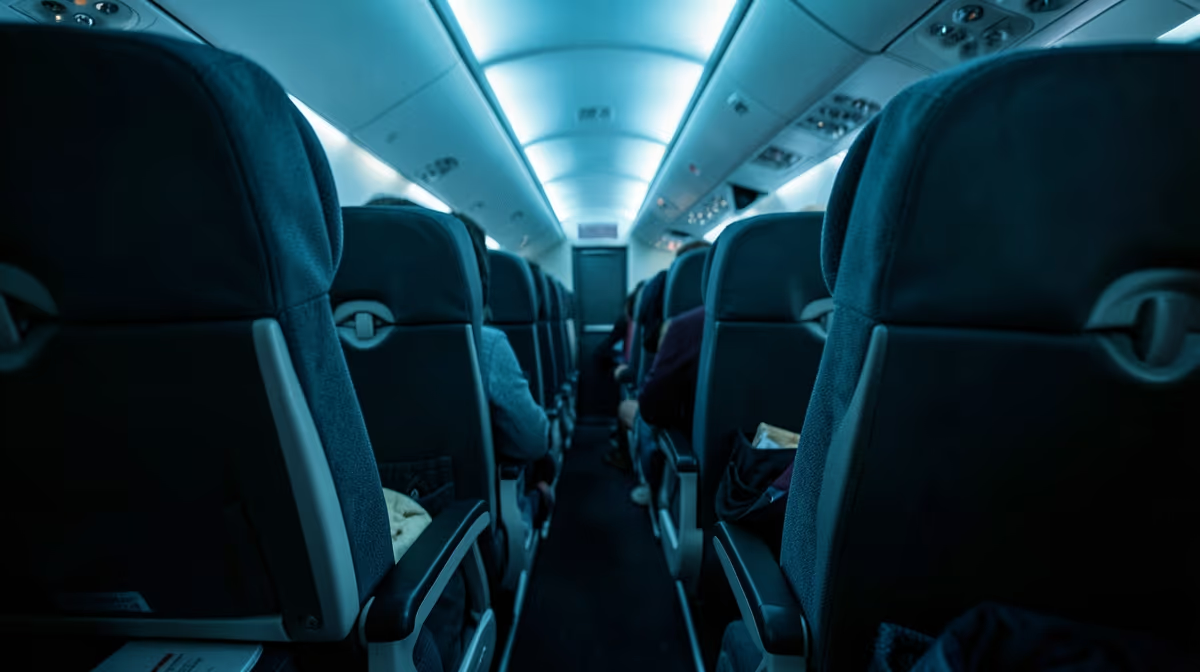
A Delta Air Lines flight from New York to Los Angeles was diverted to Detroit Metropolitan Airport on Tuesday afternoon after a passenger allegedly assaulted a flight attendant and disrupted cabin operations. The aircraft, operating as Delta Flight 482, departed John F. Kennedy International Airport with 185 passengers on board. According to reports from fellow travelers, the disturbance began roughly two hours into the flight when a passenger refused to comply with crew instructions and initiated a physical altercation in the forward cabin. The captain declared an emergency to prioritize landing at the nearest suitable airport.
The aircraft landed safely at 3:15 p.m. local time. Upon arrival in Detroit, paramedics evaluated one crew member for minor injuries while the suspect was escorted off the plane by airport police and FBI agents. The remaining passengers were held on the aircraft for nearly two hours before the flight was cleared to continue its journey to Los Angeles. Delta officials stated that the safety of passengers and crew is their primary objective and they have a zero-tolerance policy regarding unruly behavior. The suspect, whose identity has not yet been released, faces potential federal charges for interfering with a flight crew, a crime that can carry significant fines and prison time.
Key Facts
- The flight was diverted to the nearest airport to ensure the safety of those on board.
- Law enforcement met the aircraft upon landing to remove the individual and initiate custody procedures.
- Federal laws strictly prohibit interfering with a flight crew's duties during the operation of an aircraft.
- Unruly passengers can face heavy fines and significant prison time if convicted of federal charges.
- Furthermore, airlines maintain internal no-fly lists for passengers who exhibit dangerous or disruptive behavior, effectively barring them from future travel with the carrier.
Why It Matters
These incidents are more than just an inconvenience; they compromise the safety of the entire aircraft and place an immense emotional and physical burden on flight attendants. When a flight must divert, it wastes fuel, forces passengers to miss connections, and drains resources from local law enforcement and airport staff, making air travel more stressful and expensive for everyone. The ripple effect extends to airline operational costs and the overall aviation safety compliance framework, which must now adapt to a persistent baseline of high-aggression incidents.
Expert Analysis
The current trend reflects an erosion of collective social norms and hyper-individualistic stressors exacerbated by post-pandemic psychosocial instability. Analysts observe that this is not entirely new, drawing parallels to the post-deregulation era of the 1980s when labor disputes and cabin tension led to similar spikes in mid-flight altercations. The present environment, however, features a persistent baseline of high-aggression incidents fueled by systemic travel fatigue and the normalization of public confrontation. A hidden factor in this escalation is the link between airline staff burnout and the resulting inability to de-escalate minor incidents before they reach a point of physical eruption.
Political And Geopolitical Implications
On a political level, these disturbances often manifest as performative sovereignty within the confined, hyper-regulated environment of a commercial aircraft, mirroring broader societal polarization. From a geopolitical perspective, there is growing concern that airborne disruption could be exploited as a soft-target vulnerability in national critical infrastructure. This reality is forcing a necessary shift in international aviation security protocols, moving toward more rigorous and standardized enforcement across global carriers to prevent individual behavioral issues from evolving into broader security threats.
What Happens Next
Within the next 24 hours, the unruly passenger will be formally detained by federal law enforcement, processed for charges including interference with a flight crew, and denied re-entry onto commercial flights pending investigation. Within 72 hours, the FAA will initiate a civil penalty investigation, the airline will review safety protocols for de-escalation, and social media footage of the incident will undergo forensic verification. Experts predict a steady increase in zero-tolerance enforcement actions and potential advocacy for a centralized no-fly list specifically for disruptive passengers to mirror international best practices. The best-case scenario is that the incident serves as a catalyst for improved mental health resources and standardized de-escalation training, while the worst-case scenario involves a wave of copycat disruptions leading to increased flight diversions and significant staffing shortages.
Frequently Asked Questions
What happens if a passenger is unruly on a flight?
Unruly passengers may face immediate removal from the aircraft, denial of future boarding, and potential arrest upon landing. Federal law enforcement, including the FBI, may become involved depending on the severity of the incident.
Can you be fined for being an unruly passenger in the US?
Yes, the Federal Aviation Administration enforces a zero-tolerance policy that can result in substantial civil penalties. These fines can reach tens of thousands of dollars per violation, depending on the nature of the interference with the flight crew.
What is considered unruly behavior on an airplane?
Unruly behavior includes physical assault, verbal threats, failure to follow crew instructions, and interference with flight operations. This also encompasses incidents involving alcohol intoxication, smoking, or sexual harassment of passengers and crew.
Can airlines ban unruly passengers for life?
Yes, airlines maintain internal no-fly lists for passengers who exhibit disruptive or violent behavior. While a permanent ban is at the carrier's discretion, it effectively bars the individual from booking future flights with that specific airline.
Are there federal criminal penalties for interfering with a flight crew?
Yes, interfering with flight crew members or attendants is a federal crime under 49 U.S.C. Section 46504. Violators can face significant prison sentences in addition to heavy financial penalties imposed by federal courts.
How should a passenger report an unruly person on a plane?
If you witness unruly behavior, you should immediately notify a flight attendant who is trained to handle such situations. Do not attempt to intervene personally, as this could escalate the conflict and compromise the safety of the flight.
Conclusion
The diversion of Delta Flight 482 serves as a stark reminder of the challenges facing modern aviation. While the flight landed safely and the suspect is in custody, the incident highlights the ongoing necessity for strict enforcement of passenger conduct policies. As the FAA continues its investigations, the industry remains focused on addressing the root causes of these disturbances to ensure that the skies remain a safe environment for all travelers. Future efforts will likely prioritize enhanced training and a more unified approach to managing disruptive behavior, aiming to stem the tide of incidents currently impacting global air travel.
" }


