.webp)
China J-20 India Deployment Signals a Major Shift Along the Border
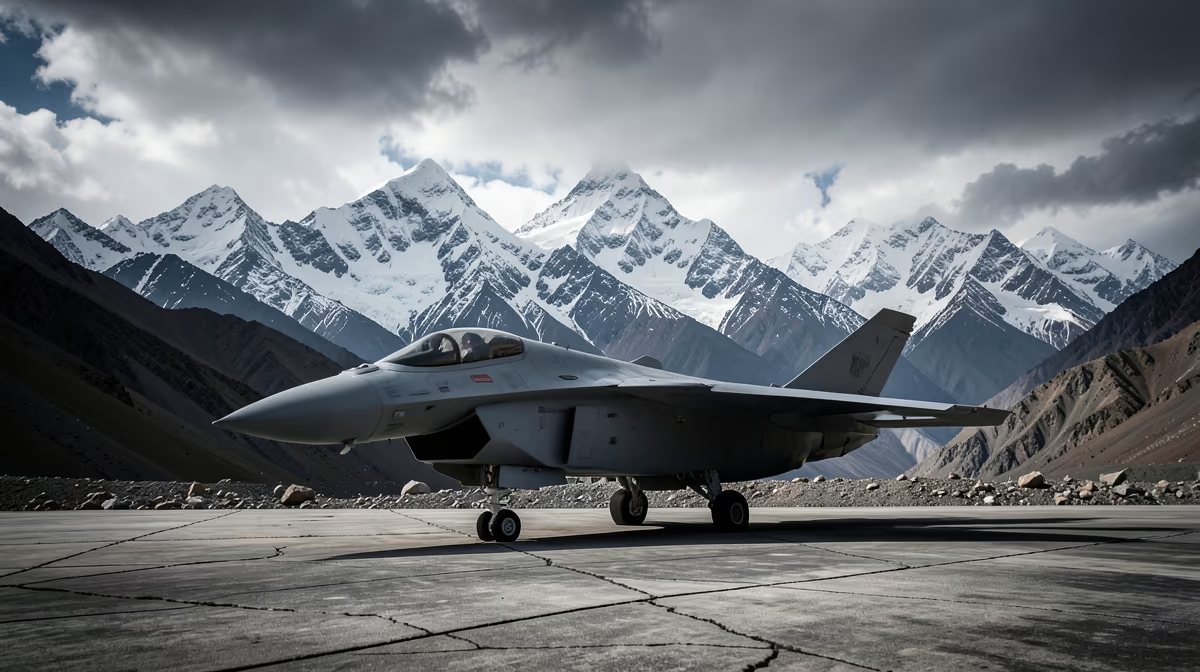
Satellite lenses capture the silent, swept-wing silhouette of a fifth-generation warplane resting on a high-altitude Tibetan tarmac, forever altering the meteorological and tactical calculations of South Asian defense planners. High above the rugged terrain of the Himalayan frontier, the geopolitical equilibrium is shifting as military commanders grapple with the realities of the china j-20 india deployment. Recent reports regarding the china j-20 india deployment have raised strategic concerns among defense analysts monitoring the disputed frontier, signaling a permanent evolution in how advanced air power is projected across contested sovereign boundaries.
China has reportedly deployed its advanced J-20 stealth fighter jets close to the Indian border, representing modern, radar-evading warplanes designed to dominate the skies and give Beijing a major strategic advantage in aerial combat. For India, this move highlights the growing military competition between the two nuclear-armed neighbors in the high-altitude region. While borders have remained relatively quiet recently, both nations are continuously upgrading their military infrastructure to prepare for any potential conflict. Satellite imagery and intelligence reports indicate that the People's Liberation Army Air Force has increasingly rotated fifth-generation J-20 Mighty Dragon stealth fighters through dual-use airbases in western Tibet, including Shigatse and Hotan. This strategic positioning enhances Beijing's power-projection capabilities in the high-altitude theater, posing new tactical challenges for the Indian Air Force.
Background
India and China share a long, poorly defined border in the Himalayas, which led to a brief war in 1962 and a deadly clash in the Galwan Valley in 2020. Since the 2020 standoff, both nations have significantly militarized the frontier, leading to a prolonged diplomatic and military stalemate. This historical parallel echoes the 1962 Sino-Indian War build-up, where gradual and unheeded forward military deployments and logistical consolidation by Beijing preceded a sudden, strategic shock that fundamentally altered regional power dynamics. The 2017 Doklam standoff highlighted deep connectivity deficits and air posture limitations for both nations in contested border sectors, while the 2020 Galwan Valley clash shattered long-standing border peace and accelerated the permanent militarization of the Himalayan frontier. Between 2022 and 2023, commercial satellite imagery confirmed the rotational deployment of J-20 stealth fighters at upgraded airbases like Shigatse and Hotan, culminating in the integration of fifth-generation air assets with advanced early warning systems and permanent logistics hubs to establish a contested, high-altitude stealth corridor.
Tactical Adjustments and Defense Preparedness
In response to these developments, New Delhi has significantly upgraded its air defense posture in the eastern and western sectors. The Indian Air Force has deployed its own potent assets, including recently inducted Rafale fighter jets, S-400 surface-to-air missile systems, and upgraded radar networks, to maintain a credible deterrent and monitor airspace incursions. Defense experts emphasize that while fifth-generation aircraft present low-radar signatures, India's multi-layered radar integration and modern fighter fleet mitigate potential surveillance gaps. Defense officials note that while the deployment of J-20s is a concern, defense preparedness and border surveillance infrastructure have evolved correspondingly. Furthermore, the extreme terrain and thin air of the Tibetan plateau limit the payload capacity and operational range of Chinese aircraft, yet the deployment of these stealth fighters marks a psychological and strategic shift that underscores Beijing's long-term commitment to modernizing theater command infrastructure opposite India.
Strategic Drivers and Geopolitical Realities
The root cause of these maneuvers lies in China's deployment of the J-20 stealth fighter near the disputed Line of Actual Control to test high-altitude operational readiness, assert territorial claims, and counter India's procurement of French Rafale jets, exploiting a perceived technological and tactical asymmetry in mountainous warfare. Domestically, the People's Liberation Army uses these deployments to project strength and legitimize the ruling party's aggressive foreign policy, while regionally applying psychological pressure on New Delhi and forcing India into costly defensive postures that strain its governance and defense budgeting. Economically, this military buildup triggers an asymmetric arms race, forcing India to divert critical capital from developmental sectors toward urgent defense procurements, surveillance infrastructure, and high-altitude logistics, ultimately benefiting Western and domestic defense contractors. Geopolitically, this escalation signals to the United States and the Quad alliance that Beijing dominates its near abroad, testing the credibility of Western security partnerships with India and signaling China's resolve to unilaterally alter the Asian security architecture. Beyond the fighter jets themselves, the critical underreported story is the rapid dual-use infrastructure development, such as hardened underground shelters, advanced radar installations, and all-weather transport networks, transforming the Tibetan plateau into a permanent, highly resilient power projection hub.
Immediate Operational Outlook
Within the next 24 hours, defense operations will likely see increased satellite monitoring and intelligence gathering by the Indian Air Force along the Line of Actual Control. Looking to the next 72 hours, observers anticipate potential diplomatic statements from New Delhi expressing concern alongside potential counter-deployment measures, such as positioning Rafale or Su-30MKI fighters to forward air bases. Expert prediction suggests the deployment is likely a strategic signaling exercise by China rather than an immediate tactical threat, prompting India to accelerate its own fifth-generation fighter programs and air defense upgrades. In the best-case scenario, heightened vigilance leads to enhanced bilateral military communication without escalation or border skirmishes, whereas the worst-case scenario warns of a prolonged air standoff in the high-altitude sector increasing the risk of miscalculation and localized aerial escalation.
Frequently Asked Questions
Is China deploying the J-20 stealth fighter near the Indian border?
Yes, the People's Liberation Army Air Force has periodically deployed its J-20 Mighty Dragon stealth fighters to forward operating airbases in the Tibetan Plateau region. These deployments are part of routine exercises and strategic posture adjustments opposite the Indian border. Indian defense authorities closely monitor these movements to assess regional security implications.
How does the China J-20 deployment impact India's air defense?
The presence of fifth-generation J-20 fighters near the Line of Actual Control poses a significant challenge to India's older fourth-generation aircraft fleet. It underscores the urgency for the Indian Air Force to accelerate its own stealth fighter programs, such as the AMCA, and enhance its integrated radar and air defense networks. India is actively upgrading its border surveillance and deploying advanced systems like the S-400 to counter this aerial asymmetry.
Where are Chinese J-20s stationed close to India?
Chinese J-20 stealth fighters have been observed operating from high-altitude airbases in the Xinjiang and Tibet military commands, including bases like Hotan and Shigatse. These locations provide strategic advantages in terms of altitude and range, allowing the aircraft to cover contested border sectors. However, operating from these high-altitude bases also places certain aerodynamic payloads and maintenance constraints on the jets.
How is the Indian Air Force countering the J-20 threat?
The Indian Air Force relies on its recently inducted Rafale fighter jets, equipped with advanced meteor missiles and sophisticated electronic warfare suites, to deter potential aerial threats. Additionally, India is strengthening its ground-based air defense architecture by acquiring and deploying advanced surface-to-air missile systems along the border. Continuous intelligence, surveillance, and reconnaissance operations are also maintained to track J-20 movements.
Does India have any fifth-generation fighter jets like the J-20?
Currently, India does not have an operational indigenous or imported fifth-generation stealth fighter in its active fleet. The Indian Air Force primarily operates fourth and 4.5-generation aircraft like the Su-30MKI, Rafale, and MiG-29. However, development on India's domestic Advanced Medium Combat Aircraft is progressing, though it will take several years before it enters service.
What is India's strategic response to China's growing air power in Tibet?
India has significantly ramped up infrastructure development along the northern border, including the construction of new runways, advanced landing grounds, and hardened aircraft shelters. The military is also focusing on rapid capability enhancement through emergency procurements and indigenous defense production. These measures are designed to ensure operational readiness and maintain a credible deterrent posture in the region.
Conclusion
The physical presence of J-20 aircraft at regional Tibetan airbases and India's subsequent air defense reinforcements along the Line of Actual Control are confirmed by intelligence and satellite data. While the permanence of these stealth fighter deployments and the exact operational readiness of support infrastructure in harsh winter conditions remain under constant observation, military authorities in both nations continue to monitor operational maneuvers closely. Realistic next steps involve sustained satellite intelligence gathering, enhanced ground-based air defense readiness, and careful diplomatic communication to prevent high-altitude miscalculation along the contested frontier.