.webp)
North Korea Missile Launch Sparks Urgent Global Defense Response
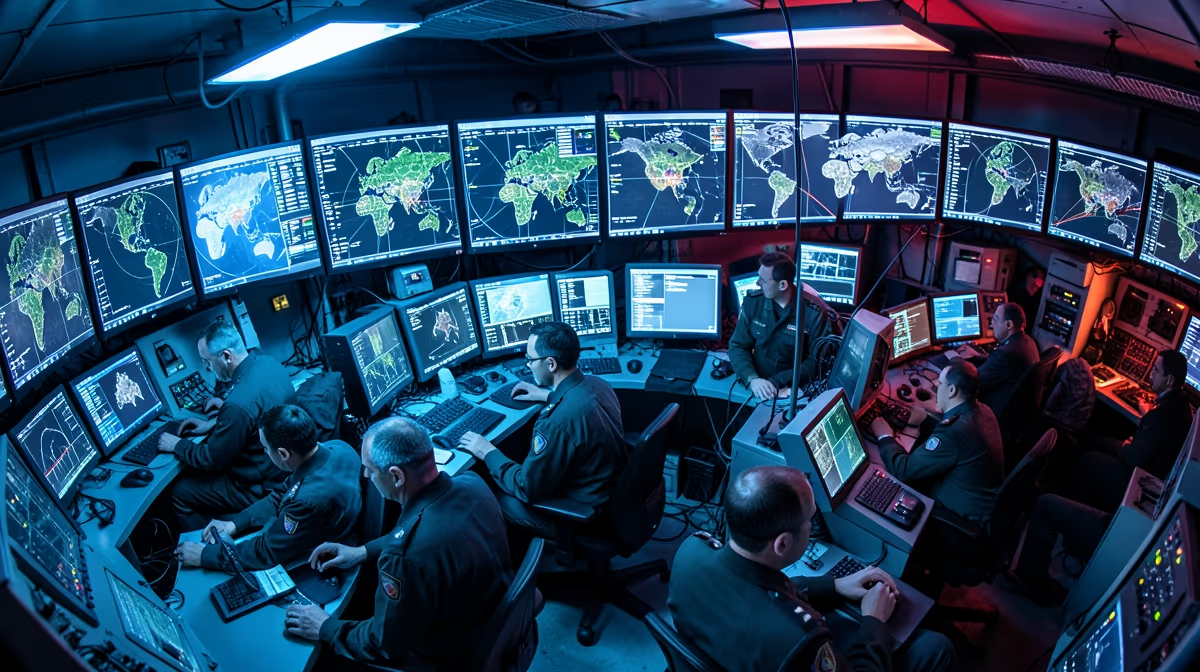
The United States Indo-Pacific Command detected and tracked a suspected ballistic missile launch by North Korea early Tuesday morning local time, marking the latest escalation in regional security tensions. Recent developments regarding north korea have heightened international concern as defense officials analyze telemetry data and monitor ongoing military maneuvers across the Korean Peninsula.
What Unfolded
The launch originated from an inland region of North Korea and traveled eastward before splashing down into the waters between the Korean Peninsula and Japan. U.S. and South Korean intelligence agencies are currently conducting a detailed analysis to determine the exact flight characteristics, range, and missile classification. The projectile landed in waters outside Japan's exclusive economic zone, and the U.S. Indo-Pacific Command tracked the launch in real-time. There are no immediate reports of damage to commercial aircraft or maritime vessels.
In response to the launch, military officials in Washington reaffirmed the United States ironclad defense commitments to South Korea and Japan. The White House National Security Council condemned the action as a violation of multiple United Nations Security Council resolutions and a destabilizing threat to regional stability. Regional allies convened emergency security briefings following the event. Japan's Coast Guard issued immediate navigational warnings to vessels in the area, while South Korea's Joint Chiefs of Staff placed military assets on heightened alert to monitor for any potential follow-up provocations. Pentagon spokesperson Maj. Gen. Pat Ryder stated during a press briefing that officials are consulting closely with regional allies and continuing to monitor the situation very closely, highlighting the unlawful nature of North Korea's weapons programs.
Core Intelligence And Verified Facts
North Korea continues to test banned ballistic missiles despite international sanctions and has accelerated its nuclear weapons program in recent years. The country maintains deep historical roots stemming from the Korean Peninsula division following the 1950s war, evolving into an isolated, authoritarian regime that pursues nuclear capabilities to guarantee its survival. The regime has also deepened its military cooperation with Russia, while diplomatic talks between Washington and Pyongyang remain stalled. The United States maintains a strong military presence in South Korea and Japan to deter potential aggression.
For people in the U.S. and regional partners, these developments require constant diplomacy, intelligence gathering, and military readiness to ensure homeland security and protect allies. The situation matters because the development of nuclear weapons and intercontinental ballistic missiles by an unpredictable regime threatens global peace and could eventually put the U.S. mainland within strike range, forcing American leaders to balance strict deterrence with the risk of military escalation. Those affected include people living in the United States, military service members stationed in East Asia, and citizens of U.S. allies such as South Korea and Japan.
Strategic Analysis
The root cause of these maneuvers lies within the regime's foundational ideology of Juche, which emphasizes self-reliance. Coupled with dynastic survival instincts, the leadership views nuclear capability as the ultimate, non-negotiable insurance policy against foreign-backed regime change. Politically, the Kim dynasty utilizes external threats to manufacture perpetual crisis, consolidating internal loyalty, neutralizing domestic dissent, and justifying pervasive totalitarian control. Economically, decades of severe international sanctions have forced Pyongyang to adapt through cyber warfare, cryptocurrency theft, illicit maritime transfers, and a heavy reliance on covert trade networks with select regional actors.
Geopolitically, the nation acts as a disruptive proxy and strategic wedge in U.S.-China relations, complicating Washington's Indo-Pacific security architecture and accelerating trilateral military cooperation between the United States, Japan, and South Korea. Beneath the surface, internal demographic shifts, including the clandestine consumption of foreign media by the market generation, pose a slower, more insidious threat to the regime than external military pressure. Historically, this dynamic parallels late-Cold War East Germany under Erich Honecker, relying on ideological rigidity and external subsidies to stave off systemic collapse while facing a disillusioned populace.
Future Outlook And Predictions
State media will likely issue rhetoric condemning recent joint U.S.-South Korea military drills over the next 24 hours, while intelligence agencies monitor potential missile test preparations. Over the next 72 hours, diplomatic channels will remain subdued as regional allies coordinate defense responses and intelligence sharing regarding North Korean satellite or missile telemetry. Independent experts predict that Pyongyang will continue incremental provocations below the threshold of direct armed conflict to pressure Washington for sanctions relief. The best-case scenario involves a return to back-channel communications and a temporary pause in missile testing to ease regional tensions, whereas the worst-case scenario entails an unannounced intercontinental ballistic missile test or a localized conventional skirmish along the maritime border.
Frequently Asked Questions
Why is North Korea so isolated from the rest of the world?
North Korea's extreme isolation stems from its official state ideology of Juche, which emphasizes absolute self-reliance and independence. Decades of strict government control over information, travel, and borders have further severed ties with the global community. Additionally, severe international economic sanctions due to its nuclear program have limited diplomatic and trade interactions.
What kind of government does North Korea have?
North Korea is widely characterized as a totalitarian dictatorship led by the Kim dynasty since 1948. The government maintains absolute control over all aspects of citizens' lives, including employment, housing, media, and education. It operates under a unique blend of communist-style state planning and nationalist ideology.
Does North Korea have nuclear weapons?
Yes, North Korea has developed an active nuclear weapons program and has conducted multiple underground nuclear tests since 2006. Despite heavy international condemnation and crippling economic sanctions from the United Nations, the regime views its nuclear arsenal as vital for its national survival and deterrence against the United States.
Can Americans travel to North Korea?
No, the U.S. Department of State enforces a strict geographic travel restriction that invalidates U.S. passports for travel to, in, or through North Korea. This ban was enacted following the tragic detainment and subsequent death of American college student Otto Warmbier in 2017. Violating this restriction can result in criminal penalties and passport revocation.
What is the standard of living like in North Korea?
The standard of living in North Korea is generally very low, with widespread poverty affecting a significant portion of the population. Chronic food shortages, economic mismanagement, and international sanctions have historically led to severe malnutrition and economic hardship. While the elite in Pyongyang enjoy modern amenities, most citizens experience limited access to electricity, healthcare, and consumer goods.
How is the relationship between North and South Korea?
Relations between North and South Korea remain deeply tense and technically remain in a state of war since the Korean War ended in 1953 with an armistice rather than a peace treaty. Periods of brief diplomatic engagement and summits have frequently alternated with heightened military provocations and border clashes. Reunification remains a distant goal, complicated by vast political, economic, and ideological differences.
Conclusion
The verified ballistic missile launch tracked by the United States Indo-Pacific Command underscores ongoing security challenges across the Korean Peninsula. Allied intelligence and defense agencies continue to analyze the telemetry data while maintaining a heightened state of readiness alongside regional partners in Japan and South Korea. Diplomatic channels remain subdued as international monitors track potential follow-up actions and coordinate defense responses in accordance with established strategic protocols.


.webp)
.webp)
