
Quasi Moon 2024 PT5 Discovery Signals a Major Change for Earth Orbit
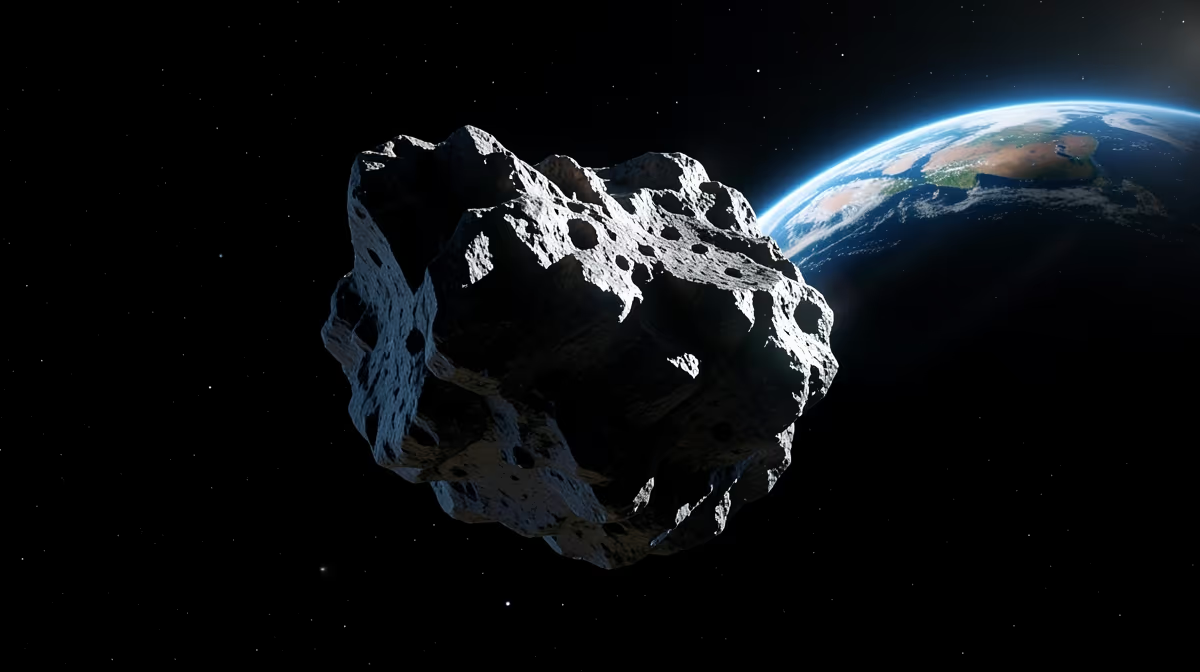
A small near-Earth asteroid designated 2024 PT5 has entered a temporary gravitational capture phase, acting as a mini-moon that offers a rare window into the mechanics of our solar system. This elusive quasi moon began its brief tenure near our planet on September 29, 2024, prompting intense scrutiny from researchers eager to map its unique orbital dance.
Understanding The Celestial Mechanics
At its core, a quasi-moon is an asteroid that travels alongside Earth while orbiting the Sun, rather than being gravitationally bound directly to our planet like the permanent Moon. This cosmic sidekick maintains a stable pattern that makes it appear as though it is tagging along with Earth, though it remains far enough away that it is invisible to the naked eye. These objects are not true satellites but are instead caught in a complex dance defined by orbital resonance.
The phenomenon occurs because the object shares a velocity and trajectory similar to Earth, allowing it to become temporarily captured by our gravitational influence before eventually breaking free. While these cosmic companions are common in space, catching one in such a stable, long-term pattern is a significant event for astronomers. They are typically rocky, faint, and temporary, often drifting away after centuries or millennia of synchronized travel.
The Discovery Of 2024 PT5
The object was first identified in early August by the Asteroid Terrestrial-impact Last Alert System, or ATLAS. Measuring approximately 37 feet in diameter, 2024 PT5 is currently performing a horseshoe-shaped trajectory that keeps it within Earth's reach for a finite window. Unlike typical near-Earth objects that might pose a collision threat, 2024 PT5 is confirmed to be on a path that ensures it will depart our gravitational influence in late November to return to a standard heliocentric orbit.
Dr. Carlos de la Fuente Marcos, lead author of a study published in the Research Notes of the AAS, suggests that the object is likely a piece of lunar ejecta resulting from a past impact on the Moon. While researchers are still analyzing data to determine if the object is natural lunar material or man-made space debris, it remains a valuable target for studying the behavior of near-Earth objects.
Strategic Implications And Resource Utilization
The identification of such objects forces a transition from purely academic monitoring to a more strategic assessment of transient bodies. The root cause of this focus lies in the intersection of celestial mechanics and the growing need for In-Situ Resource Utilization in the cislunar domain. As space-faring nations move toward infrastructure development, these transient objects are increasingly viewed as potential staging nodes or mineral banks.
There is a burgeoning political and economic dimension to these discoveries. The regulatory landscape currently faces a vacuum regarding property rights for sub-lunar bodies, with the 1967 Outer Space Treaty proving increasingly difficult to apply to modern resource extraction. Economically, the shift is moving from government-funded exploration toward private-sector initiatives aimed at identifying water ice and rare metals. Control over these orbital transit corridors acts as a force multiplier for major powers, effectively turning gravity wells into strategic assets.
Expert Predictions And Public Perception
In the immediate future, amateur astronomers are expected to drive significant social media interest as they attempt to track the object during its geocentric capture phase. Within the next 72 hours, mainstream media coverage is likely to peak as NASA's Jet Propulsion Laboratory confirms the trajectory details and clarifies the status of the mini-moon.
Experts suggest that while the object will remain a point of public fascination, it is scientifically low-risk and serves primarily as an educational tool for demonstrating orbital mechanics. The best-case outcome of this event is a surge in STEM interest and potentially increased funding for asteroid tracking programs. Conversely, there is a risk that misinformation regarding the nature of the object could spark unnecessary public panic or unfounded conspiracy theories. To maintain clarity, it is essential to emphasize that these objects do not pose a collision threat to Earth.
The Bigger Picture Of Planetary Defense
Tracking near-Earth objects is a vital component of modern planetary defense strategy. By studying the composition and paths of quasi-moons, scientists gain critical data on how asteroids behave in our solar system. This information is essential for improving our detection and monitoring capabilities for more threatening objects. These companions provide a controlled environment to practice the techniques that will be required if a more dangerous near-Earth object is ever identified. As we continue to refine our ability to predict the movements of these celestial neighbors, we effectively build a safer future for global space operations.
Frequently Asked Questions
What is a quasi-moon?
A quasi-moon, or quasi-satellite, is an object that orbits the Sun while appearing to orbit the Earth from our perspective. Unlike the Moon, it is not gravitationally bound to Earth and follows its own path around the Sun.
How is a quasi-moon different from our real Moon?
The primary difference is the orbital relationship. While the Moon is held in a stable orbit by Earth's gravity, a quasi-moon orbits the Sun and only stays near Earth because their orbital periods are synchronized. They eventually drift away after centuries or millennia.
Are there any known quasi-moons of Earth?
Yes, several objects have been identified as quasi-moons of Earth, with Kamoʻoalewa being the most prominent example. Other asteroids, such as 2014 OL339 and 2016 HO3, have also exhibited these unique orbital characteristics.
Is a quasi-moon dangerous to Earth?
No, quasi-moons do not pose a direct threat to Earth. These objects remain at very large distances from our planet, often millions of miles away, and their orbital patterns ensure they do not collide with Earth.
Do quasi-moons orbit Earth permanently?
No, quasi-moons are temporary companions. Due to the gravitational influences of the Sun and other planets, their orbital resonances eventually shift, causing them to move away and cease their quasi-satellite relationship with Earth.
Can you see a quasi-moon with the naked eye?
It is not possible to see a quasi-moon with the naked eye because they are typically small asteroids located at vast distances. Observing them requires powerful professional-grade telescopes and long-exposure imaging to track their faint light against the background stars.
Conclusion
The discovery of 2024 PT5 confirms the presence of temporary, non-threatening companions that offer unique insights into our solar system. While this object will depart our vicinity in late November, the scientific focus on such bodies will remain a priority for space agencies and researchers worldwide. Monitoring efforts will continue to refine our understanding of these orbital mechanics, ensuring that our planetary defense strategies evolve alongside our growing presence in the cislunar environment. The event stands as a reminder of the dynamic nature of our cosmic neighborhood and the importance of continued observation.


.webp)

.webp)
