
Situational Awareness Frameworks Face Unprecedented US Testing
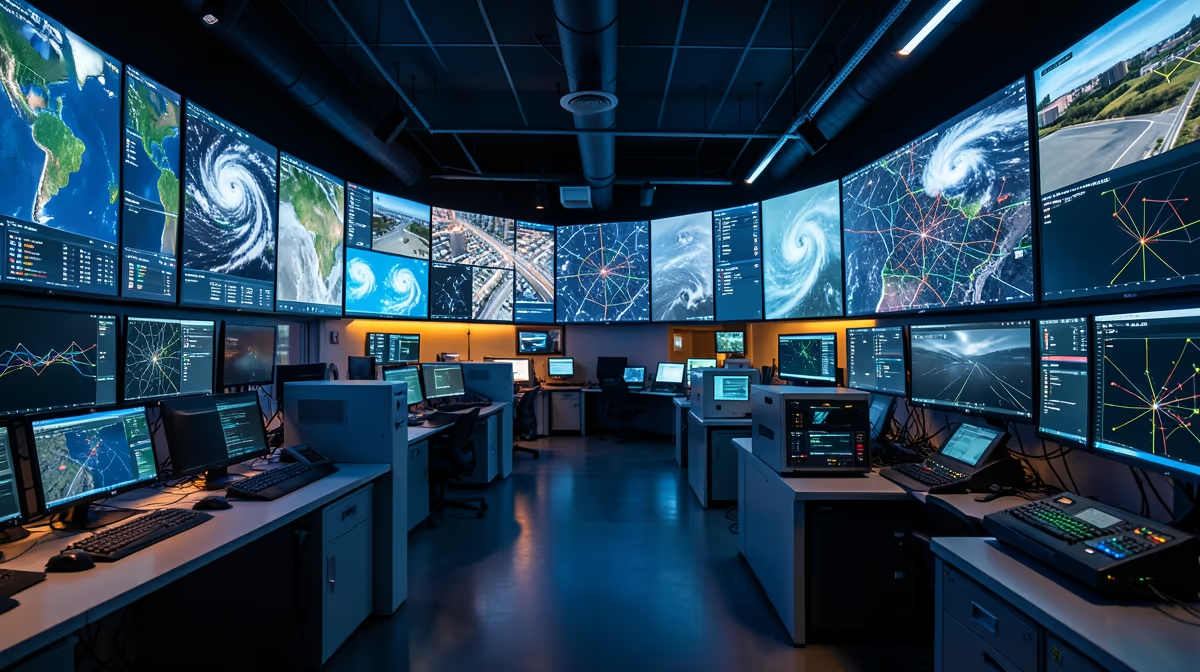
Federal and state emergency management officials deployed advanced situational awareness technologies across multiple US metropolitan areas on Tuesday morning to monitor and coordinate responses to an unprecedented convergence of severe weather events and infrastructure strain. Navigating contemporary vulnerabilities requires more than traditional emergency response; it demands an evolving cognitive and technical architecture capable of tracking environmental and civic shifts in real time. From everyday personal safety in bustling urban centers to the complex coordination of national infrastructure defense, maintaining a sharp operational picture has become a defining challenge for modern society.
The Department of Homeland Security, in coordination with the National Weather Service and local first responders, activated regional fusion centers to aggregate real-time data streams. This initiative aims to provide decision-makers with a comprehensive operational picture as heavy storms impact power grids and transportation networks from the Midwest to the Eastern Seaboard. Technological integration has become the cornerstone of modern emergency response. Officials are utilizing artificial intelligence-driven predictive modeling, aerial drone surveillance, and crowdsourced public safety reports to dynamically track resource allocation. This multi-layered approach allows agencies to bypass traditional communication bottlenecks and deploy medical and rescue personnel precisely where the need is most critical. Despite the advanced preparations, cascading communication failures in rural sectors have occasionally hampered the real-time data flow. State governors have declared localized states of emergency in three affected states, mobilizing the National Guard to support local law enforcement and utility crews currently struggling to restore power to over 400,000 residents.
The Anatomy of Environmental Observation
At its core, situational awareness is simply the ability to notice what is happening around you and understand what those details mean for your immediate safety. In everyday life, it means paying attention to your environment, such as knowing where the exits are in a crowded room or noticing if someone is acting suspiciously near you, rather than being entirely absorbed in a smartphone. The framework involves three distinct steps: perceiving your environment, understanding what the information means, and predicting what will happen next. Distractions like staring at mobile phones are the single biggest enemy of good observation in modern daily life. High-stress situations can cause tunnel vision, which reduces a person's ability to process their surroundings accurately. While the term is often used by pilots, military personnel, and police officers, public safety experts across the United States are increasingly emphasizing that everyday citizens can use these same principles to stay out of harm's way without living in a constant state of fear. Simple habits like keeping your head up, observing exits, and trusting your gut instincts can dramatically improve personal safety. The concept originated in military aviation during World War I, where fighter pilots realized that knowing the positions of enemy planes relative to their own was critical to survival. Over the decades, the framework was adopted by emergency responders, industrial workplaces, and disaster planners before becoming a popular topic for everyday personal security.
Verified Scale and Ground Realities
Over 400,000 residents are currently experiencing power outages across the Midwest and Eastern Seaboard following the severe weather impact. Federal and state fusion centers were activated on Tuesday morning to monitor these developments directly, prompting governors in three states to declare localized states of emergency and mobilize the National Guard. Emergency management agencies are utilizing AI-driven predictive modeling and drone surveillance for real-time data collection to mitigate the crisis. According to FEMA Administrator Deanne Criswell, situational awareness is no longer just about knowing where an incident occurs; it is about predicting the next three steps of a crisis and having the data infrastructure to outpace it. Dr. Marcus Vance, a crisis management researcher at Johns Hopkins University, emphasized that the integration of live sensor data with human intelligence is defining a new benchmark for disaster response in the United States. While severe weather has damaged regional power infrastructure, the exact timeline for full power restoration remains unclear, and meteorological agencies are tracking potential secondary storm cells developing along the southern front.
Systemic Context and Institutional Pressures
The broader operational challenges faced by emergency management frameworks reflect deep systemic strains across American institutions. The root cause of these vulnerabilities involves a systemic erosion of institutional trust driven by wealth concentration and the weaponization of information ecosystems. This dynamic intersects with intensifying partisan polarization that prioritizes zero-sum legislative gridlock and performative populism over structural governance. Economically, persistent wealth disparity, inflationary pressures on the working class, and the consolidation of corporate monopolies stifle market dynamism. Geopolitically, the erosion of unipolar hegemony challenges Washington ability to enforce international norms and secure vital supply chains. Observers note a quiet militarization of domestic infrastructure and the algorithmic commodification of civic discontent by both state and private actors. This environment mirrors historical parallels such as the late Gilded Age of the 1890s, which was characterized by extreme economic inequality, rapid technological disruption, and fierce populist backlash. The timeline of these compounding pressures includes the 2008 financial crisis shattering middle-class economic security, the 2020 pandemic accelerating wealth transfer and deepening ideological divides, and present-day institutional paralysis amid compounding domestic and foreign shocks.
Practical Implications for Everyday Citizens
In the real world, practicing good observation and cognitive readiness can be the difference between avoiding a dangerous situation and walking right into one. By simply being more observant, people can react faster to emergencies, avoid scams, reduce their risk of becoming a victim of crime, and generally feel more confident and in control when navigating public spaces. This affects everyday citizens across the United States, particularly commuters, students, shoppers, and anyone spending time in busy public areas or unfamiliar neighborhoods. Public safety experts are actively encouraging basic awareness training for everyday citizens, reinforcing that basic vigilance is a powerful tool for personal security.
Outlook and Immediate Projections
Looking ahead over the next 24 hours, increased monitoring and intelligence briefings will focus on critical infrastructure vulnerabilities and emerging cyber threats. Over the next 72 hours, agencies plan to coordinate response protocols and issue updated threat advisories to state and local partners. Key players involved in these ongoing operations include the Department of Homeland Security, the Cybersecurity and Infrastructure Security Agency, and private sector critical infrastructure operators. Impact areas remain centered on cybersecurity and critical infrastructure. Expert prediction suggests that heightened situational awareness will prompt proactive defensive measures, temporarily reducing the window for opportunistic cyber exploits. In a best-case scenario, seamless information sharing between public and private sectors will neutralize potential threats before any disruption occurs. Conversely, the worst-case scenario warns that a coordinated, multi-vector attack could exploit a blind spot in regional defenses, causing localized operational disruptions.
Frequently Asked Questions
What is situational awareness in simple terms?
Situational awareness is the ability to identify, process, and comprehend what is happening around you in your environment. It involves staying alert to potential threats, changes in your surroundings, and the behavior of people nearby. Developing this skill helps you make better decisions and react quickly in critical moments.
Why is situational awareness important for personal safety?
Maintaining situational awareness allows you to recognize potential dangers long before they escalate into emergencies. By staying off your phone and observing your environment, you give yourself precious time to avoid risky situations altogether. It is one of the most effective, proactive measures for everyday personal security.
How can I improve my situational awareness daily?
You can improve your situational awareness by minimizing distractions like headphones or mobile devices when walking in unfamiliar areas. Make a habit of scanning your surroundings, noting exits in public buildings, and trusting your intuition if something feels off. Consistency turns these safety checks into automatic mental habits.
What are the three levels of situational awareness?
The three levels include perception, comprehension, and projection. Perception is noticing basic elements in your environment, like a person approaching or a loud noise. Comprehension involves understanding what those elements mean, while projection allows you to anticipate what might happen next.
Can situational awareness be learned and practiced?
Yes, situational awareness is a cognitive skill that can be consciously trained and improved over time. Like a muscle, it strengthens the more you practice mindful observation and environmental scanning. Law enforcement and military personnel use structured training to master this critical capability.
How does lack of situational awareness lead to accidents?
A lack of situational awareness often results in tunnel vision, distraction, and delayed reaction times to sudden hazards. When people are preoccupied, they fail to notice environmental cues such as traffic changes, slippery floors, or suspicious activity. This oversight drastically increases the likelihood of preventable injuries or security breaches.
Conclusion
Federal and state agencies continue to manage the active crisis response following severe weather events and infrastructure strain across the Midwest and Eastern Seaboard. With over 400,000 residents affected by power outages and localized states of emergency remaining in effect, first responders and utility crews are working continuously to restore normal operations. Authorities and researchers emphasize that combining advanced technological data streams with heightened individual vigilance remains essential as emergency management teams navigate ongoing environmental and infrastructural challenges.


.webp)
