.webp)
T-Mobile Outage Hits Millions Across US As Phones Suddenly Drop To SOS
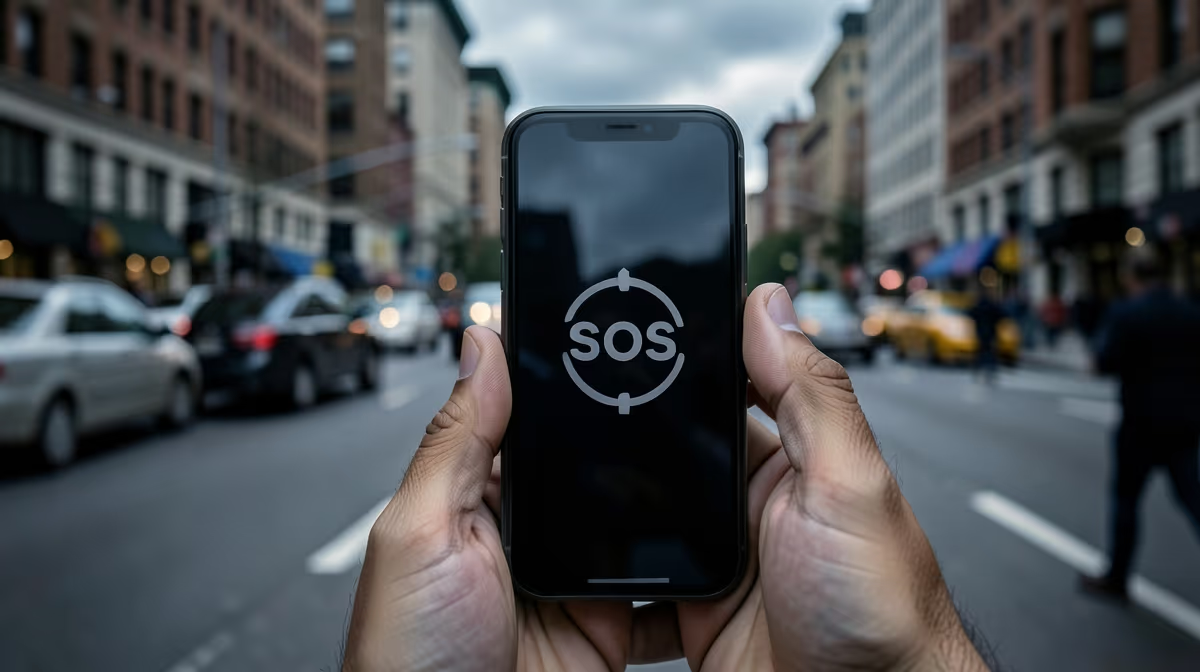
If you are experiencing a tmobile outage today, you are not alone as thousands of users report sudden connection drops. T-Mobile experienced a widespread cellular and data outage across multiple major metropolitan areas in the United States on Wednesday, leaving millions of subscribers unable to make calls, send text messages, or access the internet. The sudden loss of connectivity has left many users frustrated as their devices show no service or fail to load websites. Tech support teams and engineers have acknowledged the issue and are actively working to find the root cause and restore normal operations, though a definitive timeline for when full service will return has not yet been provided.
What Unfolded
The disruption began early Wednesday morning, triggering a surge of complaints on tracking websites like Downdetector, where reports peaked in cities including New York, Los Angeles, Chicago, and Dallas. Users reported complete losses of service, with many devices stuck displaying No Service or emergency-only status. Emergency services in several jurisdictions issued public advisories warning residents that if they experienced issues calling 911 from their T-Mobile devices, they should try using a landline, a device on another network, or attempt to restart their phones. The outage also impacted various business operations, point-of-sale systems, and rideshare drivers who rely on the carrier network for connectivity. By Wednesday afternoon, T-Mobile engineers began reporting progress in restoring services, attributing the disruption to an internal network issue rather than a malicious cyberattack. The company issued statements via social media apologizing for the inconvenience and assuring customers that technical teams were working around the clock to bring all affected towers and routing systems back online.
Key Facts
Thousands of outage reports surfaced suddenly on tracking websites like Downdetector. Both voice calls and mobile data services are failing for many users. The issue appears to be nationwide rather than limited to a single state or city. T-Mobile customer support teams are addressing complaints on social media. Emergency services in some areas may be difficult to reach via mobile phone. T-Mobile subscribers across the United States are affected, as well as customers using smaller virtual network operators that piggyback on T-Mobile cellular towers, such as Mint Mobile and Metro by T-Mobile. Major telecommunications companies rely on vast, complex networks of cell towers and software routing systems that occasionally suffer from software glitches, hardware failures, or cyber incidents, leading to unexpected nationwide disruptions.
Why This Matters
In today hyper-connected world, losing mobile service instantly disrupts daily life, preventing people from working remotely, navigating via GPS, communicating with family members, or handling essential business transactions. More critically, sudden network failures can prevent individuals from calling 911 during an emergency, posing serious safety risks. Immediate productivity losses across dependent supply chains, temporary stock volatility, and long-term capital expenditure reallocation toward infrastructure hardening rather than shareholder returns represent a significant economic toll. Heightened vulnerability of domestic supply chains and critical infrastructure to systemic IT failures also draws concerns regarding national security.
Analyst View
Analysts trace the root cause to legacy core network integration failures compounded by aggressive automation rollouts and reduced redundancy in critical routing nodes following major mergers. This technological vulnerability intersects with increased bipartisan scrutiny on telecommunications monopolies, prompting calls from federal regulators for stricter resilience mandates and potential fines for critical infrastructure failures. Historical parallels can be drawn to the 2003 Northeast blackout, which similarly exposed how tightly coupled automation and a lack of regional isolation can transform a localized glitch into a widespread systemic crisis. Analysts predict temporary reputational damage and increased scrutiny on carrier redundancy, but minimal long-term subscriber churn due to the industry-wide nature of occasional outages.
What Comes Next
T-Mobile engineering teams will fully restore core network services, issue a formal root-cause analysis statement, and provide details on customer credit or compensation. Network traffic will stabilize completely, regulatory inquiries from the Federal Communications Commission will begin regarding network resilience, and customer support will handle a surge in billing credit requests. In the best case, full service is restored within hours with zero impact on emergency services, and T-Mobile proactively issues generous service credits to retain customer loyalty. In the worst case, prolonged cascading failures affect critical infrastructure and emergency services, triggering heavy fines and a wave of customer defections to competitors.
Frequently Asked Questions
Is T-Mobile currently experiencing an outage in the US?
To check if T-Mobile is currently down, you can visit real-time outage tracking websites like Downdetector or check official social media channels. T-Mobile usually provides updates and estimated resolution times through their official support accounts when widespread issues occur. You can also test your connection by restarting your device or toggling airplane mode.
How can I check for a T-Mobile outage in my area?
The fastest way to check for local service disruptions is by using the T-Mobile app or logging into your account on their website. You can also check independent outage maps that aggregate user reports across the United States. Calling T-Mobile support from a landline or another working phone is another option to get localized status updates.
What should I do if my T-Mobile service is not working?
If your T-Mobile service is down, start by restarting your smartphone to force it to reconnect to the nearest cell tower. You should also check for any pending carrier settings updates or remove and reinsert your SIM card. If the issue persists, connect to Wi-Fi to check for service announcements from the carrier.
Does T-Mobile compensate customers for network outages?
T-Mobile generally does not offer automatic bill credits for brief or minor network outages. However, for extended disruptions that last a significant amount of time, customers can sometimes request compensation by contacting customer service. Relief is typically evaluated on a case-by-case basis depending on the severity and duration of the outage.
Why is my T-Mobile data working but I cannot make calls?
If your data works but calls fail, the issue might be related to Voice over LTE or local tower routing issues. Try toggling your mobile data off and on again, or disable 5G temporarily to see if calls route through the 4G network. Restarting your phone often resolves this specific registration glitch.
How do I report a T-Mobile network outage?
You can report a service disruption directly to T-Mobile by reaching out to their support team via Twitter or Facebook. Alternatively, you can call 611 from a T-Mobile phone or use a landline to reach customer service. Reporting the issue helps their engineering team identify localized tower failures more quickly.
Conclusion
The widespread T-Mobile network outage exposed significant vulnerabilities in nationwide cellular infrastructure, impacting millions of subscribers, business operations, and emergency communications across multiple major metropolitan areas. While technical teams worked around the clock to restore voice and data services, the incident prompted immediate scrutiny from regulators and highlighted the critical societal reliance on stable mobile networks. As engineering teams finalize network recovery and regulatory inquiries begin, subscribers affected by the disruption can monitor official updates and explore support options for service credits as network operations return to full capacity.


.webp)
.webp)
