
BrahMos Missile Extended-Range Tests Signal Major Shift in Defense
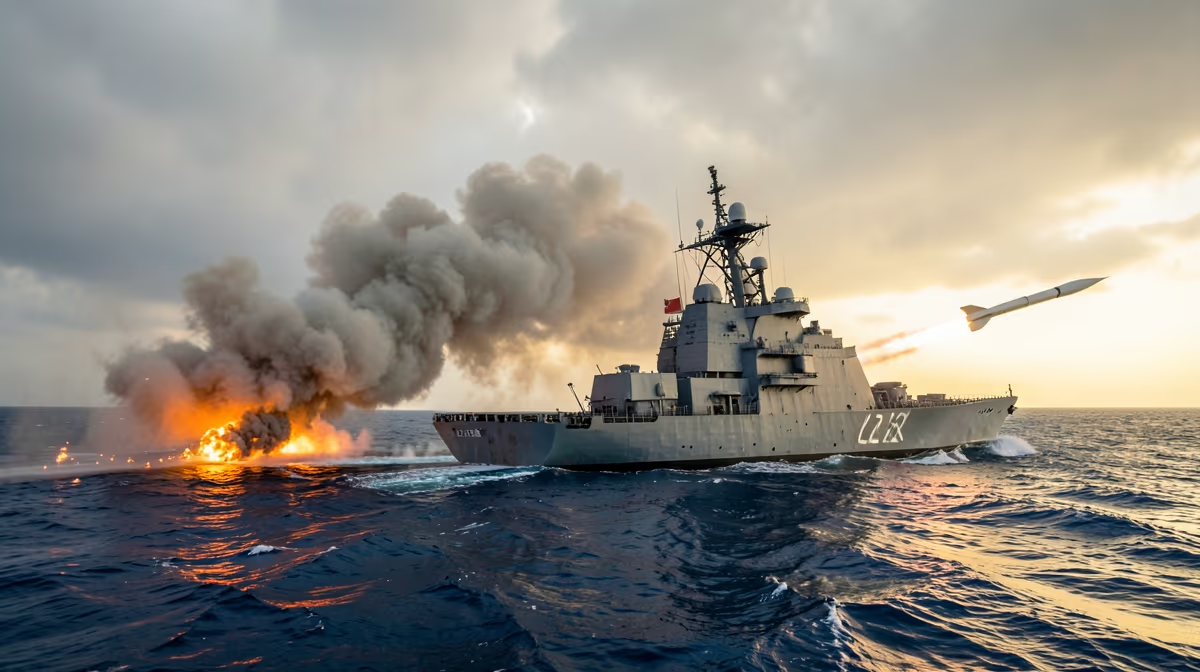
The supersonic flight trajectories cutting across the Bay of Bengal carry profound strategic weight for a nation transforming from a major arms importer into a trusted global defense exporter. Stay updated with the latest news on the brahmos missile and its strategic impact on global defense as new operational milestones reshape naval strike capabilities across the Indo-Pacific.
India successfully test-extended an extended-range version of the brahmos supersonic cruise missile from a naval warship in the Bay of Bengal on Tuesday, significantly bolstering the nation's maritime strike capabilities amidst evolving regional security dynamics. The latest trial achieved all mission objectives, successfully hitting a designated target with pinpoint accuracy after traversing an extended trajectory. Developed jointly by India's Defence Research and Development Organisation and Russia's NPO Mashinostroyeniya, the system remains one of the world's fastest operational tactical cruise missiles.
Defense analysts note that this test highlights the ongoing indigenous upgradation of military hardware, pushing the operational range beyond its initial 290-kilometer limit while adhering to international technological guidelines. The enhanced capability allows the Indian Navy to project power further across the Indo-Pacific region, engaging both land and sea targets from standoff distances. Officials from the Ministry of Defence confirmed that serial production of the extended-range variants is progressing smoothly to meet the requirements of all three branches of the Indian Armed Forces. Several friendly foreign nations have also expressed formal interest in procuring the system following its proven combat readiness and high reliability. The successful flight test marks a major milestone in the quest for self-reliance in advanced defense technologies and demonstrates naval preparedness, as stated by a senior Ministry of Defence spokesperson under the condition of anonymity.
Background Context And Evolution
The technological interdependence and joint-venture necessity stemming from Soviet-era defense cooperation laid the foundation for what evolved into a self-reliant indigenous missile development imperative for New Delhi. The program began in the late 1990s as a partnership between India and Russia to create high-speed, precision-guided cruise missiles, serving as a Cold War-era military-technical cooperation framework that bypassed Western export controls. Over the years, the technology has been continuously upgraded, resulting in extended ranges and lighter variants designed specifically for aircraft like the Indian Air Force Sukhoi-30MKI fighters.
The historical timeline underscores this steady progression, beginning with the 1998 inter-governmental agreement signed between India and Russia to form BrahMos Aerospace. This was followed by the first successful test flight in 2001 and the eventual induction into the Indian Navy in 2007, followed by subsequent Army integration. A historic turning point arrived in 2022 with a 374.9 million dollar export contract signed with the Philippines, marking India's arrival as a major defense exporter. Today, the focus centers on the expansion of extended-range variants, hypersonic research integration, and the pursuit of new export markets in Southeast Asia, Latin America, and the Middle East.
System Capabilities And Technical Specifications
As a versatile multi-platform weapon system, the missile can be successfully deployed and launched from land-based mobile launchers, warships, submarines, and fighter jets. It is a supersonic cruise missile capable of reaching speeds up to Mach 3, specifically traveling between Mach 2.8 and Mach 3.0, which is nearly three times the speed of sound. This extreme velocity makes it exceptionally difficult for enemy air defense systems to intercept.
The name itself is a portmanteau formed from the names of two major rivers: the Brahmaputra river in India and the Moskva river in Russia, symbolizing the joint military and technological collaboration between the two nations. While the original version had a range of 290 kilometers in compliance with Missile Technology Control Regime restrictions at the time, India's subsequent membership in the regime facilitated the successful development and testing of extended-range variants capable of hitting targets up to 450 to 800 kilometers.
Strategic Importance And Geopolitical Realities
The deployment of these advanced systems serves as a potent symbol of national pride and regime strength for New Delhi, while projecting deterrence capability against regional adversaries without direct Western entanglements. Geopolitically, it alters the naval and land-based balance of power in the Indo-Pacific and Southeast Asia, positioning India as a net security provider and reliable arms supplier to nations counterbalancing China.
The security assessment highlights how the Indian Armed Forces benefit from enhanced tactical capabilities, while domestic defense manufacturers gain economic growth. Neighboring regions and rival nations closely monitor its deployment due to its strategic military impact. At the same time, international buyers gain access to advanced defense technology. Behind these visible milestones lies an intricate web of dual-use component sourcing and intellectual property bottlenecks that subtly bind Russian supply chains to Indian strategic autonomy, despite ongoing diversification efforts.
Economic Impact And Export Markets
High-value defense exports act as a catalyst for the Make in India initiative, creating a specialized defense-industrial complex and generating foreign exchange through allied acquisitions. Exporting the missile helps India build stronger strategic alliances in the Indo-Pacific region and generates revenue to support domestic manufacturing. The Philippines stands as the first international customer, having signed a major defense deal to acquire shore-based anti-ship missile systems for its navy. Officials continue discussions with other friendly foreign nations interested in procuring the defense system following its proven combat readiness.
Future Outlook And Near-Term Projections
Defense analysts and media will likely discuss routine deployment updates and strategic deterrence involving these missile systems following recent geopolitical statements over the next 24 hours. Moving into the next 72 hours, diplomatic engagements or defense export discussions regarding the supersonic cruise missile system may see policy-level reviews or bilateral talks.
Expert predictions emphasize a continuous focus on indigenous defense production and the potential finalization of pending export interests from friendly nations. The best-case scenario involves the successful conclusion of new international export deals, boosting the defense manufacturing sector. Conversely, the worst-case scenario points to potential supply chain bottlenecks or geopolitical friction causing delays in planned international deliveries.
Frequently Asked Questions
What is BrahMos and why is it famous?
BrahMos is a supersonic cruise missile jointly developed by India and Russia. It is renowned for being one of the fastest anti-ship and land-attack cruise missiles currently operational in the world.
What is the top speed of the BrahMos missile?
The BrahMos missile travels at speeds of Mach 2.8 to Mach 3.0, which is nearly three times the speed of sound. This high velocity makes it extremely difficult for enemy air defense systems to intercept.
Can BrahMos be launched from submarines, ships, aircraft, and land?
Yes, BrahMos is a versatile multi-platform weapon system. It can be successfully deployed and launched from land-based mobile launchers, warships, submarines, and fighter jets like the Indian Air Force Sukhoi-30MKI.
What does the name BrahMos stand for?
The name BrahMos is a portmanteau formed from the names of two major rivers: the Brahmaputra river in India and the Moskva river in Russia. This symbolizes the joint military and technological collaboration between the two nations.
What is the range of the BrahMos missile?
The original version of the BrahMos missile had a range of 290 kilometers in compliance with MTCR restrictions at the time. With India now a member of the MTCR, extended-range variants capable of hitting targets up to 450 to 800 kilometers have been successfully developed and tested.
Which countries buy BrahMos from India?
India actively exports the BrahMos supersonic cruise missile to friendly nations. The Philippines is the first international customer, having signed a major defense deal to acquire shore-based anti-ship missile systems for its navy.
Conclusion
Recent developments confirm the successful test-firing of an extended-range BrahMos supersonic cruise missile from a naval warship in the Bay of Bengal, validating ongoing technological advancements and serial production efforts by the Ministry of Defence and BrahMos Aerospace. As the Indian Armed Forces integrate these capabilities across multiple platforms, defense manufacturing and export initiatives under the Make in India framework continue to progress. Realistic next steps involve ongoing diplomatic engagements, policy reviews regarding international defense exports, and the potential finalization of pending procurement agreements with friendly foreign nations.


.webp)
