
China reusable rocket technology hits a major milestone that changes space
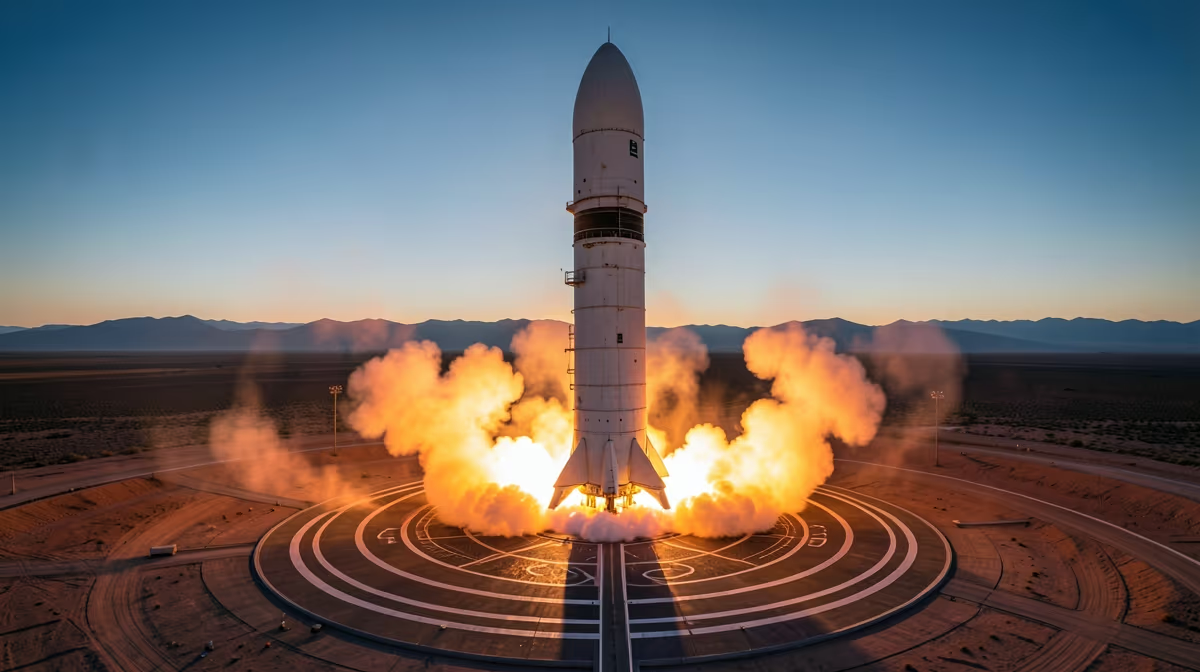
In a major milestone for global aerospace, China reusable rocket booster technology has taken a massive leap forward as LandSpace successfully tests its latest vertical landing capabilities. Chinese private aerospace company LandSpace has successfully landed a rocket booster utilizing reusable technology, marking a major milestone that places the company alongside global industry leaders like SpaceX and Blue Origin.
How LandSpace Achieved the Reusable Booster Milestone
The commercialization of space launch capabilities and the urgent necessity to drastically reduce payload delivery costs through vertical landing reusable rocket technology have driven this achievement. Space exploration has taken a major step forward as Chinese aerospace company LandSpace successfully landed a rocket booster utilizing reusable technology. This achievement marks a significant milestone for the commercial space industry, bringing China into an elite group of nations with proven rocket-landing capabilities.
Until recently, only pioneering private companies like SpaceX and Blue Origin had mastered the complex engineering required to bring orbital rocket boosters safely back to Earth for future flights. By successfully demonstrating this technology, LandSpace is paving the way for significantly reduced costs in launching payloads into space.
The achievement represents a significant leap forward for China's commercial space sector, demonstrating advanced vertical takeoff and vertical landing capabilities previously dominated by a handful of Western aerospace firms. Reusability is widely considered the holy grail of modern rocketry, dramatically lowering the financial barrier to orbit by reducing hardware waste and manufacturing lead times. As global launch cadence accelerates—evidenced by players like SpaceX hitting milestone flight frequencies—domestic Chinese firms are racing to develop competitive, cost-effective reusable architectures. This successful booster recovery sets the stage for LandSpace to scale up its flight manifest and challenge traditional state-backed models. Industry observers note that mastering this technology is a critical prerequisite for sustainable heavy-lift operations and future interplanetary endeavors.
Implications for the Global Space Race Against SpaceX
National prestige and state-backed technological competition have driven Chinese private aerospace firms like LandSpace to match milestones previously achieved only by American giants like SpaceX and Blue Origin. Achieving booster reusability drastically lowers the marginal cost per kilogram to orbit, threatening traditional expendable launch models and reshaping the global commercial satellite deployment market.
The emergence of multiple viable reusable rocket programs outside the United States signals a multi-polar space race, reducing Western dominance in critical space infrastructure and Earth observation access. Beyond commercial viability, mastering propulsive landing technology provides domestic aerospace supply chains with dual-use guidance and control capabilities applicable to advanced long-range atmospheric maneuvering systems. This historical parallel echoes the post-WWII space race between the US and the Soviet Union, transitioning from state-monopoly programs to commercialized aerospace dominance.
Key Developments in the Commercial Launch Sector
- LandSpace has successfully landed a rocket booster using reusable technology.
- The achievement joins LandSpace with companies like SpaceX and Blue Origin in the reusable rocket market.
- SpaceX recently launched its 100th mission of the year, deploying Starlink satellites.
- SpaceX's Starship was recently towed into port after a 24-day journey at sea.
- NASA imagery has previously documented craters carved by rocket hardware impacting the moon.
The broader aerospace landscape continues to evolve rapidly alongside these technological strides. While LandSpace secures its breakthrough, established players maintain an aggressive operational tempo. SpaceX recently reached its 100th mission of the year while sending Starlink satellites to orbit, and separately managed to tug its Starship into port following a 24-day journey at sea. Concurrently, NASA imagery analysis—such as Lunar Reconnaissance Orbiter documentation of the Falcon 9 booster crater on the moon—continues to highlight the tangible physical footprint of orbital launch activities.
Why Reusable Technology Matters
The ability to land and reuse rocket boosters drastically lowers the cost of launching satellites and spacecraft into orbit. As more companies and space agencies master this technology, access to space becomes more affordable and frequent, accelerating global advancements in telecommunications, Earth observation, and scientific research.
For decades, orbital rockets were designed to be completely expendable, meaning multi-million-dollar boosters burned up or crashed into the ocean after a single use. The commercial space sector revolutionized the industry by developing vertical landing techniques to recover these expensive components, dramatically changing the economics of spaceflight. Global satellite operators, commercial space companies, aerospace engineers, and telecommunications industries that rely on frequent and affordable access to orbit are directly affected by this shift.
Analyst View and Future Outlook
Industry analysts and space enthusiasts will continue analyzing the technical details of LandSpace's successful rocket booster landing, comparing its milestone achievement with established reusable launch providers like SpaceX and Blue Origin. Discussions may emerge regarding how China's growing commercial space capabilities and reusable rocket technology advancements could influence global launch markets and national space programs.
Analysts would likely expect that LandSpace's entry into the reusable booster club will accelerate competition in the commercial launch sector, prompting other international aerospace firms to expedite their own reusable technology roadmaps. In the best-case scenario, LandSpace successfully scales its reusable booster technology, driving down launch costs and fostering increased international competition and innovation in sustainable space exploration. Conversely, the worst-case scenario suggests that subsequent testing could reveal unforeseen structural or operational challenges in the recovered hardware, slowing down LandSpace's timeline and highlighting the persistent engineering difficulties of rocket reusability.
LandSpace's successful vertical landing marks a pivotal turning point, bringing China into an elite reusable rocket club alongside SpaceX and Blue Origin and fundamentally altering global commercial space economics.
Conclusion
The successful rocket booster landing executed by LandSpace marks a transformative development for global commercial spaceflight, successfully bridging a critical technological gap previously dominated by Western aerospace leaders like SpaceX and Blue Origin. By validating its reusable technology through vertical landing capabilities, LandSpace has positioned itself as a major competitor in the international aerospace market. Industry analysts, aerospace engineers, and global stakeholders will closely observe how LandSpace transitions this milestone into commercial launch cadence, while established providers continue scaling their own operational manifests across the global space sector.
Sources
- Before-and-after NASA images show crater carved by a SpaceX rocket that slammed into the moon — apnews.com
- SpaceX launches its 100th mission of the year, sends Starlink satellites to orbit — Space
- China's LandSpace lands rocket booster; joins SpaceX, Blue Origin with reusable tech — Reuters
- Against all odds, SpaceX finally tugs Starship into port after 24 days at sea — arstechnica.com
- Live coverage: SpaceX to send Starlink satellites to orbit with Tuesday night launch from California — Spaceflight Now
- NASA’s LRO Images Falcon 9 Crater on Moon, Learns New Details — NASA Science (.gov)


.webp)
