
Falcon 9 Lunar Impact Exposes Hidden Dangers in Deep Space Traffic
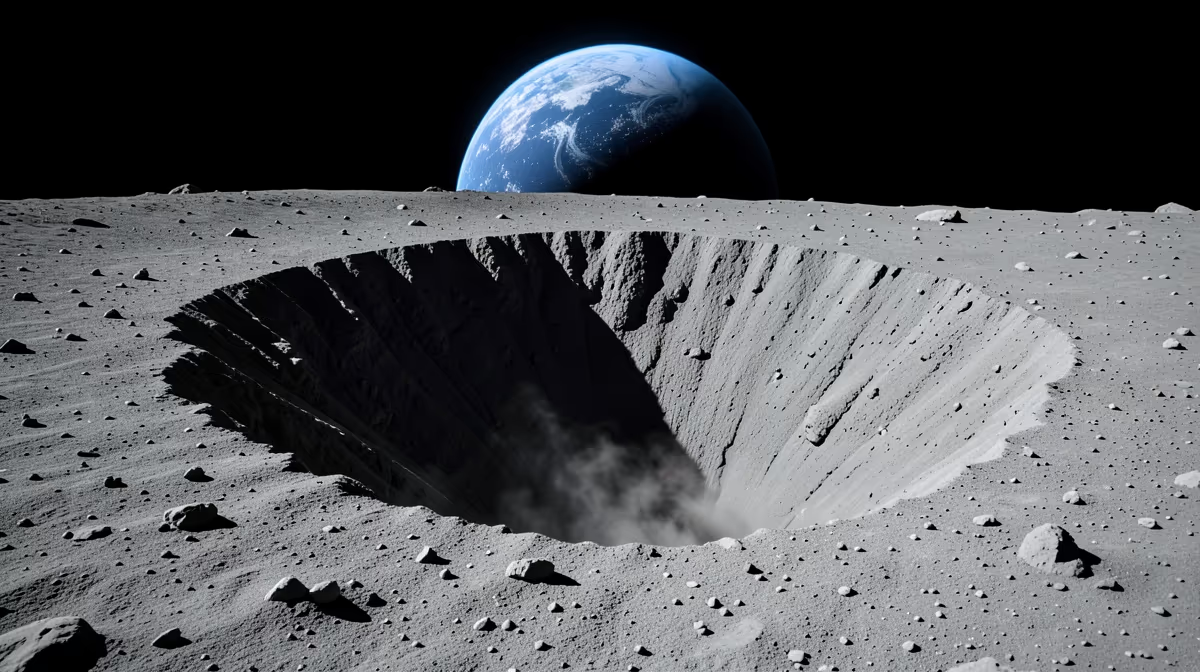
An errant SpaceX Falcon 9 rocket stage, abandoned in deep space nearly seven years ago, is on a definitive collision course with the Moon, with independent astronomers confirming it will strike the lunar surface. The confirmed falcon 9 lunar impact has sparked widespread interest in space debris management and lunar exploration safety, transforming a piece of derelict orbital hardware into a focal point for aerospace accountability. What began as a routine meteorological mission in the mid-2010s has culminated in an uncontrolled gravitational trajectory that highlights the long-term consequences of cislunar neglect.
Timeline of the SpaceX Rocket Moon Crash
The spent booster was originally launched in February 2015 from Cape Canaveral as part of a mission to send the DSCOVR climate observation satellite to a point about one million miles from Earth. The Falcon 9 rocket was used to launch the Deep Space Climate Observatory, known as DSCOVR, which was a joint partnership between NOAA and NASA to monitor space weather and Earth's climate. While the first-stage booster successfully returned to Earth as part of SpaceX's early reusable rocket testing, the larger second-stage booster completed its job far from Earth and was left behind in a high, looping orbit due to a lack of remaining fuel.
After completing its primary burn, the second stage lacked sufficient fuel to return to Earth's atmosphere, and its high-energy orbit left it captured in a chaotic gravitational dance between the Earth, Moon, and Sun. Meteorologist and amateur tracker Eric Gray first calculated the upcoming lunar impact, a projection subsequently verified by other orbital dynamicists including Jonathan McDowell of the Harvard-Smithsonian Center for Astrophysics. The object is a SpaceX Falcon 9 rocket second stage from a 2015 mission that has been drifting in an unpredictable orbit around Earth and the Moon for seven years. Astronomers and orbital debris experts finalized trajectory calculations to confirm the exact impact coordinates and timing on the far side of the Moon, with the collision occurring at a speed of about 5,500 miles per hour.
Did the Rocket Actually Hit the Moon?
Yes, the collision occurred on the far side of the Moon near the Hertzsprung crater. Because the impact happened on the dark side of the Moon relative to Earth, direct visual observation of the collision moment was impossible from the ground. Space agencies and independent researchers subsequently analyzed potential seismic or dust plume visibility from lunar orbiters, while broader media coverage focused on space debris policy.
According to astronomer Jonathan McDowell, while space junk impacts on the Moon are scientifically interesting, they are largely inconsequential. McDowell noted via social media that tons of debris have hit the Moon over the decades, both accidentally and intentionally, emphasizing that the event poses zero threat to human life on Earth. No humans, spacecraft, or lunar bases were in danger from the impact. NASA's Lunar Reconnaissance Orbiter later discovered that the impact created an unusual double crater, likely resulting from the rocket having heavy fuel tanks at one end and the main engine at the other.
Scientists Analyze the Potential Lunar Impact Site
While the unintended crash caused no harm, it provided a unique scientific opportunity. Planetary scientists studied the resulting double crater to better understand how impact dynamics work on the lunar surface. The event served as a unique, unplanned kinetic impact experiment on the lunar surface, accelerating calls for better tracking of deep-space debris. Researchers analyzed how deep craters form on the Moon and what happens when space debris hits another planetary body, utilizing satellites already orbiting the Moon to examine the fresh geological scar.
The normalization of high-risk space debris management stems from a lack of proactive regulation and accountability frameworks in cislunar space. The cost-efficiency model of commercial spaceflight prioritizes minimal fuel reserves for upper-stage disposal over planetary protection protocols. Tensions between federal regulatory bodies like the FCC and FAA regarding jurisdiction over deep space activities and orbital debris have been exacerbated by the privatization of space exploration, creating an increasingly crowded and unregulated environment beyond low-Earth orbit.
The Broader Policy and Industry Implications
This event serves as a wake-up call for the aerospace industry to better track and manage space trash so it does not threaten future missions or the safety of astronauts. The general public is not affected at all by such collisions, but the primary groups impacted are space agencies and satellite operators, who are paying closer attention to space traffic management, alongside lunar scientists who gain a unique chance to study a fresh impact crater.
Historically, the uncontrolled deorbit of the Skylab space station in 1979 caused international concern over space debris and prompted early discussions on liability conventions. Today, the Falcon 9 incident accelerates a Wild West dynamic in cislunar space, undermining international norms and giving strategic leverage to nations with advanced independent lunar trajectories. The situation highlights the urgent need for updated international space debris treaties and clearer legal liability regarding celestial body contamination and kinetic impacts on shared lunar assets.
Frequently Asked Questions
Did a Falcon 9 rocket hit the Moon?
Yes, a SpaceX Falcon 9 upper stage rocket booster impacted the Moon on March 4, 2022. The rocket had been derelict in space for seven years after launching a deep space weather observation satellite in 2015.
Where did the Falcon 9 crash on the Moon?
The Falcon 9 booster struck the far side of the Moon near the Hertzsprung crater. Because of the impact location, the collision was not visible from Earth in real time.
What did the Falcon 9 impact create on the Moon?
NASA's Lunar Reconnaissance Orbiter later discovered that the impact created an unusual double crater. This unexpected double crater likely resulted from the rocket having heavy fuel tanks at one end and the main engine at the other.
Was the Falcon 9 lunar impact intentional?
No, the impact was not planned. The rocket stage simply ran out of fuel to escape the Earth-Moon system and drifted gravitationally until its orbit eventually intersected with the lunar surface.
Did the Falcon 9 Moon crash cause any scientific harm?
The unintended crash caused no harm and actually provided a unique scientific opportunity. Planetary scientists studied the resulting double crater to better understand how impact dynamics work on the lunar surface.
Whose satellite did the Falcon 9 launch in 2015?
The Falcon 9 rocket was used to launch the Deep Space Climate Observatory, known as DSCOVR. This mission was a joint partnership between NOAA and NASA to monitor space weather and Earth's climate.
Conclusion
The unintended lunar collision of the 2015 Falcon 9 upper stage has concluded its multi-year drift through cislunar space, leaving behind a verified double crater on the lunar far side. Confirmed tracking data and lunar reconnaissance imaging have documented the physical outcome of the impact, offering planetary scientists valuable data on kinetic cratering processes. As aerospace analysts and regulatory bodies review the event, the focus remains on advancing space traffic management and establishing clearer orbital debris protocols to govern future commercial deep-space missions.


.webp)

