
Iran US News Escalates as Washington Takes Sudden Military Action
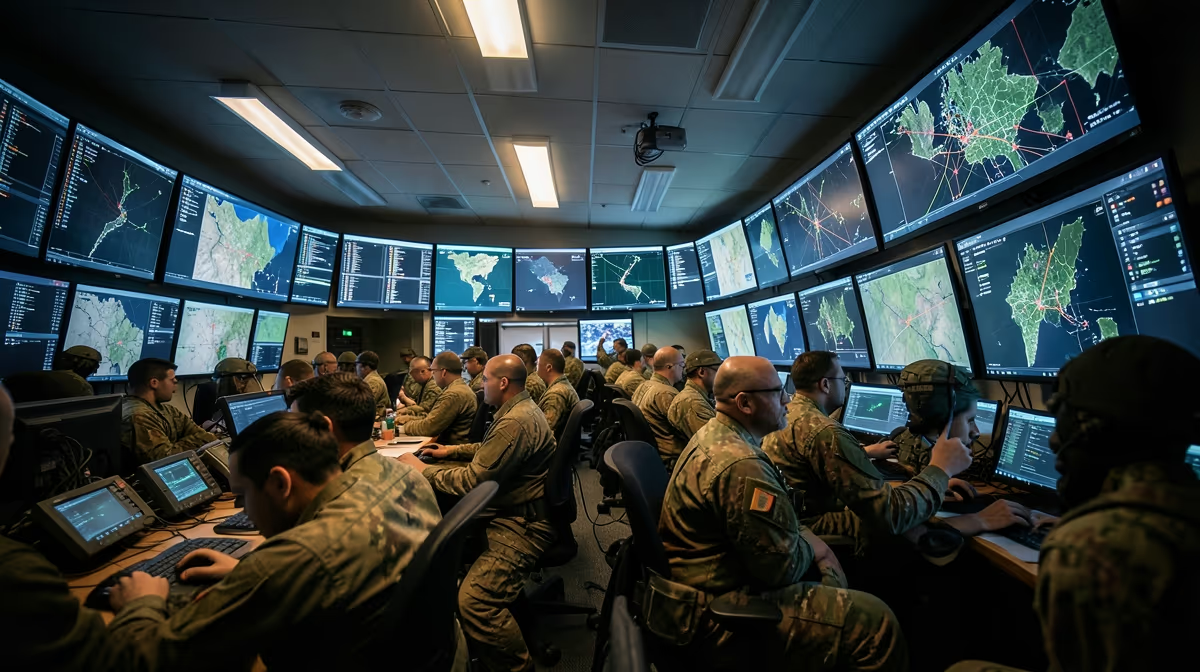
Stay informed with the latest iran us news covering diplomatic developments, international policies, and global reactions. The United States military launched targeted airstrikes against Iran-backed militia groups in eastern Syria on Tuesday, following a wave of drone attacks on coalition forces in the region. This kinetic action highlights the persistent friction defining modern us iran relations, bringing long-standing regional security challenges back into sharp focus. Behind the diplomatic readouts and military statements lies a complex web of strategic posturing, intelligence monitoring, and economic pressures that continue to shape the trajectory of foreign policy in the Middle East.
Current Status of US-Iran Relations
The retaliatory strikes, authorized by President Joe Biden, targeted facilities used by Iran's Islamic Revolutionary Guard Corps and affiliated groups near Mayadin and Abu Kamal. Defense officials stated the action was designed to degrade the capabilities of the militias responsible for recent escalations against U.S. personnel in Iraq and Syria. Tensions between Washington and Tehran have remained elevated amid broader regional instability tied to the Israel-Hamas conflict. U.S. installations have faced persistent drone and rocket attacks by regional proxies over the past several months, prompting repeated defensive responses from the American military. While Pentagon officials emphasized that the United States does not seek broader conflict with Iran, they reiterated that forces in the region will continue to take necessary measures to protect personnel. Regional monitors have reported casualties from the latest strikes, though independent verification remains ongoing. The Pentagon Press Secretary, Maj. Gen. Pat Ryder, stated that the United States will take all necessary measures to defend people and facilities, noting that President Biden directed these strikes to make clear that attacks on U.S. personnel will not be tolerated.
Key Developments and Verified Facts
U.S. forces carried out airstrikes in eastern Syria on Tuesday targeting facilities associated with Iran's Islamic Revolutionary Guard Corps and affiliated militia groups. The strikes were ordered in response to recent drone attacks on U.S. and coalition personnel in Iraq and Syria. The Pentagon confirmed the operation utilized fighter aircraft to strike infrastructure used for logistics and ammunition storage. While the immediate tactical objective was achieved, assessments of exact casualties and the full extent of damage to the targeted facilities are currently ongoing. Authorities are simultaneously monitoring the situation for potential retaliatory actions by the militia groups involved.
Background Context
Tensions between Iran and the United States have been in the spotlight again following recent military actions and diplomatic standoffs in the Middle East. Both nations have been at odds for decades over issues like Iran's nuclear program and its support for various armed groups in the region. Recently, these underlying tensions flared up after attacks involving groups backed by Iran led to responses from the U.S. military, raising worries that the situation could spiral into a broader conflict. World leaders and diplomats are urgently calling for calm to prevent the violence from spreading further across an already volatile region. While neither country officially wants a full-scale war, the risk of miscalculation remains high. Both governments are currently using a mix of military deterrence and behind-the-scenes diplomacy to try and keep the situation from boiling over. The deep hostility between the U.S. and Iran dates back to the 1979 Iranian Revolution, which transformed Iran from a U.S. ally into an Islamic republic strictly opposed to American influence in the region.
Root Causes and Geopolitical Analysis
The root cause of the current friction lies in the structural incompatibility between Iran's regional hegemony ambitions and the US-led security architecture in the Middle East, compounded by the collapse of the 2015 JCPOA nuclear agreement. Domestic vulnerability in both nations drives hardline foreign policies; Tehran uses anti-Americanism to suppress internal dissent, while Washington navigates bipartisan pressure to project strength without entangling in a new Middle Eastern war. Economically, the conflict involves the weaponization of the global financial system through secondary sanctions, ongoing disruptions to critical energy chokepoints like the Strait of Hormuz, and Iran's pivot toward de-dollarized trade with China and Russia. Geopolitically, the accelerating fragmentation of the unipolar global order is evident as US containment strategies inadvertently push Iran deeper into a Sino-Russian axis, reshaping Eurasian security and energy corridors. Beneath the surface, an extensive shadow war is conducted via decentralized cyber espionage, maritime gray-zone sabotage, and intelligence operations that bypass traditional deterrence thresholds to avoid total war, mirroring historical parallels such as the 1979-1981 Iran hostage crisis.
Economic Impact and Why It Matters
An escalation between the U.S. and Iran could severely disrupt global oil supplies, leading to higher gas prices for everyday people around the world. It also increases the risk of a wider war in the Middle East, which would cause immense human suffering and economic instability globally. Comprehensive US economic sanctions continue to heavily impact Iran's economy and its international trade by targeting vital sectors such as oil exports, banking, and shipping. While these measures are designed to pressure the Iranian government into altering its foreign and nuclear policies, they have also severely impacted the Iranian civilian population, contributing to high inflation and economic hardship. Furthermore, because Iran controls crucial shipping lanes like the Strait of Hormuz, any threat of military escalation or disruption to oil tankers in this region immediately causes energy prices to spike worldwide, affecting global energy consumers, international travelers, and people living across the Middle East.
Future Outlook and Expert Predictions
Looking ahead over the next 24 hours, analysts anticipate increased diplomatic posturing and heightened intelligence monitoring following recent regional naval maneuvers. Within the next 72 hours, potential proxy group signaling or cyber activity could occur, accompanied by back-channel de-escalation messages through European or Middle Eastern intermediaries. Key players involved include the U.S. Department of Defense, the Iranian Islamic Revolutionary Guard Corps, and regional mediators, with impact areas focused on Persian Gulf maritime security, energy markets, and cyber defense infrastructure. Expert predictions suggest that both nations will likely maintain a posture of deterrence, avoiding direct military confrontation while managing tensions through proxy and diplomatic channels. In a best-case scenario, a quiet resumption of indirect talks on regional security and maritime protocols could significantly lower immediate threat levels. Conversely, a worst-case scenario involves a miscalculation in contested waters leading to a localized kinetic clash, triggering rapid escalation in the region.
Frequently Asked Questions
Why are US and Iran relations currently strained?
Relations between the United States and Iran have been deeply strained for decades due to geopolitical disagreements, economic sanctions, and regional conflicts. Key issues include Iran's nuclear program, its support for various militant groups across the Middle East, and past military clashes. Recent diplomatic efforts have frequently stalled, keeping tensions at an elevated level globally.
Is the US and Iran currently in a military conflict?
While the US and Iran are not in a state of direct, declared war, they frequently engage in proxy conflicts and indirect confrontations in the Middle East. US forces in the region have occasionally traded fire with Iranian-backed militias in countries like Iraq and Syria. Both nations continuously monitor each other's military movements to avoid sparking a wider regional war.
What is the status of the Iran nuclear deal?
The Joint Comprehensive Plan of Action, commonly known as the Iran nuclear deal, is currently in limbo after the United States unilaterally withdrew from it in 2018. Subsequent attempts by international diplomats to revive the agreement have largely failed due to disagreements over uranium enrichment limits and the lifting of economic sanctions. Consequently, Iran has continued to advance its nuclear capabilities beyond the original restrictions.
How do US economic sanctions affect Iran?
Comprehensive US economic sanctions target vital sectors of Iran's economy, including oil exports, banking, and shipping, severely restricting its international trade. These measures are designed to pressure the Iranian government into altering its foreign and nuclear policies. However, the sanctions have also severely impacted the Iranian civilian population, contributing to high inflation and economic hardship.
Are there any diplomatic talks happening between the US and Iran?
Direct diplomatic talks between the US and Iran are rare and usually conducted through intermediaries such as European or Middle Eastern nations like Oman and Qatar. These backchannel discussions typically focus on specific issues, such as the release of detained prisoners or efforts to de-escalate regional tensions. Comprehensive negotiations over broader geopolitical issues remain largely frozen.
How does the US-Iran conflict impact global oil prices?
Tensions between the US and Iran heavily influence global oil markets because Iran controls crucial shipping lanes like the Strait of Hormuz, through which a significant portion of the world's petroleum passes. Any threat of military escalation or disruption to oil tankers in this region immediately causes energy prices to spike worldwide. Consequently, global markets closely monitor any political developments between the two countries.
Conclusion
Recent developments confirm that military friction between the United States and Iran in eastern Syria has elevated regional security concerns without crossing into direct state-on-state warfare. Verified facts underscore that U.S. airstrikes targeted infrastructure associated with Iran's Islamic Revolutionary Guard Corps in direct response to ongoing drone attacks on coalition personnel. As assessments of damages and potential militia responses continue, both nations face a delicate balance of deterrence and back-channel communication. Realistic next steps point toward sustained intelligence monitoring, potential diplomatic messaging through regional intermediaries, and continued efforts by international stakeholders to prevent further escalation in the Middle East.