
Kuril Islands Dispute Deepens as New Economic Push Sparks Friction
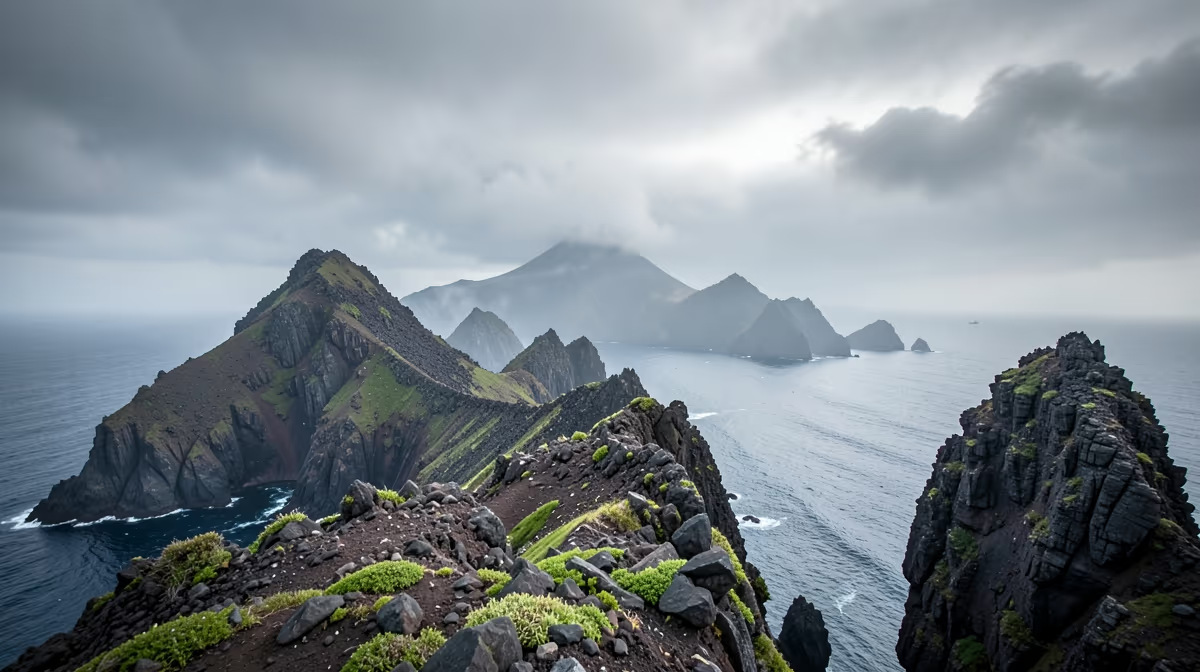
Moscow announced new economic incentives this week for the disputed kuril islands, aiming to attract foreign investment despite an ongoing territorial row with Japan that has stalled a post-World War II peace treaty for nearly eight decades. The ongoing tension surrounding the kuril islands continues to shape geopolitics in East Asia, serving as a constant reminder of unresolved borders and competing sovereignty claims that show no signs of easing.
Historical Roots and Origins of the Conflict
The unresolved sovereignty dispute stems from the ambiguous implementation of the Yalta Agreement and the San Francisco Peace Treaty regarding the kuril islands, also known as the Northern Territories, following World War II. The kuril islands are a chain of volcanic islands stretching between the Russian peninsula of Kamchatka and the Japanese island of Hokkaido. Right now, they are at the center of a long-standing territorial dispute between Russia and Japan. Both countries claim ownership of the southern part of the island chain, which has prevented them from signing a formal peace treaty to officially end their involvement in World War II.
Following Japan's surrender in 1945, the Soviet Union took control of the kuril islands. Japan argues that the southernmost islands were never part of the kuril chain and should have remained Japanese territory, leading to a decades-long diplomatic stalemate. The kuril islands chain spans about 1,300 kilometers between Russia and Japan. Russia controls all the islands, but Japan claims sovereignty over the four southernmost ones. The dispute stems from the end of World War II, when Soviet troops occupied the islands. Japan refers to the disputed territory as its Northern Territories. Russia and Japan have never signed a formal World War II peace treaty because of this conflict.
Current Status of Russia Japan Relations
In recent years, Russia has ramped up its military presence on the archipelago, deploying modern missile systems and constructing new barracks. Moscow argues its sovereignty over the islands is unquestionable under international law following the outcome of the Second World War, a stance that has drawn consistent protests from the Japanese government. Meanwhile, Japan maintains that the four southernmost islands were illegally occupied and insists on the return of the territories before normal diplomatic relations can be fully realized. Economic joint-venture proposals have repeatedly stalled due to disagreements over which country's legal framework should apply on the islands.
Bilateral diplomatic engagement remains largely frozen following Japan's alignment with Western sanctions against Russia over the war in Ukraine, leading Moscow to suspend peace treaty talks. Russian Foreign Ministry representatives stated that Moscow's sovereignty over the islands is unconditional and not subject to review, while Japanese Prime Minister Fumio Kishida reiterated Tokyo's resolve to resolve the territorial issue and conclude a peace treaty. The entire kuril islands chain is currently controlled by the Russian Federation. Russia has held administrative control over the islands since they were annexed by the Soviet Union at the conclusion of World War II in 1945.
Strategic and Economic Importance of the Archipelago
While the islands themselves are relatively small and sparsely populated, they sit in a region rich in natural resources like fish, oil, and rare minerals. They also hold immense strategic value for military control over the Sea of Okhotsk and the Pacific Ocean. Because both nations refuse to back down on their historical claims, the issue remains a major flashpoint in East Asian geopolitics. Control over the islands grants exclusive economic zones rich in fisheries, potential rare earth mineral deposits, and strategic hydrocarbon reserves in the Sea of Okhotsk, alongside vital Pacific access.
The islands serve as an unsinkable aircraft carrier and a critical strategic bastion for the Russian Pacific Fleet to secure its nuclear submarine bastions, while acting as a key flashpoint in US-Japan security alliance containment strategies against Russia and China. The militarization of the islands by Moscow also serves as a direct message to Washington regarding the defense of the Arctic and the Sea of Okhotsk, deeply intertwining the Kurils with broader US-China-Russia maritime competition. The unresolved dispute prevents Russia and Japan from fully normalizing diplomatic and economic relations. As global powers increasingly compete for influence and resources in the Asia-Pacific region, the kuril islands serve as a constant reminder of lingering World War II borders that have yet to be peacefully settled. The affected populations include the governments and citizens of Japan and Russia, particularly the local residents living on the islands and fishermen whose livelihoods depend on the surrounding waters.
Political Dynamics and Key Milestones
Domestic nationalism in both Russia and Japan constrains leaders from making territorial concessions, transforming a diplomatic dispute into a test of regime legitimacy and historical grievance. This political friction mirrors historical parallels such as the Franco-German dispute over Alsace-Lorraine from 1871 to 1919, where territorial loss became a central pillar of national humiliation and irredentism, preventing lasting regional reconciliation. The timeline of this dispute reflects decades of failed breakthroughs. In 1945, Soviet forces occupy the kuril islands in the final weeks of World War II. In 1956, the Soviet-Japanese Joint Declaration ends the state of war and Moscow agrees to hand over two of the islands after a peace treaty is signed, but the deal collapses under US pressure. In 2018, Prime Minister Shinzo Abe and President Vladimir Putin agree to accelerate peace treaty negotiations based on the 1956 declaration, raising false hopes for a breakthrough. By 2022, following Western sanctions over the war in Ukraine, Russia suspends peace treaty talks and withdraws from joint economic projects, cementing the stalemate.
Outlook and Projected Scenarios
Over the next 24 hours, routine diplomatic posturing and standard maritime patrols by Russian forces in the region are expected, with no immediate escalation. Looking ahead to the next 72 hours, a continuation of rhetorical exchange between Tokyo and Moscow regarding sovereignty claims is anticipated, alongside monitoring of regional military exercises. Expert prediction indicates that the territorial dispute over the kuril islands will remain deadlocked with neither side willing to compromise, while low-level diplomatic tensions persist. In a best-case scenario, there could be a resumption of humanitarian access and joint economic projects previously agreed upon by Japan and Russia. Conversely, the worst-case scenario involves sudden military escalation or live-fire exercises leading to temporary airspace closures and heightened bilateral crisis management.
Frequently Asked Questions
What and where are the Kuril Islands?
The Kuril Islands are a volcanic archipelago that stretches approximately 1,300 kilometers from the Japanese island of Hokkaido to the Russian Kamchatka Peninsula. They separate the Sea of Okhotsk from the North Pacific Ocean and are administered as part of Russia's Sakhalin Oblast.
Why are the Kuril Islands disputed?
The islands are the subject of a long-standing territorial dispute between Russia and Japan. Japan claims the four southernmost islands—which it calls the Northern Territories—while Russia administers the entire chain as part of its territory following the end of World War II.
Can tourists visit the Kuril Islands?
Yes, tourism is possible, but it requires special permits because the islands are located in a border zone. Visitors typically need advance clearance from Russian authorities, and travel is often heavily weather-dependent due to the remote and rugged nature of the region.
Which country controls the Kuril Islands?
The entire Kuril Islands chain is currently controlled by the Russian Federation. Russia has held administrative control over the islands since they were annexed by the Soviet Union at the conclusion of World War II in 1945.
What is the climate like in the Kuril Islands?
The climate is generally harsh, subarctic, and maritime, characterized by cool, foggy summers and cold, snowy winters. Strong winds and heavy precipitation are common throughout the year due to the convergence of cold Arctic currents and warmer Pacific air masses.
Are the Kuril Islands volcanically active?
Yes, the Kuril Islands are part of the Pacific Ring of Fire and feature intense tectonic and volcanic activity. The archipelago contains over 100 volcanoes, of which about 35 are active, along with numerous hot springs and frequent seismic tremors.
Conclusion
The territorial dispute over the kuril islands remains entrenched in historical grievances, domestic political pressures, and strategic military imperatives for both Russia and Japan. With bilateral diplomatic channels largely frozen and economic joint ventures suspended following broader international conflicts, the archipelago continues to serve as a critical geopolitical flashpoint in the Indo-Pacific region. As routine maritime patrols and diplomatic posturing persist, the outlook points toward a continued stalemate, with neither Tokyo nor Moscow showing willingness to compromise on sovereignty over the contested territory.


.webp)

