
Mojtaba Khamenei Emerges at the Center of Iran Leadership Succession
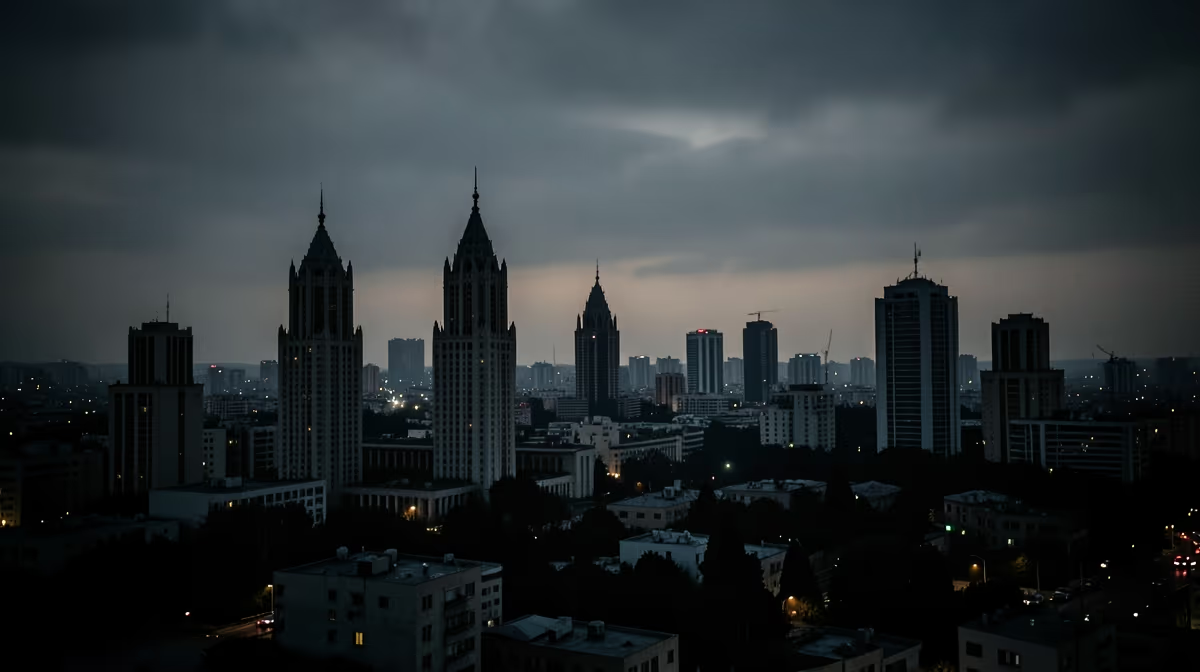
Mojtaba Khamenei, the influential second-eldest son of Iran's Supreme Leader Ayatollah Ali Khamenei, has increasingly emerged in regional and international intelligence assessments as a central figure in succession planning amid heightened geopolitical tensions in the Middle East. Behind the closed doors of Tehran, a quiet institutional maneuver is underway that could permanently reshape the trajectory of the Islamic Republic. mojtaba khamenei has emerged as a central figure in discussions surrounding the future supreme leader iran. As foreign capitals monitor every shift in the Iranian political landscape, the opaque mechanics of clerical power projection have placed this un-elected figure directly at the center of global strategic analysis.
Born in 1969 in Mashhad, Mojtaba Khamenei has long operated primarily behind the scenes within Iran's political and security apparatus. While holding no formal government or military title, he has maintained deep ties with the Islamic Revolutionary Guard Corps and the Basij paramilitary forces, wielding substantial influence over domestic policy and the security establishment. His journey within these power structures began in the 1980s, when he formed crucial early networks within the Islamic Revolutionary Guard Corps during the Iran-Iraq War. By 2009, he emerged as a key behind-the-scenes coordinator in the violent suppression of the Green Movement protests, and between 2019 and 2022, he gradually assumed greater administrative control over his father's office and intelligence apparatus. Today, he is positioned as the leading opaque successor to the Supreme Leader amidst acute regional instability and succession urgency.
Speculation regarding his potential succession to the role of supreme leader iran has intensified as his 85-year-old father's health is frequently scrutinized by foreign analysts and regional observers. Although the Assembly of Experts is constitutionally responsible for choosing the next Supreme Leader, the opaque nature of Iranian politics lends significant weight to informal power brokers. International governments, particularly the United States and Israel, view his rising profile with concern, associating him with the hardline continuation of Iran's regional proxy network and nuclear ambitions. In November 2019, the U.S. Department of the Treasury imposed sanctions on Mojtaba Khamenei, citing his close alignment with his father and his advancement of the regime's destabilizing regional policies. Western intelligence analysts note that while he lacks the official clerical rank traditionally required for the supreme leadership, his control over financial networks and security apparatuses makes him a formidable contender.
The root cause of these unfolding dynamics lies in the institutionalization of the Iranian clerical-security apparatus seeking regime self-preservation and continuity post-Ali Khamenei through hereditary succession. This has triggered a high-stakes power struggle between reformist elements, Islamic Revolutionary Guard Corps hardliners, and traditional clerical hierarchies over the future governance model of the state. Economically, this trajectory involves the consolidation of vast financial conglomerates and bonyads under direct military-clerical control, impacting foreign sanctions resilience and state-directed capital allocation. Geopolitically, it manifests as heightened friction with Western and regional adversaries who view his potential ascension as the hardening of Iran's anti-status quo foreign policy and proxy network management. Simultaneously, an intense behind-the-scenes resistance persists from senior traditional clerics in Qom who view hereditary succession as a betrayal of republican and theological principles of the 1979 revolution, drawing historical parallels to the institutional consolidation of the Safavid dynasty through tightly knit military-religious elites or transitions seen in other authoritarian states.
Over the next 24 hours, regional and international media are expected to increase monitoring and speculative reports regarding Mojtaba Khamenei's public visibility and potential succession positioning within the clerical establishment. Within 72 hours, security apparatus reactions and potential diplomatic signaling from neighboring states and Western intelligence will likely focus on his influence on the political landscape. Analysts suggest that while he remains a pivotal behind-the-scenes figure in succession dynamics, any formal elevation would provoke intense internal debate and heightened external scrutiny. The best-case scenario envisions a transparent and stable political transition process within Iran that avoids major internal unrest or regional escalation, whereas the worst-case scenario entails a succession struggle that triggers acute domestic protests, harsher internal crackdowns, and an increased aggressive posture toward regional adversaries.
Frequently Asked Questions
Who is Mojtaba Khamenei?
Mojtaba Khamenei is an Iranian Shia cleric and the second-eldest son of Iran's Supreme Leader, Ayatollah Ali Khamenei. He wields significant political influence behind the scenes in Iran, particularly within conservative and security circles. Despite holding no official government position, his name is frequently discussed in connection with the country's power structure.
What is Mojtaba Khamenei's role in Iranian politics?
While Mojtaba Khamenei does not hold an official state office, he is widely believed to exercise considerable influence over Iran's political and military establishments. He maintains close ties with the Islamic Revolutionary Guard Corps and the Basij paramilitary forces. Analysts often view him as a key power broker within the conservative faction.
Is Mojtaba Khamenei a potential successor to Supreme Leader Ali Khamenei?
Mojtaba Khamenei is frequently mentioned by analysts and media outlets as a potential candidate to succeed his father as Supreme Leader of Iran. However, the idea of a hereditary succession has been controversial within the ruling clerical establishment, as it contrasts with the republican principles initially claimed by the 1979 revolution.
What sanctions have been imposed on Mojtaba Khamenei?
The United States Department of the Treasury placed Mojtaba Khamenei on its sanctions list in 2019. The sanctions target individuals closely associated with Ayatollah Ali Khamenei who help advance the regime's destabilizing regional policies and domestic repression. As a result, his foreign assets are frozen, and international entities are restricted from doing business with him.
What is Mojtaba Khamenei's educational and clerical background?
Mojtaba Khamenei studied theology in the traditional seminaries of Qom, which is the spiritual center of Shia Islam in Iran. He has attained the clerical rank of Hojjatoleslam and has taught theology courses at the seminary level. His clerical standing provides him with religious legitimacy within the traditional ruling elite.
Who is Mojtaba Khamenei married to?
Mojtaba Khamenei is married to the daughter of Gholam-Ali Haddad-Adel, a prominent Iranian politician and former speaker of the Iranian parliament. This marriage alliance further solidified his connections to the conservative political elite in Tehran. The couple has children together, though his family life is kept largely private.
Conclusion
The evolving discussions surrounding Mojtaba Khamenei highlight the delicate intersection of family lineage, military influence, and clerical authority within the Islamic Republic. As confirmed developments show an un-elected power broker maintaining deep operational ties with security forces without holding formal state office, international observers and regional actors continue to monitor the inner workings of Tehran's leadership. Realistic next steps involve close observation of the Assembly of Experts, internal clerical deliberations in Qom, and the security apparatus's posture as the leadership transition draws closer.


.webp)

