
Vladimir Putin Moves Spark Global Concern Amid Deepening Tensions
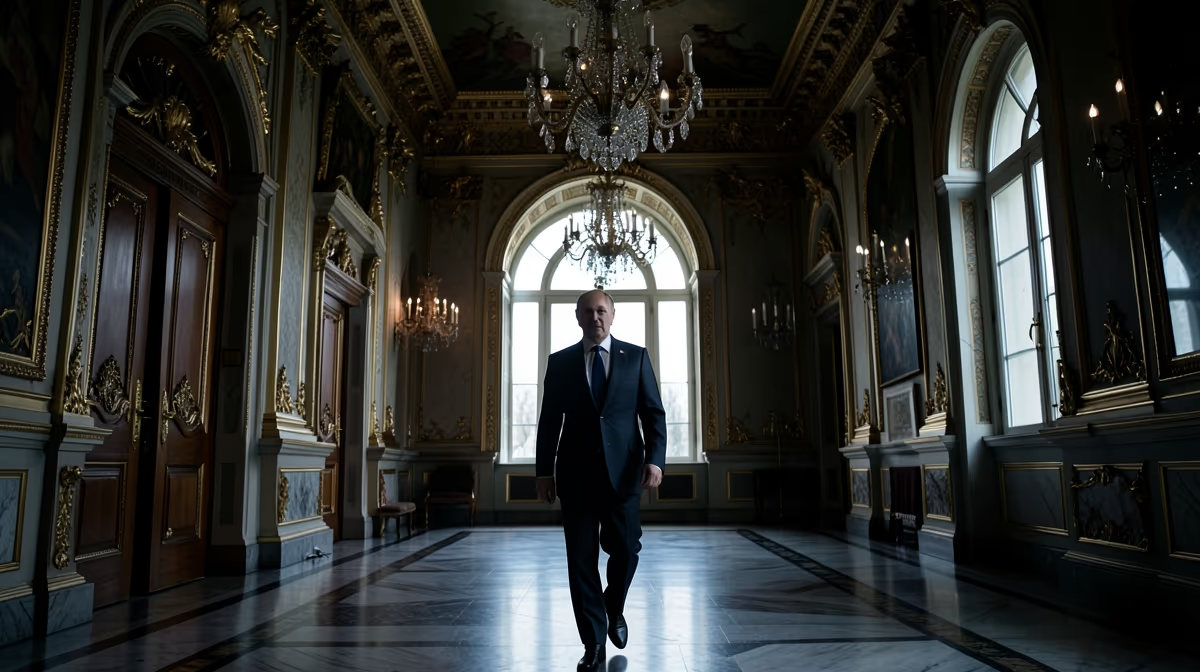
Russian President Vladimir Putin addressed the nation today regarding ongoing updates on russia security and the escalating geopolitical tension across global borders. Russian President Vladimir Putin announced a major restructuring of the nation's defense leadership on Wednesday, appointing career economist Andrei Belousov as the new defense minister in a sweeping move aimed at integrating the economy into the ongoing war effort in Ukraine.
The Kremlin Strategic Pivot
The appointment of Belousov, a former first deputy prime minister known for his close ties to Putin and expertise in macroeconomic planning, signals a strategic pivot by the Kremlin. Analysts suggest the Kremlin is preparing for a protracted conflict, prioritizing industrial capacity and financial sustainability over traditional military command in the upper echelons of the defense ministry. Former Defense Minister Sergei Shoigu, who held the post since 2012, has been reassigned as the secretary of the Security Council, a powerful but largely bureaucratic role.
Under Shoigu, the Russian military faced significant logistical challenges and high casualty rates, particularly during the initial phases of the 2022 invasion of Ukraine. While Shoigu retains influence in security matters through the Security Council, the removal of a close Putin ally from direct operational control of the armed forces marks a notable acknowledgment of necessary reforms within the military-industrial complex.
International reactions have poured in from Western capitals, where intelligence agencies are closely monitoring the shift. Officials in the United States and European Union note that placing a technocrat at the helm of the defense apparatus underscores Moscow's intent to weaponize its entire economy for long-term military production, posing new challenges for Western sanctions enforcement and military aid timelines for Ukraine. Kremlin spokesperson Dmitry Peskov stated during a press briefing that the appointment of Andrei Belousov is driven by the absolute necessity to innovate, introduce advanced ideas, and create competitive conditions for economic adaptation within the security sector.
Historical And Economic Roots
The root cause of these maneuvers traces back to the collapse of the Soviet Union and the subsequent economic trauma of the 1990s, viewed by the leadership as a geopolitical catastrophe that compromised Russia's great power status. Vladimir Putin rose to power following the chaotic collapse of the Soviet Union in 1991, initially gaining popularity by restoring economic stability and national pride to Russia before gradually centralizing all political authority into his own hands.
Politically, the regime relies on the centralization of power through managed democracy, the elimination of independent political opposition, and reliance on security elites known as siloviki to maintain internal stability. Economically, the state practices a form of capitalism heavily reliant on hydrocarbon exports, the weaponization of energy supplies, and the creation of a resilient financial fortress to withstand international sanctions. Geopolitically, these policies manifest as a systematic pushback against NATO enlargement, the reassertion of dominance in the post-Soviet space, and forging strategic partnerships to accelerate the transition to a multipolar world order.
Verified Facts Of The Leadership Reshuffle
Several key developments have been formally enacted by presidential decree, shifting civilian and military structures. Vladimir Putin appointed Andrei Belousov as Russia's new defense minister in May 2024. Sergei Shoigu was moved from defense minister to the role of secretary of the Security Council. Belousov previously served as the first deputy prime minister with a background in economics, and Valery Gerasimov will remain as the chief of the general staff.
The full operational impact of the leadership change on frontline military strategy in Ukraine and the specific timeline for industrial production overhauls remain ongoing developments. Meanwhile, Western intelligence services and allied governments continue to analyze the broader implications of these structural shifts for global energy markets, Eastern European security, international diplomacy, and Russian domestic politics.
Global Impact And Expert Outlook
The ongoing geopolitical tension affects multiple spheres of international life, driving up the costs of essential goods like energy and food for people around the world. The people of Ukraine face the most direct impact through the destruction of their homes and daily lives, while citizens in Russia, European countries, and consumers globally contend with inflation and high energy prices.
Looking ahead to the next 24 hours, Kremlin officials will likely issue statements addressing recent international diplomatic developments and ongoing military operations in Ukraine. Within the next 72 hours, state media will continue to emphasize domestic stability and economic resilience while monitoring potential sanctions adjustments or allied responses. Key players in this dynamic include Vladimir Putin, Sergey Lavrov, Dmitry Peskov, and Western Heads of State.
Expert predictions indicate that Putin is expected to maintain his current strategic posture, balancing military pressure in Ukraine with signaling readiness for conditional negotiations on Russian terms. The best-case scenario involves a de-escalation of rhetoric that opens backchannels for substantive ceasefire talks and reduces immediate geopolitical tensions, whereas the worst-case scenario entails miscalculations on the ground leading to a sharp escalation of the conflict and the imposition of severe new economic sanctions.
Frequently Asked Questions
Who is Vladimir Putin?
Vladimir Putin is a Russian politician and former intelligence officer who has served as either the president or prime minister of Russia since 1999. He is one of the world's most influential and longest-serving contemporary leaders, significantly shaping Russia's domestic policies and foreign affairs.
How long has Vladimir Putin been in power?
Putin has been the dominant political figure in Russia for over two decades, holding power continuously since 1999. He served as prime minister from 1999 to 2000, president from 2000 to 2008, prime minister again until 2012, and president from 2012 to the present day.
What was Vladimir Putin's career before politics?
Before entering politics, Putin served as a foreign intelligence officer for the KGB of the Soviet Union for 16 years, rising to the rank of lieutenant colonel. Following the dissolution of the USSR, he transitioned to municipal administration in Saint Petersburg and later held various high-ranking government roles in Moscow.
Why is Vladimir Putin controversial internationally?
Putin faces widespread international condemnation for authoritarian governance, suppression of political opposition, and human rights violations within Russia. His geopolitical actions, particularly the 2014 annexation of Crimea and the 2022 full-scale invasion of Ukraine, have led to severe global economic sanctions and diplomatic isolation.
What is Vladimir Putin's political party?
While Putin has frequently run as an independent in presidential elections, he is closely associated with and has previously led United Russia, the country's dominant ruling political party. United Russia holds a majority in the State Duma and consistently supports his legislative agenda and executive policies.
What are Vladimir Putin's main political goals?
Putin's primary objectives center on restoring Russia's status as a major global superpower and countering Western influence, particularly the expansion of NATO. Domestically, he focuses on maintaining centralized state control, promoting economic stability through energy exports, and fostering patriotic nationalism.
Conclusion
The structural realignment within Moscow's defense and economic apparatus underscores a deliberate pivot toward sustained industrial mobilization and long-term military preparedness under Vladimir Putin. As confirmed leadership changes take effect, international observers, policymakers, and markets will closely monitor the Kremlin's next diplomatic and operational steps. Realistic next steps involve ongoing observation of Russian defense restructuring, Western sanctions enforcement, and the evolving economic adaptation of the state security sector amid continuing geopolitical tension.


.webp)
