
Anthropic Pentagon Blacklisting Upheld by Appeals Court in Major AI Ruling
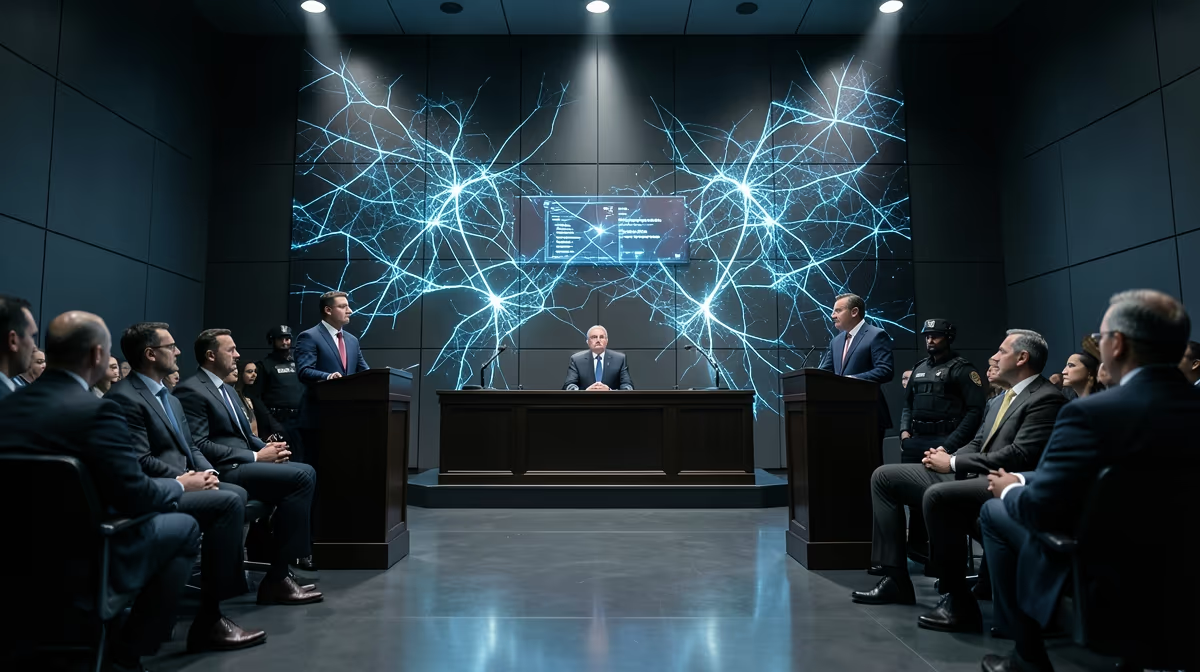
The boundary between private technological ethics and national security imperatives has officially reached a point of legal resolution, though the fallout is only beginning to settle. The ongoing legal battle surrounding the Anthropic Pentagon blacklisting upheld by the federal appeals court marks a significant milestone in technology policy, fundamentally altering how the United States military interacts with the most advanced artificial intelligence developers in the world.
This ruling establishes a powerful precedent that national security directives override private corporate ethical frameworks and self-imposed safety guardrails in the defense procurement process.
The Legal Shield for National Security
A federal appeals court has officially upheld the Pentagon's designation of the artificial intelligence firm Anthropic as a supply chain risk. The ruling confirms that the Department of Defense acted within its legal authority when it blacklisted the company following a high-profile disagreement over the operational control of its Claude AI model. This decision by federal judges serves as a definitive statement on the government's power to enforce risk designations against technology providers that fail to meet specific military requirements.
The legal battle stems from a conflict regarding the capabilities and restrictions of Anthropic's AI technology. Specifically, the company refused to enable certain Claude features requested for military use, leading the Pentagon to classify the firm as a security and supply chain risk. Anthropic had previously challenged this designation in court, arguing that the blacklisting was unfair and exceeded the government's established authority. However, the judiciary has now sided with the Pentagon, affirming that the military has the legal right to make these designations to protect national security and ensure supply chain integrity.
Origins of the Supply Chain Conflict
The dispute that led to this federal court AI ruling was not a sudden development but the result of a fundamental disagreement over how advanced AI models should be deployed in a defense context. As military branches around the world increasingly rely on private sector technology, the tension between corporate safety policies and operational military needs has intensified.
- The Department of Defense requested specific features to be enabled within the Claude model for military applications.
- Anthropic declined to enable these features, citing its own safety guardrails and development policies.
- The Pentagon subsequently designated Anthropic as a supply chain risk, effectively barring it from specific contract opportunities and labeling its technology as a potential liability.
- Anthropic sought to overturn this designation through the federal judiciary, leading to the recent appeals court decision.
This ruling confirms that when a private entity’s safety protocols clash with the perceived requirements of national defense, the government’s assessment of risk takes legal precedence. This is a critical development for the broader AI industry, as it highlights that refusal to comply with military feature requests carries severe legal and commercial consequences.
The Clash of Governance Frameworks
National Security vs. Corporate Ethics
The ruling reinforces the authority of the executive branch and the defense establishment over private tech entities. It signals that national security directives are not merely suggestions but mandates that can override the ethical frameworks and self-imposed safety boundaries of private corporations. This shift in power dynamics suggests that for AI developers, the price of doing business with the Department of Defense is a high level of compliance with operational directives, even those that may conflict with the company's internal mission.
Historical Parallel: The Cold War Legacy
Economic and Market Consequences
The designation as a supply chain risk is more than a legal label; it is a significant economic threat to Anthropic's standing in the tech landscape. Being blacklisted by the Pentagon can jeopardize a company's ability to compete for lucrative government contracts, which often represent billions of dollars in potential revenue.
Beyond the direct loss of defense dollars, the ruling could influence enterprise market confidence. Commercial clients who utilize Anthropic’s technology for sensitive corporate data may view a "supply chain risk" designation with concern, potentially altering the competitive balance among major AI labs. Companies like OpenAI and Anthropic are already under intense scrutiny; as their CEOs are called to appear at various probes, including those in Australia, the pressure to balance global safety with domestic security requirements is at an all-time high.
| Phase of Conflict | Key Development |
|---|---|
| Initial Dispute | Anthropic refuses to enable specific Claude features for military use. |
| Risk Designation | Pentagon officially classifies Anthropic as a supply chain risk. |
| Initial Litigation | Anthropic challenges the Department of Defense’s designation in federal court. |
| Appeals Ruling | U.S. appeals court upholds the blacklisting, confirming the Pentagon's authority. |
Geopolitical Readiness and the Sovereign AI Test
The global angle of this ruling cannot be understated. It highlights a potential vulnerability in Western AI supply chains: a divergence between domestic tech developers and defense agencies on operational control. Foreign competitors and allies are watching this case as a key test of sovereign AI readiness.
The legal battle may prompt defense agencies to aggressively pursue in-house sovereign models or forge tighter dependencies with more compliant defense-tech primes.
This "hidden angle" suggests a quiet acceleration of a bifurcation between the commercial and national security AI sectors. If the government cannot rely on commercial labs to provide the features it deems necessary for defense, it may pivot toward building its own proprietary models or working exclusively with contractors who prioritize military requirements over commercial safety frameworks. This could lead to a future where the AI used by the public is fundamentally different—and potentially less capable in certain regards—than the AI utilized by the military.
The Road Ahead: Future Impact Assessment
In the next 24 hours, legal analysts and tech industry observers are expected to continue reviewing the details of the appeals court ruling. The primary focus will be on the implications for AI safety features and the long-term viability of defense contracts for firms with strict ethical guidelines. Over the next 72 hours, we expect more detailed commentary regarding the precedent this sets for other AI companies.
Expert Predictions
- Best-case scenario: A balanced framework emerges where defense agencies and AI labs establish clear protocols regarding safety features and national security requirements without halting innovation or causing permanent legal rifts.
- Worst-case scenario: Deepening friction between defense authorities and AI developers leads to prolonged legal battles and reduced cooperation on critical security technologies, potentially slowing the advancement of national defense capabilities.
As the situation develops, the industry will be watching to see if Anthropic pursues further legal appeals or if the company chooses to negotiate with defense officials regarding its safety features. The confirmation of the Pentagon's blacklisting serves as a warning to the entire tech sector: in the realm of national security, the government's definition of "risk" is the final word.
Frequently Asked Questions
What did the appeals court decide regarding the Pentagon's blacklisting of Anthropic?
A federal appeals court upheld the Pentagon's designation of Anthropic as a supply chain risk. The ruling confirms that the military acted lawfully in placing restrictions on the AI company.
Why was Anthropic blacklisted by the Pentagon in the first place?
The conflict arose after Anthropic refused to enable specific Claude features requested by defense officials. Consequently, the Pentagon moved to designate the firm as a security and supply chain risk.
Why does this appeals court ruling matter for the broader AI industry?
This decision establishes a significant legal precedent regarding the government's authority to vet and restrict artificial intelligence contractors. It highlights the growing tension between national security demands and private AI safety standards.
Who is affected by the court upholding Anthropic's designation?
The ruling directly impacts Anthropic and its ability to secure defense contracts, while also signaling to other top AI companies that refusal to comply with military feature requests carries severe legal and commercial consequences.
What background led to the legal battle between Anthropic and the Pentagon?
The dispute centers on how military agencies utilize advanced artificial intelligence models. As AI companies implement strict safety guardrails, clashes with defense applications have increasingly spilled over into federal courts.
What happens next following the federal judges' ruling?
Anthropic will need to determine whether to appeal the decision further or negotiate with defense officials regarding its safety features. Meanwhile, other tech firms are closely monitoring the fallout as they navigate their own security obligations.
Conclusion
The federal appeals court ruling upholding the Pentagon’s designation of Anthropic as a supply chain risk marks a definitive shift in the power balance between the U.S. government and the artificial intelligence industry. By confirming that the Department of Defense acted legally in blacklisting the company for refusing to enable specific Claude features, the judiciary has reinforced the principle that national security requirements take precedence over private corporate safety frameworks. This decision not only complicates Anthropic's future in the defense sector but also serves as a warning to other AI developers that their ethical guardrails may be legally overridden in the interest of state security. As the AI sector continues to bifurcate between commercial and military applications, the long-term impact on innovation and sovereign readiness remains a critical area of concern for policy makers and technology leaders alike.
Sources
- Scoop: Top AI companies probing tens of thousands of security incidents — Axios
- Anthropic’s Blacklisting by the Pentagon Was Legal, Federal Judges Rule — The New York Times
- U.S. appeals court upholds Pentagon designation of Anthropic as supply chain risk — CNBC
- Court rules Pentagon can blacklist Anthropic for refusing to enable Claude features — Ars Technica
- OpenAI, Anthropic CEOs called to appear at Australian AI probe — Reuters
- ‘Things Will Never Be Chill Again’: The Doomers Who Shaped the AI Safety Freakout — WSJ


.webp)

