
Ken Griffin CMU Donation Stuns Academics With Historic $3 Billion Pledge
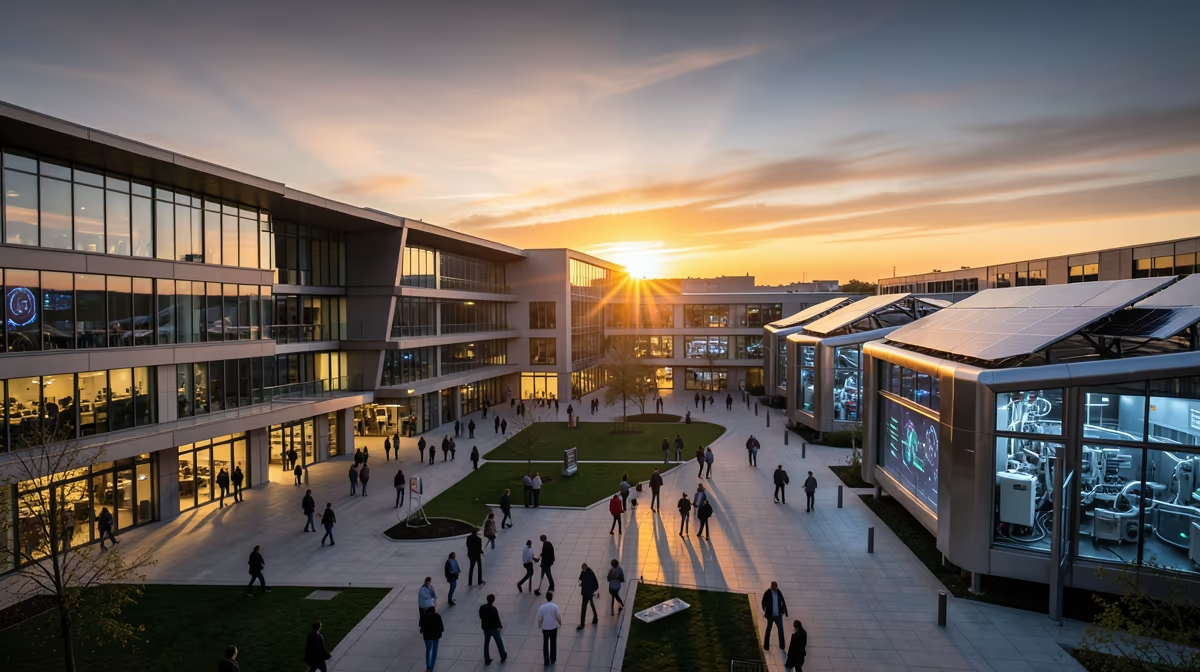
The traditional map of American technological excellence is being redrawn by a single, massive financial stroke that bridges the industrial heritage of the North with the emerging financial power of the South. In a historic move for academia, the recent Ken Griffin CMU donation is set to reshape the landscape of technological research and campus expansion, fundamentally altering how elite institutions scale their physical and intellectual footprints.
The billionaire Citadel founder Ken Griffin has pledged a historic $3 billion donation to Carnegie Mellon University to fund a major expansion in Pittsburgh and the establishment of a brand-new campus in Miami.
A Historic Commitment to Innovation
The monumental financial commitment, reported by multiple outlets including CNBC and Reuters on September 30, 2026, ranks among the largest philanthropic gifts ever made to a higher education institution. This multi-billion dollar contribution is designed to catalyze massive infrastructure projects and long-term endowments that will sustain Carnegie Mellon’s leadership in high-tech fields. By securing this funding, the university aims to accelerate its research capabilities, particularly in the sectors of computer science and artificial intelligence, which have long been the hallmarks of its academic reputation.
The $3 billion pledge is not merely a financial boost for existing programs; it represents a strategic alignment between private wealth and advanced technological research infrastructure. University administrators and regional officials view this as a landmark contribution that could fundamentally transform the university’s global capabilities. The funding is designated to support substantial growth at the university's main Pittsburgh campus, ensuring that its traditional home remains at the cutting edge of academic infrastructure while simultaneously launching a significant new venture in Florida.
Expanding Horizons: The Vision for the New Miami Campus
A cornerstone of this historic gift is the establishment of a new Carnegie Mellon campus in Miami, an initiative that signifies a major geographic expansion for the university. This plan is anchored by Ken Griffin's recent closing on a $1 billion-plus purchase of the Mana Wynwood property in Miami. This real estate acquisition sets the physical foundation for the new campus, providing the university with a high-profile location in one of the fastest-growing urban tech hubs in the United States.
The purchase of Mana Wynwood serves as a critical bridge between top-tier academia and the burgeoning tech and business ecosystem developing in South Florida. This dual-location strategy—maintaining a stronghold in Pittsburgh while building a massive presence in Miami—is intended to create a localized, private-public tech ecosystem. The new South Florida footprint will allow Carnegie Mellon to tap into new markets, attract prospective students in Florida, and integrate with the regional labor market.
Strategic Integration with Mana Wynwood
The integration of the university into the Mana Wynwood property is expected to have the following impacts:
- Establishment of state-of-the-art classrooms and research laboratories in Miami.
- Revitalization of urban development circles through high-tech campus infrastructure.
- Creation of a new physical hub for students, faculty, and tech professionals in the Miami area.
- Strengthening of the real estate market in the Wynwood district through institutional investment.
Analyzing the Economic and Regional Realignment
The economic implications of a $3 billion injection are vast, potentially shifting the high-tech economic gravity of the United States. Analysts observe that this move catalogs a shift in talent pipelines and venture capital ecosystems toward southern tech corridors. By establishing a world-class research institution in Miami, the initiative promises to reshape the educational and economic landscape of South Florida, creating new opportunities that were previously centralized in Northeastern clusters.
This massive regional expansion also serves as a strategic play to influence local municipal taxation and labor markets. The influx of university resources and the subsequent arrival of high-tech talent are expected to bolster the regional economy, although such shifts often come with complex integration challenges. The sheer scale of the investment suggests a long-term play to secure regional development supremacy in one of the country’s most dynamic economic gateways.
Geopolitical and Political Implications of Private Philanthropy
The heavy concentration of philanthropic capital from billionaire financiers into elite academic institutions highlights the growing influence of private wealth over public-interest technology policy and higher education priorities. This $3 billion gift places significant power in the hands of private individuals to shape regional development agendas and national research priorities. It raises questions about the balance between private-interest funding and the public mission of higher education institutions.
On a domestic strategic level, this expansion is viewed as a move to secure US technological and artificial intelligence dominance. By decentralizing critical research hubs and moving beyond traditional Northeastern tech clusters, the initiative helps build a more robust and geographically diverse research network. This positioning is essential for maintaining a competitive edge in global technology sectors, particularly as AI research becomes a central pillar of national economic security.
A monumental $3 billion injection that catalyzes massive real estate development while shifting high-tech economic gravity and talent pipelines toward southern tech corridors.
Historical Parallels and the Long-Term Vision
The scale and intent of the Griffin gift draw historical parallels to the Leland Stanford Junior endowment of the late 19th century. Just as Stanford was founded to drive regional economic and technological transformation in the American West, this $3 billion pledge to Carnegie Mellon is positioned to catalyze a similar transformation in the American South. This comparison underscores the potential for massive philanthropic gifts to found or expand institutions that eventually define the economic identity of an entire region.
In the long term, the best-case scenario for this investment sees Carnegie Mellon becoming an even more dominant educational and technological powerhouse. The seamless launch of the Miami campus, combined with the revitalization of Pittsburgh’s academic infrastructure, could set a new standard for multi-campus university operations. However, logistical challenges in real estate integration or administrative hurdles could complicate the rollout, potentially delaying the intended benefits of this historic donation.
Timeline of Recent and Future Developments
The progression of this announcement has moved rapidly through financial and academic circles, with significant milestones reached in late September 2026.
| Date | Development Stage |
|---|---|
| September 28-29, 2026 | Early reporting and contextual developments regarding regional tech expansions and real estate acquisitions in Miami. |
| September 30, 2026 | Official announcement of the $3 billion pledge; Ken Griffin closes on the $1 billion-plus Mana Wynwood purchase. |
| Next 24 Hours | Universities, financial analysts, and regional stakeholders review the specific details of the expansion plans. |
| Next 72 Hours | Discussions surrounding the strategic implementation of the Miami campus gain traction in urban development circles. |
| Post-September 2026 | Anticipated rollout of infrastructure, talent acquisition, and integration of advanced research programs. |
Implementation Roadmap and Stakeholder Outlook
As the university works alongside the donor to finalize development phases, detailed operational timelines and architectural plans are expected to be unveiled. Analysts expect this massive endowment to significantly accelerate Carnegie Mellon's research capabilities, particularly in its quest to bolster its geographical footprint in AI education. The integration of advanced research programs across two distant hubs will require sophisticated administrative coordination to ensure the academic quality remains consistent.
Key players in this transition include Ken Griffin, the leadership at Carnegie Mellon University, and representatives from Citadel. Their collaboration will determine how effectively the $3 billion is utilized to bridge the gap between world-class technology education and the business ecosystem in Miami. While the donation is confirmed, the precise timeline for construction and the specific academic program offerings at the Miami campus remain developing stories that regional stakeholders are watching closely.
Frequently Asked Questions
How much did Ken Griffin donate to Carnegie Mellon University?
Ken Griffin pledged a historic $3 billion gift to Carnegie Mellon University. This massive donation is intended to fund major expansions and new initiatives.
Where is the new Carnegie Mellon campus going to be located?
As part of the massive $3 billion pledge, Carnegie Mellon University is planning a new Miami campus. This follows billionaire Ken Griffin closing on a major property purchase in the area.
What is the purpose of Ken Griffin's $3 billion donation to CMU?
The historic funding is allocated for a significant Pittsburgh expansion as well as the establishment of a brand-new Miami campus. It aims to broaden the university's reach and educational capabilities in key locations.
Which organizations are involved in the Carnegie Mellon expansion announcement?
The expansion involves Carnegie Mellon University and Citadel's founder Ken Griffin, who made the massive donation. Major news outlets like CNBC, Reuters, and Pulse 2.0 have covered the historic announcement.
What real estate transaction is tied to the Carnegie Mellon Miami campus?
Ken Griffin closed on a $1 billion-plus purchase of Mana Wynwood, which ties directly into bringing Carnegie Mellon to Miami. This real estate acquisition sets the physical foundation for the new campus.
When was Ken Griffin's gift to Carnegie Mellon announced?
The historic $3 billion pledge was announced at the end of September 2026. Multiple financial and news outlets reported on the development starting September 30, 2026.
Conclusion
The $3 billion pledge from Ken Griffin to Carnegie Mellon University stands as a watershed moment in the intersection of private philanthropy and higher education. By funding a substantial expansion in Pittsburgh and the creation of a new campus at Mana Wynwood in Miami, Griffin is effectively financing a new era of technological research and regional development. This move not only strengthens Carnegie Mellon’s position as a global leader in AI and computer science but also signals a major shift in the economic landscape toward the southern tech corridor. While the confirmed gift provides a clear roadmap for growth, the coming months and years will reveal how the university navigates the logistical complexities of a dual-city expansion and how this massive infusion of capital will influence the broader landscape of public-interest technology and regional labor markets. Anticipated next steps include the release of architectural plans and specific academic program rollouts for the Miami campus.
Sources
- Ken Griffin pledges $3 billion to Carnegie Mellon University in 'historic' gift — CNBC
- Exclusive | Mamdani’s taxpayer-funded troll farm plots new smear campaign against NY CEOs — New York Post
- Billionaire Ken Griffin closes on $1B-plus purchase of Mana Wynwood, bringing Carnegie Mellon to Miami — The Real Deal
- Citadel's Griffin donates $3 billion to Carnegie Mellon with plans for Miami campus — Reuters
- Work with AI, don’t fear it — University of Miami News
- Ken Griffin Gives Carnegie Mellon $3 Billion For Pittsburgh Expansion And New Miami Campus — Pulse 2.0


.webp)

