
Turkey Warns France Over Cyprus Troop Deployment in High-Stakes Clash
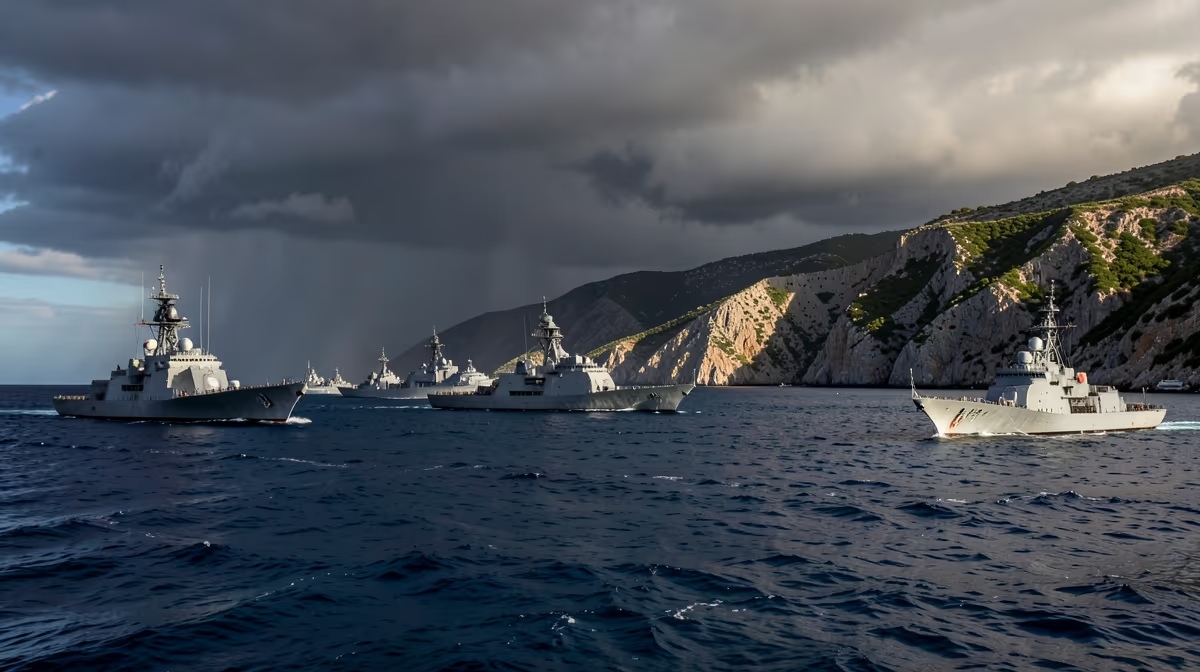
The strategic equilibrium of the Eastern Mediterranean has been thrust into a state of high-stakes diplomatic maneuvering following a direct confrontation over military positioning. Turkey warns France Cyprus troop deployments risk destabilizing an already fragile region, signaling a significant rift between two major NATO powers over the sovereignty and security of the divided island.
This diplomatic standoff risks escalating tensions between NATO allies in a critically important maritime region, potentially impacting global shipping routes and Mediterranean energy security.
The Escalation of Diplomatic Friction
The current friction centers on Turkey’s formal warning to France regarding the deployment of military forces to Cyprus. Ankara has expressed deep suspicion toward the French military presence on the island, interpreting the move as a disruption of the delicate balance of power that has been maintained in the region for decades. According to reports from al-monitor.com published on April 30, 2026, the Turkish government views these troop movements not merely as a localized security measure, but as a provocative strategic maneuver.
Turkey’s sensitivity to foreign military presence in Cyprus is rooted in its role as a protector of the rights of Turkish Cypriots. The Turkish administration argues that any external military buildup, particularly by a powerful European nation like France, complicates the already complex political landscape of an island that has been divided for more than half a century. The warning issued to Paris underscores Ankara’s resolve to remain the dominant regional influence in the Eastern Mediterranean.
Root Causes of the Strategic Competition
The tension between Ankara and Paris is not an isolated event but the result of profound disagreements over three primary pillars: maritime boundaries, energy exploration rights, and military influence. The Eastern Mediterranean has become a focal point for international interest due to the discovery of lucrative offshore hydrocarbon reserves. Control over these resources is a primary driver of the intense strategic competition currently unfolding.
Maritime and Energy Disputes
The struggle for control over Mediterranean shipping and energy routes has led to a situation where European powers and Turkey are in direct competition for strategic leverage. The economic angle of this dispute is significant; the offshore hydrocarbon reserves represent a major shift in energy independence for the nations that can successfully claim them. Turkey views French military involvement as an attempt by Paris to project power at Turkey's expense, particularly in areas Ankara considers part of its maritime jurisdiction.
The Fracturing of NATO Diplomacy
This standoff highlights a growing crisis within the security architecture of the North Atlantic Treaty Organization (NATO). As France challenges Turkey's assertive foreign policy posture in its southern neighborhood, the internal cohesion of the alliance is put to the test. The dispute underscores how individual national interests regarding regional sovereignty can override collective alliance goals, leading to what analysts describe as a "geopolitical friction" that could have long-term consequences for NATO’s military strategy.
A History of Partition and Crisis
To understand the current warning, one must look back to the historical foundations of the Cyprus dispute. The island has been politically and physically divided since 1974. This division followed a Turkish military intervention that was triggered by a coup inspired by the Greek government of the time. The result was the partition of the island into the internationally recognized Republic of Cyprus—now a member of the European Union—and the internationally unrecognized Turkish Republic of Northern Cyprus.
The 1974 Legacy and the UN Buffer Zone
The 1974 crisis created a lasting territorial dispute involving Turkey, Greece, and various international intermediaries. A UN buffer zone still separates the two sides, and the island remains a historically sensitive flashpoint. Turkey maintains a significant military presence in the north to protect its interests and the Turkish Cypriot population. The introduction of French troops into this environment is seen by Ankara as a direct challenge to the status quo and the Hellenic Armed Forces' historical alignment with the Republic of Cyprus.
- The island remains one of the most militarized regions in Europe.
- The Republic of Cyprus holds international recognition and EU membership.
- The Turkish Republic of Northern Cyprus is recognized only by Ankara.
- The UN buffer zone serves as a constant reminder of the unresolved conflict.
Strategic Manuevering and Hidden Agendas
Analysts monitoring the situation have identified a "hidden angle" to the French deployment. It is suggested that France may be using the troop movements to Cyprus as a means to forge tighter defense pacts with Greece and other southern EU member states. This strategy appears designed to create a unified anti-Turkey coalition within the framework of European Union foreign policy. By positioning itself as a security guarantor for the Republic of Cyprus, France projects itself as the leading military power in the Mediterranean, often at the direct expense of Turkish regional sovereignty.
| Actor | Primary Objective | Strategic Risk |
|---|---|---|
| Turkey | Protect regional influence and Turkish Cypriot rights | International isolation and strained NATO ties |
| France | Project European power and secure energy routes | Escalation with a major NATO military power |
| Cyprus | Maintain territorial integrity and EU support | Becoming a theater for a larger proxy conflict |
Security Assessment and Predicted Developments
The immediate future of this standoff is expected to be defined by intense diplomatic posturing. In the next 24 hours, Turkish authorities are expected to continue issuing statements responding to the French presence. Within the next 72 hours, we may see further policy clarifications from both Paris and Ankara as they attempt to define their strategic positions without triggering a direct military confrontation.
The situation underscores an ongoing competition for security and strategic leverage in Mediterranean shipping and energy routes that could redefine regional alliances.
Experts predict that while a best-case scenario would involve a de-escalation through diplomatic dialogue and clarified intentions, the worst-case scenario remains an escalation of rhetoric that leads to further strained bilateral relations. Any miscalculation in the Eastern Mediterranean could lead to increased strategic competition that would affect not only the immediate neighbors but the entire European security landscape.
The Human and Regional Impact
The people most affected by this diplomatic clash are the residents of Cyprus and the populations of the surrounding Mediterranean nations. The uncertainty of military movements and the potential for a "Cyprus sovereignty crisis" create an environment of instability. For international actors, the primary concern is the maintenance of Mediterranean stability. The shipping routes in this region are vital for global trade, and any disruption caused by military friction would have economic ripples far beyond the shores of Cyprus.
Frequently Asked Questions
What happened regarding Turkey and France over Cyprus?
Turkey issued a warning to France concerning a French troop deployment to Cyprus. This diplomatic friction highlights ongoing geopolitical tensions in the Eastern Mediterranean region.
Why does the Cyprus troop deployment matter?
Military movements in Cyprus carry significant weight due to the island's long-standing division and strategic importance. Any external military involvement can inflame regional rivalries between NATO allies like Turkey and France.
Who is affected by the Turkey-France tensions over Cyprus?
The diplomatic fallout directly involves the governments of Turkey and France, while also impacting regional stability in Cyprus and the broader Eastern Mediterranean. Additionally, it concerns international bodies monitoring security dynamics in the area.
What happens next following Turkey's warning?
Diplomatic channels will likely be utilized to de-escalate the rhetoric between Ankara and Paris. Observers will closely monitor both nations' military postures in and around Cyprus to prevent further friction.
What is the background of French and Turkish involvement in Cyprus?
Cyprus has long been a flashpoint involving various international actors due to its partitioned status between the Republic of Cyprus and the Turkish Republic of Northern Cyprus. Turkey maintains a military presence there, while nations like France engage in regional defense cooperation.
How has the situation been reported by media sources?
Recent developments regarding the Turkish warning to France over Cyprus troop deployments have been highlighted by international news outlets like al-monitor.com. These reports focus on the diplomatic implications and strategic positioning in the region.
Conclusion
The warning issued by Turkey to France over the deployment of troops to Cyprus represents a critical juncture in Eastern Mediterranean geopolitics. This dispute is fueled by a complex intersection of historical grievances dating back to 1974, a modern struggle for hydrocarbon energy reserves, and a competition for leadership within the NATO alliance. As Ankara remains fiercely protective of its regional sovereignty and the rights of Turkish Cypriots, France’s move to increase its military footprint signals a push for greater European influence in Mediterranean security.
The unfolding diplomatic situation highlights the fragility of regional stability. While both nations are expected to utilize diplomatic channels to manage the immediate friction, the underlying root causes—maritime boundary disputes and energy rights—remain unresolved. Observers will continue to monitor the 72-hour window for any signs of de-escalation or further strategic competition. Ultimately, the resolution of this standoff will require a delicate balance between national interests and the collective need for security in one of the world's most vital maritime regions.
Sources
- Turkey warns France over Cyprus troop deployment: What to know — al-monitor.com


.webp)


