
France Student Protests Turn Violent As Unrest Grips Paris
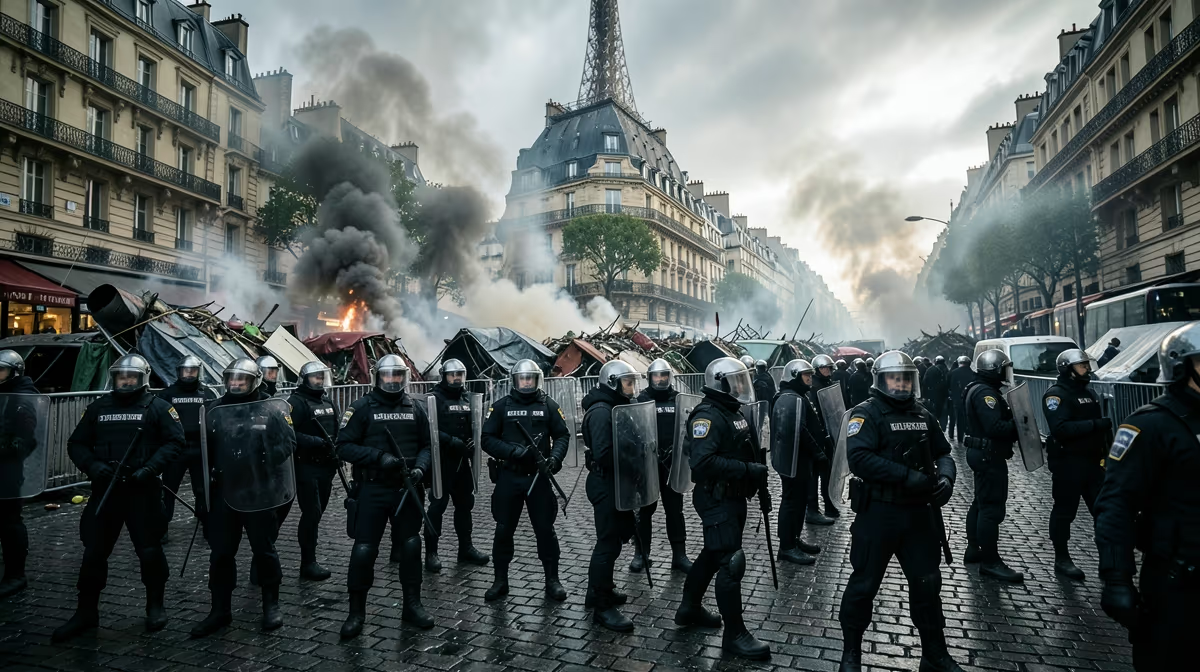
Plumes of thick smoke rising above Parisian neighborhoods and the rhythmic thud of security boots on cobblestones now signal a deepening crisis that has paralyzed the French education system. What began as localized student strikes in the capital has evolved into a nationwide mobilization, as France student protests turn violent and force the closure of hundreds of secondary institutions.
The massive scale of unrest, marked by the shuttering of hundreds of high schools and over 2,000 arrests, signals a profound rupture between the French state and its youth over education reform and economic security.
Across the country, the atmosphere has shifted from organized political demonstration to volatile civil disruption. The escalation has been rapid, catching many by surprise as the movement jumped from the streets of Paris to the broader French landscape. Major news organizations including The Guardian, NBC News, and Al Jazeera have documented a surge in fires, property destruction, and intense physical altercations between demonstrators and law enforcement. This is not merely a localized strike; it is a systemic eruption of youth-led frustration that has effectively gripped the nation’s infrastructure.
The Rapid Escalation of Nationwide School Closures
The geographic spread of the movement has transformed a Parisian protest into a national emergency. Initially focused on the heart of the capital, the demonstrations have radiated outward, touching nearly every major administrative region. This expansion has left the Ministry of Education and local authorities struggling to maintain standard operations.
The Impact on High School Infrastructure
Containment and Police Intervention
Analyzing the Socio-Political Triggers
The violence seen in the streets is a symptom of deeper, underlying grievances that have been building for months. Analysts point to a combination of policy changes and economic realities that have left the younger generation feeling increasingly marginalized.
- Frustration over education reforms that many students believe will limit their future opportunities.
- Mounting cost-of-living pressures that disproportionately affect families and young adults.
- A general sense of anxiety regarding future economic security in an era of high inflation.
| Timeline | Evolution of the Movement |
|---|---|
| Late September 2026 | Initial student demonstrations materialize in Paris, escalating into localized clashes and early detentions. |
| Early October 2026 | Protests spread outward from Paris, resulting in hundreds of school closures and 2,000 arrests nationwide. |
The widespread closure of schools and the high volume of arrests highlight a significant civil disruption in France, raising concerns about public safety and how the government handles youth-led movements.
The Political and Economic Stakes for the Macron Government
The rapid escalation and violent turn of these protests place significant pressure on the French government and administrative authorities. For the Macron government, the challenge is two-fold: maintaining public order while addressing the core grievances that have galvanized the youth. The current situation tests the resilience of the state’s security apparatus and its ability to negotiate under duress.
Local Economic Disruption
Geopolitical Implications
Historical Parallels and Systemic Disillusionment
To understand the current "fury and fires," one must look at the historical context of French activism. The current wave of unrest draws inevitable comparisons to the May 1968 student riots and general strikes. Much like that era, the current movement suggests a deeper, systemic disillusionment with traditional political representation among urban and suburban youth.
This "hidden angle" of the protests suggests that the movement is about more than just specific education reforms; it is a signal of a longer-term shift in French civic engagement. The youth are not just asking for policy changes; they are expressing a lack of faith in the existing political structures to provide a stable and prosperous future. This disillusionment often manifests as the volatile street presence currently being witnessed.
Predicting the Next 72 Hours
The immediate future remains highly uncertain, with the potential for both stabilization and further escalation.
Immediate Security Outlook
Medium-Term Expectations
Best and Worst Case Scenarios
Frequently Asked Questions
What caused the student protests in France to turn violent?
The student demonstrations escalated into intense clashes with authorities, resulting in widespread fires, fury, and major disruptions. Protesters and security forces faced off in the streets, leading to high levels of tension across the country as frustration over education reforms and economic pressures boiled over.
How many people have been arrested during the French student protests?
Hundreds of individuals were detained in the early stages, but as the unrest spread over several days and violence escalated, total reports indicate that arrests have climbed into the thousands following major law enforcement operations.
Why are students protesting across France?
Students are taking a stand against educational reforms, cost-of-living pressures, and concerns over future economic security. The movement has grown into a massive nationwide mobilization involving both high school and university students.
Who is affected by the school closures in France?
Hundreds of high schools have been forced to close. This directly impacts students, teachers, and parents, causing major disruptions to the academic schedule and daily life in multiple regions.
Did the protests remain confined to Paris?
No. While the demonstrations originated in Paris, they quickly spread far beyond the capital, triggering violent clashes and disruptions in multiple cities and regions across France.
What is expected to happen next as the protests escalate?
Tensions remain high as thousands have been arrested and many schools remain shuttered. The situation poses a significant challenge for French authorities, who are attempting to restore order while students continue to voice their demands.
Conclusion
The current wave of student unrest in France represents one of the most significant challenges to domestic stability in recent memory. By spreading from Paris to the national stage and resulting in the closure of hundreds of high schools, the movement has demonstrated the depth of youth frustration over education and economic reform. With over 2,000 arrests and continued violent clashes, the immediate priority for the state is the restoration of order and the safety of the public education infrastructure. However, the underlying socio-political triggers—economic anxiety and systemic disillusionment—suggest that a simple security response may not be enough to resolve the crisis. The coming days will determine whether the French government can engage in a dialogue that addresses these deep-seated grievances or if the nation will face a prolonged period of civil disruption and academic paralysis.
Sources
- Fires, fury and hundreds of arrests as France gripped by student protests — The Guardian
- Hundreds detained as student protests across France turn violent — The Guardian
- Why Are Students Protesting Across France? — Time Magazine
- 2,000 arrested in France as student protests escalate into violence — NBC News
- France student protests spread from Paris, with violent clashes forcing hundreds of high schools to close — CBS News
- Protests shutter hundreds of French schools as violence flares — Al Jazeera


.webp)
