
Indian Pilot Saves Flydubai Flight from Terrifying 9/11-Style Attack
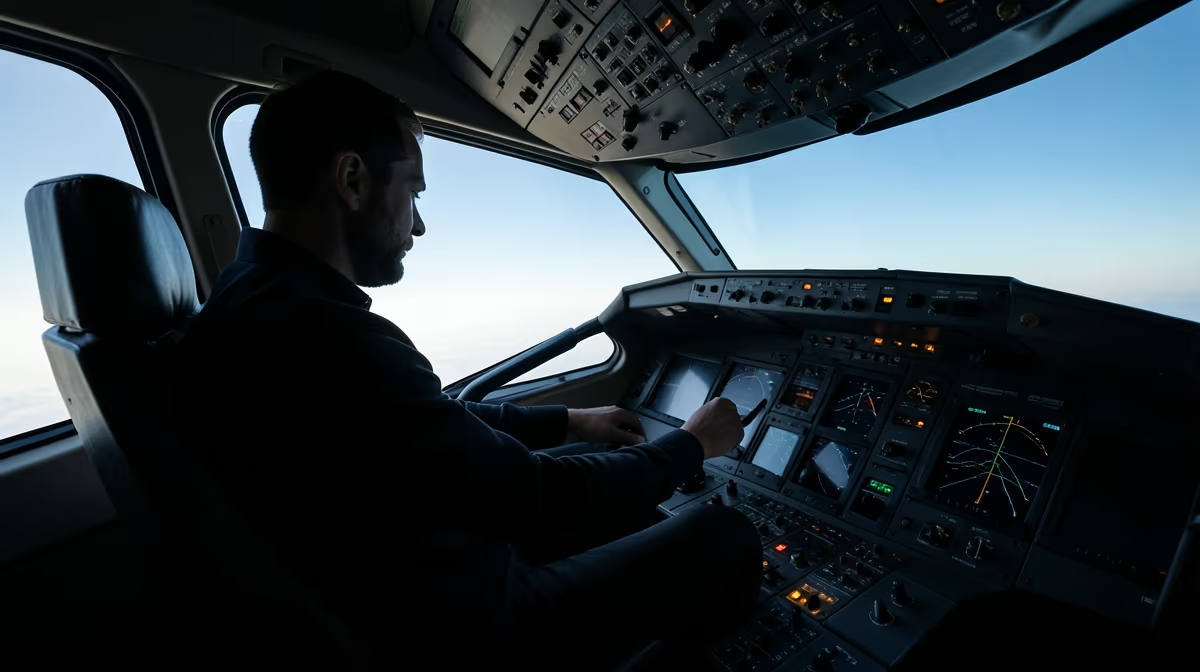
High above the transit routes connecting the Gulf to Israel, the boundary between a routine commercial journey and a global tragedy was held together by the resolve of a single individual. In a remarkable display of courage and quick thinking, an Indian pilot saves flydubai flight from a catastrophic security threat that many are now comparing to the dark mechanics of the September 11 attacks.
The incident involved a high-stakes struggle for control within the cockpit, where the lives of 174 passengers—many of whom were Israeli nationals—hung in the balance. Captain Smit Machchhar, an Indian national, found himself in a life-or-death confrontation with his first officer, who reportedly attempted to compromise the aircraft during its journey toward Israel. This harrowing mid-air emergency has sent shockwaves through the aviation community, highlighting the persistent vulnerability of the flight deck to internal threats.
Captain Smit Machchhar's quick action and bravery in the cockpit ensured the safety of 174 passengers, averting what could have been a catastrophic tragedy.
The Mid-Air Confrontation and Intervention
The details emerging from the flight deck paint a scene of sudden and extreme violence. While the aircraft was en route, the first officer—later identified in reports as an Omani national—allegedly wielded a knife against Captain Machchhar. The motive, according to initial reports and Israeli media, was an attempt to take forceful control of the aircraft with the intent to crash it, mirroring the tactics used in historic terrorist incidents.
In the confined space of the cockpit, Machchhar was forced to engage in a physical struggle to neutralize the threat. Reports indicate that despite sustaining knife injuries during the altercation, the captain managed to subdue the hostile co-pilot. This decisive intervention prevented the first officer from executing a maneuver that could have resulted in a mass-casualty event. The ability of the captain to maintain situational awareness while under physical assault is being hailed by security experts as a masterclass in mid-air emergency response.
The Profile of Captain Smit Machchhar
Captain Smit Machchhar has been widely identified as the hero of the incident. An Indian national flying for the Dubai-based carrier, Machchhar’s background and professional conduct are now under the global spotlight. His actions have been praised not only for his physical bravery but for his adherence to the ultimate responsibility of a pilot-in-command: the safety of the souls on board. Media outlets, including the New York Post and Deccan Herald, have focused on Machchhar's identity as a testament to the international nature of aviation crews and the shared commitment to passenger safety that transcends national borders.
Aviation Security and the Insider Threat
This incident underscores a chilling reality in modern aviation: the "insider threat." While global security measures have focused heavily on passenger screening and the hardening of cockpit doors since 2001, the risk posed by a radicalized or psychologically unstable crew member remains a complex challenge.
The struggle aboard the flydubai flight is being analyzed as a failure of internal cockpit threat management, where an individual with authorized access to the controls turns against the mission. This event places immense pressure on airlines to reassess how they vet and monitor the mental health and ideological leanings of their flight crews, particularly those operating on politically sensitive or high-risk regional routes.
Historical Parallels in Cockpit Security
Analysts have quickly drawn parallels between this event and the Germanwings Flight 9525 tragedy. In that instance, a co-pilot intentionally crashed an aircraft, exposing significant vulnerabilities regarding internal cockpit threats and the absence of mandatory rules requiring at least two authorized persons to be in the cockpit at all times.
While the Germanwings disaster resulted from a lack of intervention, the flydubai incident was a "near-miss" specifically because of the active resistance provided by Captain Machchhar. The comparison highlights that despite the stricter door-locking mechanisms and enhanced vetting processes implemented after 2001, the presence of a second, loyal crew member remains the final line of defense against an internal hijacking attempt.
Geopolitical and Regional Implications
The incident carries significant geopolitical weight, testing the intelligence-sharing mechanisms and diplomatic relations between India, Oman, and Israel. Because the flight was Israel-bound and carried a large number of Israeli citizens, the attempt to crash the plane is viewed through the lens of regional counter-terrorism.
Impact on Middle Eastern Aviation
| Event Phase | Development |
|---|---|
| Initial Incident | Captain Smit Machchhar fends off a knife-wielding co-pilot on an Israel-bound flydubai flight. |
| Global Recognition | Media outlets identify Machchhar and highlight the averted 9/11-style attack, praising the rescue of 174 passengers. |
| Institutional Review | International aviation authorities begin reviews of cockpit security protocols and crew screening. |
The political angle of this event is particularly delicate. It places diplomatic pressure on aviation safety standards across the Middle East and highlights the complexities of national security cooperation. For Israel, the incident reinforces concerns over the safety of its citizens on international carriers, while for Oman and India, the involvement of their nationals necessitates transparent and swift multinational investigations.
Economic and Operational Fallout
Beyond the immediate safety concerns, the economic impact of such a security breach is substantial. Airlines may face potential cost increases as they are forced to reassess cockpit vetting processes. This could include more frequent and rigorous mental health evaluations and, in some high-risk scenarios, the consideration of increased security measures for crews on sensitive routes.
There is also the potential for public anxiety regarding regional travel. If the incident is perceived as part of a broader trend of radicalization within the industry, it could lead to prolonged grounding or increased security delays for flights heading into high-profile destinations like Israel. For flydubai, the challenge will be to demonstrate that its recruitment and monitoring protocols are robust enough to prevent a recurrence.
Security Assessment and Future Protocols
In the wake of this averted disaster, expert predictions suggest a period of heightened scrutiny. Aviation authorities and flydubai management are expected to conduct a deep-dive investigation into the background of the Omani co-pilot to determine the root cause—whether it was an isolated psychological breakdown or a result of ideological radicalization.
This incident highlights the critical role and immense pressure faced by commercial airline pilots, whose split-second decisions can mean the difference between life and death for hundreds of passengers.
The investigation will likely focus on: - Strengthening the psychological vetting during the recruitment of flight crews. - Implementing more rigorous "peer reporting" mechanisms within airlines. - Reviewing the safety of cockpit tools and the potential for them to be used as weapons. - Enhancing diplomatic communications between the home countries of flight crews and the destination countries of sensitive flights.
Predicting the Next 72 Hours
The next 72 hours are expected to be dominated by official statements from aviation authorities and flydubai management. Further investigations into the cockpit security breach will continue alongside diplomatic communications between the involved nations. The "best-case scenario" for the industry would be a transparent investigation confirming the incident was an isolated event, leading to strengthened global protocols without causing major diplomatic fallout. Conversely, the "worst-case scenario" involves this triggering intense friction between the involved countries and severe public anxiety over regional flight safety.
Frequently Asked Questions
What happened on the flydubai flight involving the Indian pilot?
An Indian captain named Smit Machchhar successfully fought off a knife-wielding co-pilot who attempted to carry out a 9/11-style attack on an Israel-bound flight. The captain's swift intervention prevented a catastrophic disaster mid-air.
Who is the Indian pilot hailed for preventing the flydubai attack?
The pilot is identified as Captain Smit Machchhar, an Indian national serving as the captain on the flydubai flight. He has been widely praised for his bravery in subduing the attacker.
Why is this incident being compared to a 9/11-style attack?
The incident is being compared to 9/11 because reports indicate the co-pilot attempted to forcefully take control of the aircraft with the intent to crash it. Quick thinking and physical intervention by the captain thwarted the attempt.
How many passengers were on board the flydubai flight?
The flight was carrying passengers, including 174 Israeli nationals, who were safely protected thanks to the pilot's heroic actions in stopping the rogue co-pilot.
What is the background of the co-pilot involved in the flydubai incident?
According to initial reports, the co-pilot involved in the attack was an Omani national who wielded a knife against the captain inside the cockpit before being overpowered.
What happens next regarding the investigation of the flydubai flight attack?
Airlines and international aviation authorities are expected to review cockpit security protocols and thoroughly investigate the background and motives of the co-pilot. Legal and security proceedings will follow as official details are finalized by relevant authorities.
Conclusion
The intervention by Captain Smit Machchhar stands as a definitive moment in modern aviation security, proving that even with advanced technology and locked doors, the human element remains the most vital safety component. By subduing a knife-wielding co-pilot who sought to crash a flight carrying 174 passengers, Machchhar averted a regional disaster that could have had massive geopolitical consequences. As international authorities transition from the immediate shock of the event to a formal investigative phase, the focus will shift toward closing the security gaps that allowed a co-pilot to become an internal threat. The coming weeks will likely see a global re-evaluation of crew vetting, ensuring that the heroism shown by Machchhar is met with systemic changes to prevent such a confrontation from ever happening again.
Sources
- Pilot of flydubai plane who fought off 'terrorist' first officer on Israel-bound flight ID'd as Indian national — New York Post
- Know all about Smit Machchar, the Indian pilot of Flydubai flight who got stabbed by co-pilot — Deccan Herald
- Who is Smit Machchhar, Indian pilot who prevented '9/11-like' attack?: Fought off knife-wielding co-pilot; ... — Bhaskar English
- Not All Heroes Wear Capes: Capt. Smit Machchhar, The Indian Pilot Who Saved 174 Israelis — The Bronx Daily
- Who Is Smit Machchhar, Indian Pilot Who Fended Off Omani Co-Pilot Aboard Flydubai Flight? — News18
- Indian captain fought off co-pilot who tried to crash plane: Israeli media — Deccan Herald


.webp)

