
Bahrain Iran Tensions Escalate in a Dangerous New Regional Shift
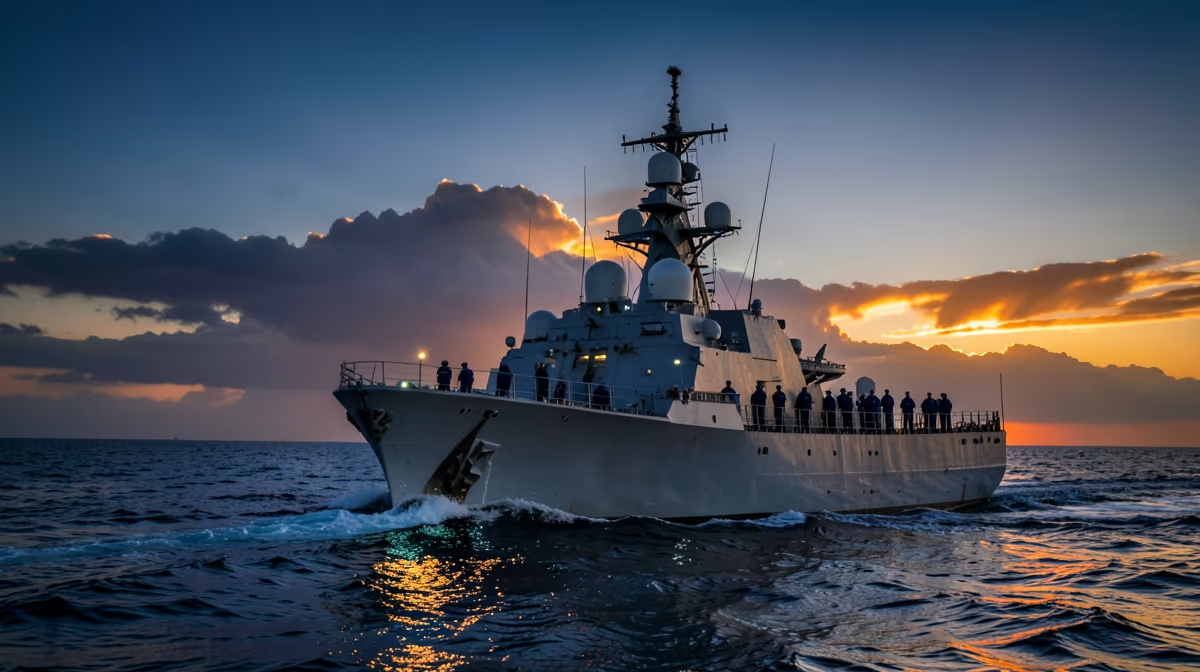
Shadows are lengthening across the Persian Gulf as a cycle of aggressive posturing threatens to puncture the fragile status quo in one of the world's most critical maritime corridors. The latest escalation regarding Bahrain Iran tensions has reignited concerns over Middle East regional stability, prompting international observers to closely monitor shifts in Gulf defense and potential proxy activities.
What Unfolded
The United States has condemned recent escalatory rhetoric and destabilizing activities linked to Iran regarding Bahrain, reaffirming its commitment to the security of its regional partners amidst rising tensions in the Persian Gulf. In a statement issued from Washington, the U.S. State Department expressed deep concern over reported Iranian-backed threats directed at Bahraini sovereignty. Officials emphasized that the United States continues to monitor maritime security and regional intelligence to deter potential military or proxy aggression against the island nation, which hosts the U.S. Navy’s Fifth Fleet.
This regional friction follows a series of public warnings from Bahraini officials regarding alleged foreign interference and support for illicit groups. Analysts suggest that the rhetoric reflects a broader strategy by Tehran to exert pressure on Gulf states that have pursued normalization or closer security ties with Western powers. Defense experts in the United States noted that the presence of U.S. naval assets serves as a critical deterrent against any direct or indirect military confrontation. Washington maintains that regional stability is paramount to global energy supplies and continues to coordinate closely with Manama to bolster local defensive capabilities.
Key Facts
The current security landscape is defined by several critical realities. Reports indicate increased military posturing and aggressive actions linked to Iranian proxies near Bahrain. Because Bahrain serves as the headquarters for the U.S. Navy's Fifth Fleet, it is a critical strategic location that necessitates a constant, heightened defensive posture. Global oil markets often react nervously to security threats in this region, and current diplomatic communications between regional powers remain severely strained. Furthermore, the U.S. government is actively evaluating the threat level to its personnel and assets stationed in the area. While there have been no direct full-scale military invasions by Iran against Bahrain, the Bahraini government has frequently accused Tehran of interfering in its internal affairs and supporting insurgent groups to destabilize the kingdom.
Why It Matters
The region acts as a vital artery for global energy supplies and international shipping. Any significant escalation involving Iran and its neighbors risks destabilizing world oil prices and potentially drawing the United States into a direct military conflict, which would have immediate economic and security repercussions worldwide. For the general public, this situation represents a spike in geopolitical friction that could influence maritime safety and trade routes. Citizens of Bahrain, U.S. military personnel stationed in the region, global energy consumers, and international shipping companies are the stakeholders most immediately affected by these developments. The historical memory of the 1980s Tanker War serves as a cautionary parallel, where regional maritime commerce became a primary theater for indirect conflict.
Analytical Assessment
The root cause of this instability lies in the structural containment of Iran's regional influence by the GCC-U.S. security architecture. The political angle is underscored by an intensification of the sectarian divide and the normalization of ties between Israel and Bahrain, a development Tehran views as an existential encroachment. Geopolitically, these events serve as a strategic test of the U.S.-Bahrain Defense Cooperation Agreement and a signal from Tehran regarding its asymmetric capabilities in the face of expanded Western military posture. A hidden dimension involves the exploitation of internal civil discord within Bahrain, which provides a pretext for external kinetic action, effectively blurring the lines between domestic insurgency and state-sponsored proxy aggression.
Political and Geopolitical Implications
Relations between Bahrain and Iran remain extremely tense, having been characterized by diplomatic hostility for years. Bahrain officially severed diplomatic ties with Iran in 2016 following attacks on Saudi diplomatic missions and persistent allegations of Iranian-backed subversion. The current tension is further exacerbated by the economic necessity of protecting oil transit chokepoints in the Persian Gulf and the subsequent requirement for increased regional military spending, which often diverts funds from domestic infrastructure development. Bahrain is a key strategic ally of the United States and continues to work closely with American officials to monitor and counter Iranian maritime and regional activities, maintaining that Iran's expansionist policies are designed to undermine the stability of the Bahraini monarchy.
Projected Developments
Within the next 24 hours, expect intensified diplomatic demarches and high-level calls between Manama and Washington to coordinate a joint defensive response and intelligence sharing. Moving into the next 72 hours, the region may witness an increased U.S. naval presence in the Persian Gulf and the potential imposition of new targeted U.S. sanctions against Iranian-linked entities identified in the recent incidents. Expert consensus points toward a cycle of calibrated escalation where the U.S. reinforces Bahrain's defensive capabilities while simultaneously utilizing back-channel communication to prevent a wider kinetic conflict. While a best-case scenario involves the situation being contained through diplomatic pressure, a worst-case scenario involves a retaliatory strike that leads to a cycle of tit-for-tat maritime skirmishes, threatening the security of critical energy chokepoints like the Strait of Hormuz.
Frequently Asked Questions
Has Iran ever attacked Bahrain?
There have been no direct full-scale military invasions by Iran against Bahrain. However, the Bahraini government has frequently accused Iran of interfering in its internal affairs and supporting insurgent groups to destabilize the kingdom.
What is the current state of relations between Bahrain and Iran?
Relations between Bahrain and Iran remain extremely tense and have been characterized by diplomatic hostility for years. Bahrain officially severed diplomatic ties with Iran in 2016 following attacks on Saudi diplomatic missions and ongoing allegations of Iranian-backed subversion.
Does Iran pose a threat to Bahrain?
The Bahraini government considers Iran to be a significant national security threat due to its regional influence and alleged support for local opposition factions. Bahrain relies on a strong security partnership with the United States to deter potential aggression.
Why are there tensions between Bahrain and Iran?
The primary sources of tension are geopolitical, religious, and security-related disagreements. Bahrain often cites Iran's expansionist policies and claims that Tehran exploits internal sectarian divisions to undermine the stability of the Bahraini monarchy.
Is Bahrain part of the US-led coalition against Iran?
Bahrain is a key strategic ally of the United States and aligns with American policies regarding regional security. While it is not part of a formal coalition specifically focused on an offensive against Iran, it works closely with the U.S. to monitor and counter Iranian maritime activities.
Could an Iran-Bahrain conflict start?
While direct military conflict is not currently underway, analysts remain concerned about the potential for proxy warfare or cyber-attacks. Regional stability is fragile, and any significant escalation in the Persian Gulf involving major powers could potentially draw Bahrain into a direct confrontation.
Conclusion
The situation in the Persian Gulf remains fluid as U.S. and Bahraini officials coordinate their response to recent provocations. While the immediate focus remains on intelligence gathering and reinforcing defensive postures, the risk of miscalculation persists in a theater defined by complex proxy dynamics. The commitment from the United States to support its regional partners serves as the primary barrier against further escalation. As the situation develops, the international community continues to watch for signs of either diplomatic de-escalation or further kinetic friction that could threaten global energy security.


.webp)

.webp)

