
Iran War Risks Mount as US Military Shifts Middle East Posture
Introduction
The delicate balance of power in the Persian Gulf is currently being tested as military assets reposition and diplomatic channels are stretched to their absolute limits. As geopolitical tension across the region reaches a critical threshold, reports of a potential iran war have dominated international headlines, prompting urgent analysis of regional safety. The current state of affairs is defined not by a sudden ignition of total conflict, but by a high-stakes, gray-zone struggle that risks slipping into kinetic escalation if miscalculations occur.
What Happened
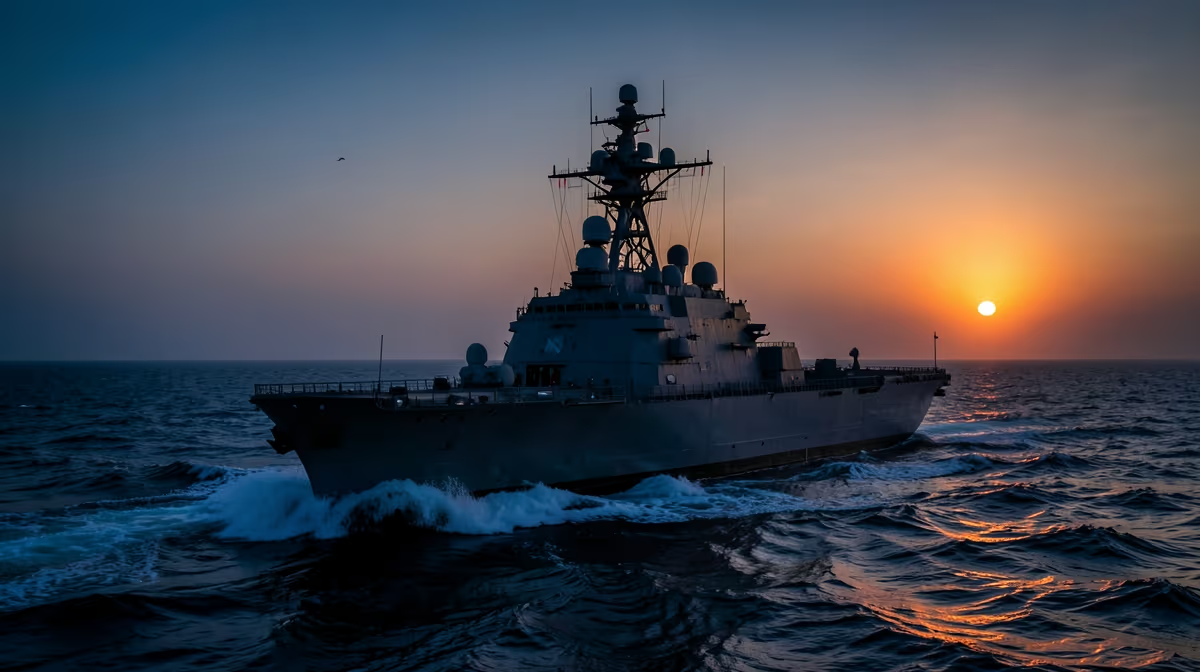
The United States has reinforced its military presence in the Middle East following heightened tensions with Iran, as officials confirm preparations for potential defensive maneuvers amid a surge in regional proxy activity. Pentagon officials announced the deployment of additional naval and aerial assets to the U.S. Central Command area of responsibility this week. This movement follows months of escalating hostilities between Iranian-backed groups and U.S. personnel stationed in Iraq and Syria, alongside a broader increase in regional maritime instability.
The Pentagon has formally confirmed the arrival of supplemental military hardware and a stated policy of proactive deterrence against Iranian influence. While the Biden administration has attributed multiple strikes to groups supported by the Islamic Revolutionary Guard Corps (IRGC), U.S. forces have responded with precision strikes against storage facilities in eastern Syria linked to the group. The current situation remains fluid, as the threshold for potential direct engagement between U.S. forces and Iranian military units continues to be tested by regional volatility.
Key Facts
The security architecture of the region is currently underpinned by several verified developments. The U.S. has successfully dispatched additional warships and fighter squadrons to the Middle East as a direct deterrent. Concurrently, Iranian-backed militias have maintained a steady pace of drone and rocket attacks on U.S. bases in Iraq and Syria, a pattern that has intensified since October. Economic sanctions remain a primary, consistent tool used by the U.S. to pressure the Iranian government, while concerns over Iran’s nuclear enrichment program continue to serve as a primary driver of the broader diplomatic standoff. Despite these pressures, international diplomatic efforts are ongoing to prevent a wider regional conflict that could engulf multiple sovereign nations.
Why It Matters
A direct war between the U.S. and Iran would have immediate global consequences, most notably a severe disruption to oil supply chains, which would cause energy prices to spike for international consumers. Furthermore, such a conflict could destabilize the entire Middle East, triggering a massive humanitarian crisis and necessitating the mobilization of thousands of American service members, drawing the U.S. into another prolonged foreign entanglement. The populations most affected include U.S. military personnel deployed in the Middle East, consumers facing potential fuel price hikes, and regional populations caught in the direct line of conflict zones. For global financial markets, the unpredictability of the region represents a significant threat to long-term stability and energy security.
Expert Analysis
The root cause of this volatility is the structural failure of the 2015 Joint Comprehensive Plan of Action and the fundamental incompatibility between Iran's regional hegemony strategy and the U.S. goal of maintaining the status quo in the Middle East. Historically, the relationship has been hostile since the 1979 Iranian Revolution and the subsequent hostage crisis, cycling through periods of extreme tension and brief diplomatic openings.
Analysts note that the current environment is defined by strategic posturing where both sides seek to avoid an all-out direct conflict, favoring proxy-based pressure while keeping lines of communication open to prevent miscalculation. There is a hidden layer of complexity involving clandestine cyber-warfare infrastructure that targets critical national industrial control systems rather than traditional military assets, creating a gray zone of perpetual instability. This mirrors the 1980s Tanker War during the Iran-Iraq conflict, where regional skirmishes threatened to expand into direct superpower intervention.
Political And Geopolitical Implications
Domestic U.S. electoral pressures necessitate a tough on Iran stance, while Iran utilizes anti-Western sentiment to consolidate internal political control amidst economic stagnation. This geopolitical dynamic is further complicated by the emergence of an Axis of Resistance backed by Russia and China, which frames the conflict as a proxy war between Western unipolarity and a multipolar world order. Economically, the conflict risks the weaponization of global financial systems via secondary sanctions and the potential for severe disruption to Strait of Hormuz oil shipments, threatening global energy inflation. The timeline of this descent is clear: from the 2018 U.S. withdrawal from the nuclear deal to the 2024 direct, retaliatory exchange of fire between the two nations, the shadow-war paradigm is effectively ending.
What Happens Next
Over the next 24 hours, expect heightened surveillance of Iranian proxies in Iraq, Syria, and Yemen, with U.S. naval assets remaining on high alert in the Persian Gulf accompanied by increased reconnaissance flights. Within 72 hours, the focus will likely shift toward diplomatic back-channel communication to de-escalate tensions, though the risk of minor skirmishes involving maritime assets or proxy militias remains.
The best-case scenario involves successful diplomatic intervention leading to a temporary ceasefire and de-escalation of rhetoric, preventing any kinetic military engagement. Conversely, the worst-case scenario involves a miscalculation by a proxy group resulting in significant U.S. casualties, which would trigger a formal U.S. military strike on Iranian territory and subsequent wider regional escalation.
Frequently Asked Questions
Is the United States currently at war with Iran?
No, the United States is not currently at war with Iran. While tensions remain high due to geopolitical disagreements and regional proxy conflicts, there has been no formal declaration of war or direct large-scale military engagement between the two nations.
What is the current relationship status between the US and Iran?
The diplomatic relationship between the U.S. and Iran is highly strained and currently characterized by a lack of formal diplomatic ties. Both nations rely on third-party intermediaries, such as Switzerland, to facilitate communications regarding critical security and consular issues.
Why are there tensions between the US and Iran?
Tensions stem from a variety of factors, including Iran's nuclear program, U.S. economic sanctions, and conflicting regional interests in the Middle East. The U.S. frequently expresses concern over Iran's support for militant proxy groups, while Iran views the U.S. military presence in the region as a threat to its sovereignty.
Would a war with Iran involve a ground invasion?
Military analysts widely suggest that a direct conflict with Iran would be significantly more complex than previous conflicts, given Iran's geography and defensive capabilities. Most experts emphasize that any hypothetical escalation would likely prioritize air, naval, and cyber operations rather than a large-scale ground invasion.
How do US sanctions affect Iran?
U.S. sanctions are designed to exert economic pressure on the Iranian government by restricting its access to international financial systems and energy markets. These measures have significantly impacted Iran's economy, leading to inflation and limited access to imported goods, though they remain a point of intense political contention.
What is the likelihood of a war between the US and Iran?
While the risk of unintended escalation exists due to regional incidents, most experts believe that neither the U.S. nor Iran actively seeks a full-scale direct war. Both sides generally employ deterrent strategies to manage the conflict and avoid a scenario that could lead to widespread regional instability.
Conclusion
The regional security environment remains dominated by a cycle of posturing and defensive maneuvering. While verified military assets have been bolstered to discourage further escalation, the overarching reality is that both the United States and Iran are navigating an increasingly narrow path to avoid direct, large-scale kinetic conflict. As diplomatic channels remain the primary focus for de-escalation, the global community must contend with the fact that regional stability is currently contingent upon the containment of proxy activities and the prevention of miscalculation in the Persian Gulf. Future developments will be defined by the success or failure of these quiet diplomatic efforts and the containment of localized skirmishes.
" } ]


.webp)

.webp)

