
Iran War Prospects Ignite Major Military Shift in the Middle East
Introduction
Shadows lengthen over the Persian Gulf as a precarious web of proxy conflicts threatens to unravel decades of delicate Middle Eastern security. The escalating prospect of an iran war continues to dominate international headlines, raising urgent questions about middle east energy security and the potential for wider conflict.
What Happened
The United States has reinforced its military presence across the Middle East this week following a significant escalation in regional hostilities involving Iran and its regional proxies. The Biden administration maintains that the increased troop deployments and naval assets are a deterrent measure aimed at preventing a broader conflict while seeking to protect American personnel and strategic interests.
Pentagon officials announced on Tuesday the deployment of additional fighter squadrons and air defense systems to the region, signaling a shift toward a more aggressive posture. This move follows a series of direct and indirect exchanges between Tehran and neighboring nations, which have heightened concerns in Washington regarding the stability of critical shipping lanes and the safety of U.S. diplomatic outposts. A deadly drone attack that claimed the lives of American service members in Jordan acted as the primary catalyst for these recent developments, prompting U.S. retaliatory airstrikes against Iranian-backed militia groups in Iraq and Syria.
White House security advisors have met throughout the week to evaluate the potential for further kinetic engagements. While U.S. officials have stated that they are not seeking an open war with Iran, they have emphasized that all options remain on the table should Iranian-backed forces continue to strike at U.S. assets or the security of allied nations. Diplomatic channels remain active as U.S. representatives engage in back-channel communications to de-escalate tensions. Despite these efforts, the situation remains volatile, with intelligence agencies monitoring potential movements of Iranian ballistic missile systems, which could pose an immediate threat if conflict parameters were to expand.
Key Facts
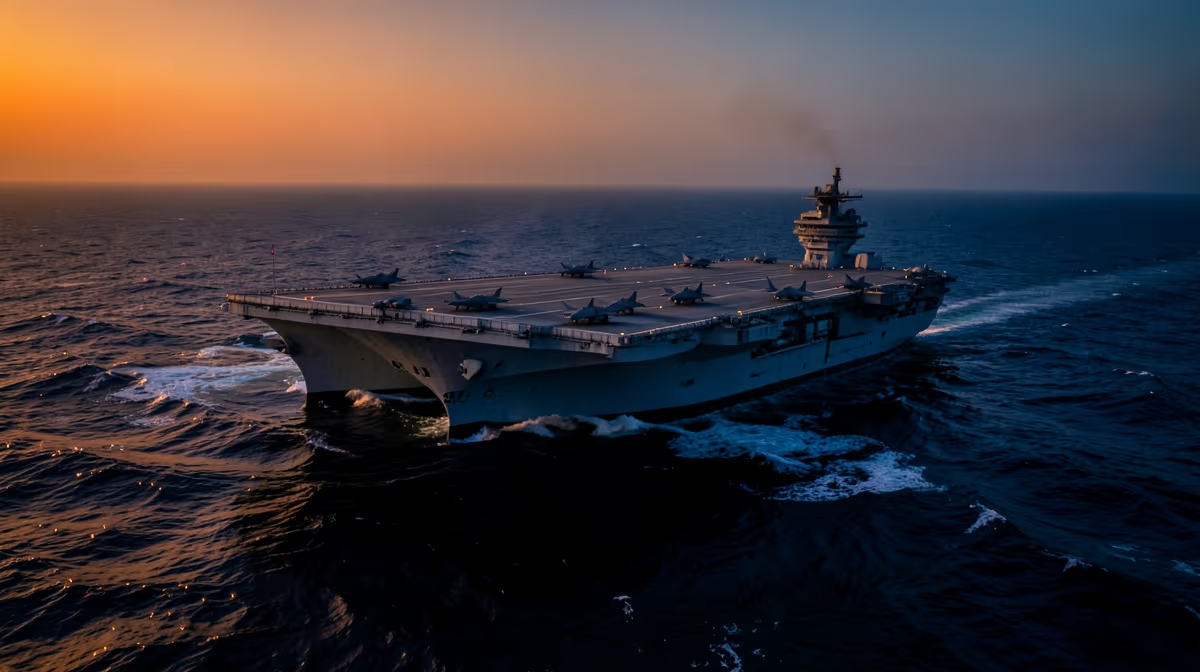
The core of the current crisis rests on a series of verified military and diplomatic realities. U.S. forces have conducted multiple retaliatory strikes against Iran-linked groups in Iraq and Syria. The conflict saw a major inflection point after a drone strike killed three U.S. soldiers at a base in Jordan. While the United States has dispatched additional fighter aircraft and moved naval assets, including a carrier strike group, into proximity with Iranian maritime borders, Tehran maintains that it does not directly control the various militia groups operating across the region. The White House has confirmed that protecting U.S. citizens remains its top priority, while global powers continue to call for urgent de-escalation to prevent the conflict from spreading further.
Why It Matters
A direct or prolonged conflict in this region threatens global energy supplies, as a significant portion of the world's oil flows through the nearby Persian Gulf. This reality places middle east energy security at the center of the current geopolitical stability debate. Instability in this corridor risks drawing in other major powers, potentially leading to a massive geopolitical crisis that would disrupt global markets, increase fuel prices for everyday consumers, and necessitate a broader U.S. military commitment abroad. Those most affected include U.S. military personnel stationed in the Middle East, local populations in Iraq and Syria, global oil markets, and the integrity of international supply chains.
Expert Analysis
The root cause of this friction is the structural failure of the 2015 JCPOA and the fundamental incompatibility between Iran's regional hegemony strategy and the U.S. goal of maintaining the regional status quo via the Abraham Accords. Analysts observe that domestic U.S. polarization forces a rigid hawkish stance, while conversely, Tehran utilizes anti-American defiance to consolidate internal revolutionary legitimacy amidst socio-economic fragility.
Economically, the situation is defined by the weaponization of the dollar-denominated global financial system against Iran, combined with Iran’s pivot to the BRICS plus energy architecture to bypass sanctions. Geopolitically, the world is witnessing a shift from a unipolar U.S.-led security architecture to a multipolar reality where Iran acts as a central node for the China-Russia-Iran resistance axis to challenge Western containment. Furthermore, a silent technological arms race in cyber-warfare and clandestine drone proliferation renders traditional kinetic war scenarios obsolete in favor of perpetual gray zone attrition. Historically, the current environment mirrors the 1980s Tanker War combined with US-Soviet proxy conflict dynamics, where escalation is managed through low-intensity encounters to avoid a total systemic collapse.
Political And Geopolitical Implications
The current landscape is defined by a high-frequency shadow warfare and deterrence balancing. Since the 2018 U.S. withdrawal from the JCPOA and the subsequent activation of the Axis of Resistance post-October 7, the window for traditional diplomacy has narrowed. Domestic political pressures on both sides of the divide complicate attempts at long-term resolution. Foreign policy analysts warn that the current cycle of strikes risks miscalculation, potentially turning managed, low-intensity conflict into a broader, uncontrollable regional catastrophe.
What Happens Next
Over the next 24 hours, the region will likely see heightened surveillance and intelligence gathering by U.S. assets in the Persian Gulf, accompanied by increased diplomatic signaling to regional allies to prevent escalation. Within 72 hours, observers may witness the implementation of targeted sanctions or increased maritime patrol presence in the Strait of Hormuz to deter potential Iranian proxy attacks. Experts anticipate a continuation of the gray zone conflict model, favoring covert asymmetric warfare and diplomatic posturing over a direct, large-scale military confrontation. The best-case scenario involves successful back-channel de-escalation leading to a temporary cessation of proxy group hostilities, while the worst-case scenario entails a miscalculation by regional proxies resulting in significant U.S. military casualties, which would trigger a formal kinetic response and a wider regional conflict.
Frequently Asked Questions
Is the US at war with Iran?
The United States is not currently at war with Iran, and there has been no formal declaration of conflict between the two nations. While the US and Iran have engaged in long-standing geopolitical tensions and proxy conflicts, they have avoided direct large-scale military confrontation.
Why are there tensions between the US and Iran?
Tensions between the US and Iran and the US stem from decades of diplomatic friction, including disagreements over Iran's nuclear program and its influence in the Middle East. The US has imposed various economic sanctions on Iran, while Iran has often criticized US military presence in the region.
What is the current status of the US-Iran relationship?
The relationship remains highly volatile and characterized by a lack of formal diplomatic ties. Both nations frequently engage in verbal warnings and military posturing, though both sides have historically sought to avoid a full-scale direct war.
Would a war with Iran affect the US economy?
A major conflict with Iran would likely have significant global economic consequences, particularly concerning oil prices and international shipping routes. Because Iran is a major oil producer and controls the Strait of Hormuz, disruption in the region could cause a spike in gas prices and affect global supply chains.
Does the US have military bases near Iran?
Yes, the United States maintains a significant military presence in the Middle East with bases in countries such as Qatar, Bahrain, Kuwait, and the United Arab Emirates. These bases are positioned to project power and maintain stability in the region, which Iran frequently views as a security threat.
Could a war with Iran lead to a larger regional conflict?
Many experts warn that a direct war between the US and Iran could rapidly escalate into a broader regional conflict involving various proxy groups and allied nations. Given the complex network of alliances in the Middle East, a localized skirmish has the potential to destabilize the entire region.
Conclusion
The situation in the Middle East remains a volatile intersection of historical grievances and modern power struggles. While both the United States and Iran continue to signal a preference for avoiding total systemic collapse, the cycle of low-intensity proxy warfare ensures that the risk of miscalculation remains high. Current military posturing and intelligence activity are focused on deterrence and the protection of strategic interests, particularly concerning global energy corridors. As diplomatic channels continue to operate under extreme pressure, the immediate future will likely be defined by the success of these back-channel negotiations and the restraint shown by all parties in the face of ongoing gray zone attrition.


.webp)

.webp)

