
Iran War Tensions Trigger Urgent US Military Reinforcements Worldwide
Introduction
The shadow of a potential iran war looms over the Persian Gulf, forcing a delicate recalibration of international security architectures. This shift in the global balance of power is not merely a regional friction but a structural stress test for every major capital from Washington to Tehran.
What Happened
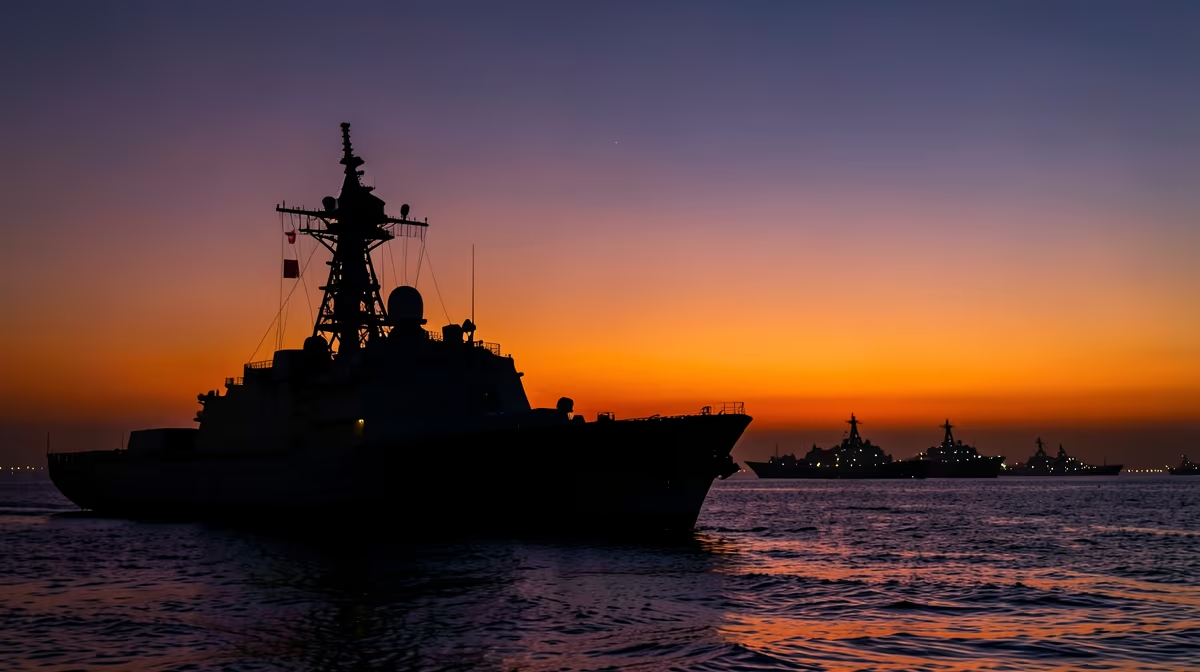
The United States has reinforced its military posture in the Middle East as heightened tensions between Iran and Israel threaten to escalate into a broader regional conflict following recent cross-border strikes. Pentagon officials confirmed the deployment of additional naval and air assets to the region this week, citing the urgent need to protect American personnel and support the defense of strategic partners. This move follows a series of direct exchanges between Iranian forces and Israeli defense systems, which have prompted intense diplomatic interventions from the White House and international allies seeking to prevent a full-scale war.
Intelligence agencies are actively monitoring Iranian military movements for signs of a coordinated multi-front response. While the Biden administration has consistently maintained that the United States does not seek a direct conflict with Tehran, it has affirmed its preparedness to take necessary actions to ensure regional stability and deter further aggression. Defense Secretary Lloyd Austin stated that the United States will continue to take all necessary measures to protect its people and its partners, emphasizing that the current American military presence is specifically designed to deter wider conflict. Currently, diplomatic channels remain active as regional brokers attempt to mediate a ceasefire, though the rhetoric emanating from Tehran suggests a continued commitment to retaliatory measures.
Key Facts
The historical context of the current standoff dates back to 1979, the year the United States and Iran lost formal diplomatic relations. The relationship has been consistently strained by the collapse of the 2015 Iran nuclear deal, persistent cyber-warfare, and competing strategic interests across the region. Iran actively supports a network of regional militias often described as the Axis of Resistance, while the United States maintains severe economic sanctions aimed at curbing Iranian influence and nuclear ambitions. Recently, U.S. military bases in the Middle East have been targeted by Iranian-backed groups, prompting both nations to utilize direct military assets to signal strength and deterrence. Currently, the United States has dispatched additional fighter squadrons and naval vessels to the Central Command area of responsibility to bolster its defensive capabilities.
Why It Matters
The prospect of regional escalation carries significant weight for the global order. A full-scale conflict would likely lead to a volatile spike in global oil prices, as the Persian Gulf serves as a primary corridor for international energy supplies. Beyond energy, the conflict threatens the stability of regional allies such as Israel and Saudi Arabia, potentially drawing other global powers into the fray. The instability directly affects U.S. military personnel stationed abroad, civilians living in the Middle East, and the integrity of international trade routes. Investors and policymakers remain focused on the risk to global markets, as any sustained disruption to the Strait of Hormuz would have immediate economic consequences for energy-dependent nations worldwide.
Expert Analysis
The root cause of this instability lies in the structural failure of the 2015 Joint Comprehensive Plan of Action and the fundamental incompatibility between Iran's regional hegemony strategy and the U.S. policy of maintaining the status quo in the Middle East. Analysts point to a historical parallel in the 1953 Anglo-Iranian oil crisis, which serves as a foundational trauma shaping Iranian distrust of Western interventionism.
From a geopolitical perspective, the emergence of an anti-Western axis between Iran, Russia, and China forces the United States to balance containment in the Middle East with intense competition in the Indo-Pacific and Ukraine. Furthermore, there is a hidden internal dynamic regarding Iran's transition to a post-Khamenei power structure; the Islamic Revolutionary Guard Corps appears to be seeking to lock in a hardline foreign policy before a leadership vacuum occurs. Domestically, the situation is further complicated by U.S. pressure to project strength during election cycles, which mirrors the Iranian regime's requirement to maintain internal stability through external revolutionary rhetoric.
Political And Geopolitical Implications
The ongoing tensions have forced a strategic pivot in U.S. foreign policy. The United States must manage the volatility of global energy markets while navigating the efficacy of secondary sanctions as a weaponized economic tool. Because Iran, Russia, and China are increasingly coordinating their efforts, the U.S. is constrained in its ability to focus exclusively on any one theater. Meanwhile, regional actors are balancing their security needs against the risk of becoming collateral damage in a broader kinetic exchange, leading to a precarious landscape of limited skirmishes and intense back-channel diplomacy.
What Happens Next
Over the next 24 hours, experts anticipate increased intelligence gathering, a heightened regional military posture, and urgent diplomatic back-channel communications intended to prevent immediate escalation. If these de-escalation efforts fail, the next 72 hours may involve targeted kinetic operations or cyberattacks, accompanied by intense United Nations Security Council deliberations. Most analysts anticipate a continuation of gray zone warfare and limited skirmishes rather than an immediate full-scale invasion, as both sides appear to be avoiding existential total war. The best-case scenario involves successful mediation leading to a ceasefire and a temporary freeze on aggressive military maneuvers. Conversely, the worst-case scenario involves a miscalculation that triggers a kinetic chain reaction, forcing the United States into a large-scale intervention.
Frequently Asked Questions
Is the US currently at war with Iran?
No, the United States is not officially at war with Iran. While there have been ongoing regional tensions and localized military engagements involving proxies, no formal declaration of war or direct large-scale conflict exists between the two nations.
What is the current status of US-Iran relations?
US-Iran relations remain highly strained, characterized by a lack of formal diplomatic ties and the imposition of extensive economic sanctions by the US. Tensions are frequently exacerbated by regional conflicts in the Middle East and disagreements over Iran's nuclear program.
Could a war between the US and Iran actually happen?
While experts consider a full-scale direct war between the US and Iran to be unlikely due to the catastrophic consequences for both sides, the risk of miscalculation remains a concern. Most analysts focus on the potential for indirect conflict through proxy groups or targeted escalations rather than an all-out invasion.
Why is the US involved in conflicts in the Middle East near Iran?
The US maintains a military presence in the Middle East to protect its national interests, support key allies, and ensure the stability of global energy supplies. This presence is often aimed at countering the influence of regional actors like Iran that the US government views as destabilizing.
What would a war with Iran look like for the United States?
A direct military conflict with Iran would likely involve significant cyber warfare, naval skirmishes in the Persian Gulf, and the use of long-range ballistic missiles. Such an event would cause severe disruption to global oil markets and likely draw in other regional and international powers.
Does the US have the authority to strike Iran without congressional approval?
The US President has the authority to take limited military action to protect national security interests under the War Powers Resolution. However, a major, sustained war would typically require formal authorization from Congress, which remains a subject of ongoing debate among US lawmakers.
Conclusion
The current situation remains a high-stakes cycle of calculated deterrence and indirect engagement. While the deployment of U.S. military assets signals a clear intent to protect regional interests, diplomatic efforts continue to focus on preventing a slide into total conflict. The primary risks remain the potential for tactical miscalculation and the volatility inherent in gray-zone warfare. Stakeholders should continue to monitor intelligence reports and official policy statements as the region remains in a state of operational readiness, waiting to see if mediation efforts can effectively stabilize the current standoff.


.webp)

.webp)

