
Israel US Iran Conflict Escalation Signals a Major Regional Shift
Introduction
Introduction
The delicate balance of power in the Middle East has shifted following a series of unprecedented military exchanges that now threaten the stability of the entire region. As the Israel US Iran war escalation continues to dominate international headlines, the focus shifts to how these tensions impact the broader Middle East conflict and regional stability.
What Happened
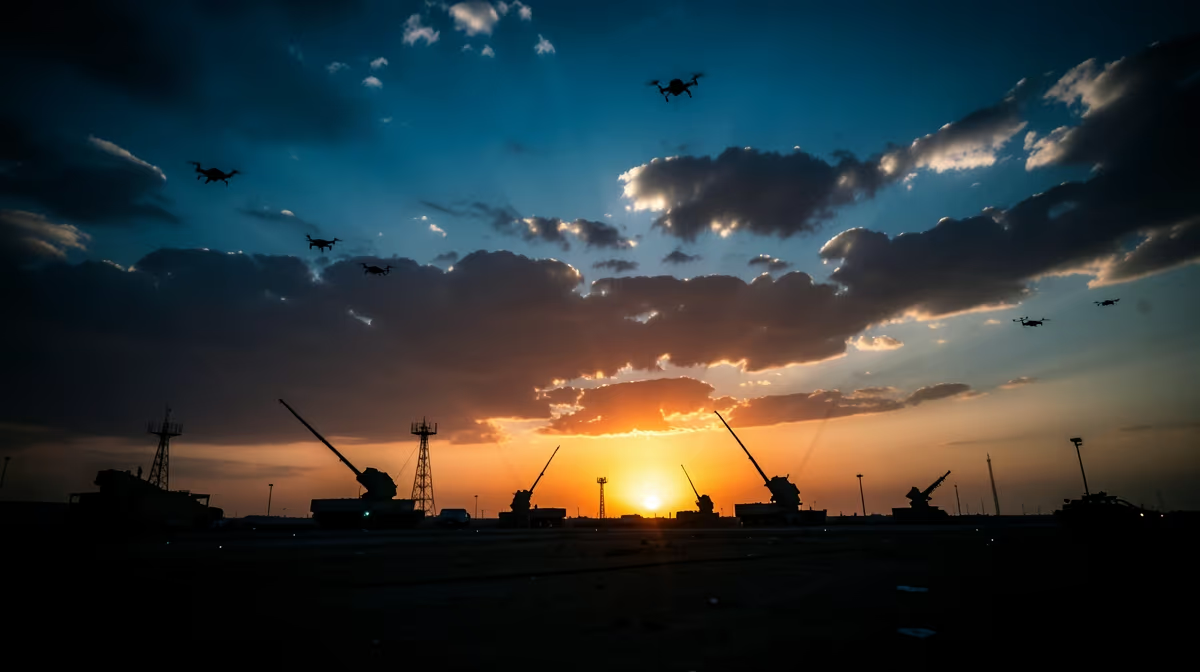
The current volatility stems from a direct shift in hostilities between Israel and Iran, moving beyond decades of shadow warfare into open military engagement. In mid-April 2024, Iran launched a massive, coordinated attack involving over 300 drones and missiles directly from its own territory toward Israel. Tehran framed this offensive as a legal and rational response to an earlier Israeli airstrike that targeted an Iranian diplomatic compound in Syria.
Across Israel, air raid sirens signaled the incoming threat, sending millions to seek safety in bunkers. The Israeli defense network, supported by sophisticated systems like the Iron Dome and Arrow interceptors, successfully neutralized the majority of the incoming projectiles. The United States played a pivotal role in the defense, with President Joe Biden confirming that U.S. naval assets in the region provided critical assistance to intercept the barrage. Following the event, the White House reaffirmed its ironclad support for Israeli security, while Israeli officials signaled that a response would be calculated and carried out at a time and place of their choosing.
Key Facts
The conflict is defined by several verified developments. Iran carried out a large-scale military assault from its own soil for the first time in history, utilizing a mix of drones and missiles. The United States, working alongside partners including the UK and Jordan, provided intelligence and defensive support to mitigate the impact of the attack. While the strike caused significant regional alarm, there have been no reports of mass casualties inside Israel. The situation remains in a state of high alert as world powers assess the long-term impact on alliances and military strategies.
Why It Matters
The escalation carries profound consequences for the global community, primarily because the Middle East serves as the central hub for global energy supplies. Any sustained conflict threatens to destabilize this region, leading to potentially massive hikes in crude oil prices and significant disruptions to global trade supply chains. Beyond energy, the humanitarian risk is substantial. A wider war could trigger migration crises and place an enormous strain on international diplomatic efforts to maintain regional order. For global investors and governments alike, the focus is on the volatility of maritime security, particularly in the Strait of Hormuz, which remains a critical chokepoint for international commerce.
Expert Analysis
The root cause of this escalation lies in the structural friction between Iran’s regional hegemony, facilitated by its Axis of Resistance, and Israel’s existential security doctrine, which is currently being mediated by U.S. containment strategies. Historically, the two nations were locked in a shadow war of cyberattacks, proxy battles, and targeted assassinations. This current transition toward state-on-state confrontation marks a departure from that historical norm, reminiscent of the intelligence failures and shocks seen during the 1973 Yom Kippur War. The political landscape is further complicated by the internal fragility of the Netanyahu administration, which faces electoral pressure, and the transition risks of U.S. domestic polarization, which may influence the capacity for sustained regional intervention.
Political And Geopolitical Implications
The geopolitical theater is undergoing a significant shift. India, in particular, finds its neutral stance increasingly tested as it navigates a strategic partnership with Israel while maintaining crucial energy-dependent and diplomatic ties with Iran. The economic pressure from potential volatility in the Strait of Hormuz threatens inflation stability, forcing nations to reconsider their reliance on regional trade routes. Furthermore, the intelligence struggle for dominance in the regional proxy theater has intensified, with both sides utilizing cyber-kinetic attacks on critical infrastructure to gain an advantage without necessarily triggering full-scale kinetic warfare.
What Happens Next
In the next 24 hours, the focus remains on intensive intelligence gathering and backchannel diplomatic communications aimed at preventing an immediate, unmanaged kinetic escalation. Over the next 72 hours, the U.S. is expected to position additional military assets in the Persian Gulf to act as a deterrent, while Iran evaluates its next steps and Israel maintains its high alert status. Analysts expect the conflict to largely remain in the gray zone, involving continued cyber-attacks and proxy skirmishes, as all parties are acutely aware of the economic and military costs of a total war. The best-case scenario involves a successful de-escalation via diplomacy, leading to a temporary ceasefire. Conversely, the worst-case scenario involves a miscalculation that forces a direct exchange of ballistic missiles, dragging the United States into active combat and triggering a wider regional conflagration.
Frequently Asked Questions
Q: What is the current status of tensions between Israel, the US, and Iran?
A: The situation remains highly volatile due to ongoing regional conflicts and proxy warfare in the Middle East. The United States maintains a strong military presence in the region to support Israel and deter further escalation from Iran and its affiliated groups.
Q: Would the US get involved in a direct war between Israel and Iran?
A: The US government has consistently stated its commitment to Israel's defense, though it officially seeks to avoid a direct, full-scale regional war. Military involvement would depend on the scale of the attack and the specific threat posed to American interests and personnel in the region.
Q: How would a potential war between Israel and Iran affect India?
A: A conflict could significantly impact India by causing a sharp rise in global crude oil prices, as the region is a critical energy hub. Additionally, it could disrupt maritime trade routes, affect the safety of the large Indian diaspora in the Middle East, and complicate India's balanced diplomatic relations with both countries.
Q: What are the primary triggers for conflict between Israel and Iran?
A: Key triggers include Iran's nuclear ambitions, support for militant groups like Hezbollah and Hamas, and Israel's targeted military operations against Iranian interests. These factors create a persistent cycle of retaliatory strikes and heightened security alerts.
Q: Is there a risk of World War 3 if Israel and Iran go to war?
A: While many analysts view the prospect of a global conflict as low, an escalation could trigger a domino effect of alliances and proxy engagements. Major world powers are actively engaged in diplomatic efforts to prevent such a scenario from destabilizing the global order.
Q: What role does the US play in managing the Israel-Iran conflict?
A: The US acts primarily as a strategic partner to Israel and a diplomatic mediator aiming to de-escalate tensions. Through a combination of sanctions, naval deployments, and intelligence sharing, the US attempts to contain Iranian influence while preventing a broader regional military collapse.
Conclusion
The confrontation between Israel and Iran represents a dangerous inflection point in Middle Eastern geopolitics. While both nations have previously operated through shadows and proxies, the direct nature of the recent missile exchange has created a precarious environment that demands high-level diplomatic intervention. As world powers continue to urge restraint, the immediate focus remains on managing the risk of miscalculation. The global community continues to monitor maritime security and energy markets closely, waiting to see if backchannel communications can secure a path toward de-escalation or if the region is destined for a more severe military trajectory.


