
Strait of Hormuz Tensions Signal a Shift in Global Energy Flows
Introduction
A mere twenty-one miles of water separates the Iranian coastline from the Arabian Peninsula, yet this narrow gap serves as the most critical artery for the global energy supply chain. The Iran Hormuz Strait geopolitical escalation has once again moved to the forefront of international concerns, as tensions surrounding Iran maritime security threaten to disrupt the stability of the global energy markets.
What Happened
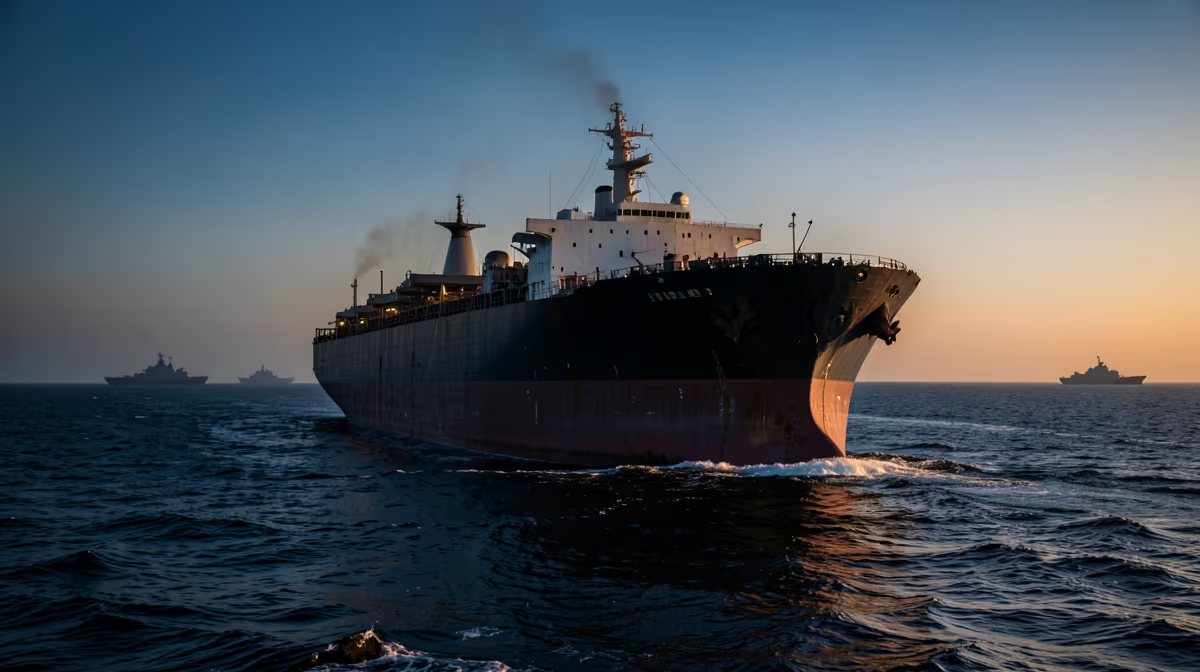
The United States Fifth Fleet, headquartered in Bahrain, has officially confirmed an augmentation of its naval presence within the Persian Gulf. This strategic pivot serves as a direct response to a recurring series of maritime interdictions involving the Islamic Revolutionary Guard Corps Navy (IRGCN). Over the past months, these incidents have involved the interception and attempted seizure of commercial tankers, creating an atmosphere of heightened vigilance among international shipping operators.
Iran continues to assert that its naval activities remain entirely routine, framing its presence in the region as a necessary measure for safeguarding its national sovereignty and maintaining security across its primary shipping lanes. Tehran has voiced significant criticism regarding the influx of foreign naval assets, labeling these deployments as provocative maneuvers that unnecessarily elevate the risk of miscalculation within the constrained, high-traffic corridor. While military leaders in Washington emphasize a commitment to freedom of navigation, the diplomatic fallout remains tense. Shipping insurers are currently in the process of reassessing risk profiles for vessels operating in the region, a move that threatens to increase overhead costs for logistics providers and, by extension, the global supply chain.
Key Facts
The Strait of Hormuz acts as the primary transit point for oil exports from major producers, including Saudi Arabia, Iraq, Kuwait, and the United Arab Emirates. At its narrowest, the passage spans only 21 miles, with dedicated shipping lanes restricted to two-mile widths in either direction, separated by a thin buffer zone to minimize collision risks.
Approximately one-fifth of the world’s total petroleum consumption is transported through this chokepoint daily. The region is heavily monitored by international naval coalitions tasked with protecting commercial interests. Iran maintains a substantial military footprint in the area, utilizing a combination of fast-attack craft, missile batteries, and advanced naval surveillance to project power.
Why It Matters
The global economy is fundamentally tethered to the free flow of energy through this specific waterway. Because a significant portion of the world’s crude oil relies on this route, any sustained disruption carries the potential to force energy prices upward with near-instantaneous effects. This volatility impacts more than just fuel prices at the pump; it creates a cascade of inflationary pressure that hits shipping costs for a vast array of global commodities.
Nations heavily dependent on energy imports—most notably China, India, and Japan—are particularly vulnerable to maritime instability in this region. If the Strait were to face a full-scale blockade, the lack of viable alternative pipeline infrastructure would necessitate a rapid and costly shift in the global energy supply chain. For the everyday consumer, this translates to higher logistics costs, increased costs of goods, and broader economic uncertainty.
Expert Analysis
The root cause of this ongoing friction lies in the complex intersection of regional power projection and asymmetric deterrence. Iran utilizes its geographical position as a tool of leverage, positioning the Strait as an unofficial tax on the global economy to push back against Western-led economic and military containment. This strategy of gray zone warfare, which avoids the threshold of full-scale conflict while still exerting tangible pressure, mirrors the tactical environment seen during the Tanker War of the 1980s.
Economically, the presence of these tensions creates a constant risk premium. By controlling the maritime transit of roughly 20 to 30 percent of global petroleum, Iran effectively forces the global market to factor in insurance risks and security costs. The primary challenge for international actors is identifying the threshold where posturing shifts into a genuine blockade. Currently, the status quo is defined by a calculated cycle of deterrence, where the objective is to maintain pressure without triggering a direct military confrontation that would invite a massive, coordinated response from the United States and its regional partners.
Political And Geopolitical Implications
The Strait of Hormuz acts as a barometer for both Iran’s internal stability and its broader regional influence. For Tehran, the ability to control these waters is deeply linked to regime survival and the projection of influence against the U.S.-led maritime security architecture. This creates a friction point that extends beyond simple trade, as it involves an alignment of interests between Iran, Russia, and China against the traditional Western security framework.
Furthermore, the environmental risk of deliberate maritime sabotage represents a silent, high-stakes variable. Beyond the immediate economic impact, the potential for an ecological catastrophe remains a constant threat in these crowded shipping lanes. This serves as a potent weapon in the gray zone, where the risk of environmental damage creates a diplomatic hurdle that complicates traditional military response protocols.
What Happens Next
In the immediate 24-hour window, the region will likely see an intensification of aerial surveillance and a heightened naval posture from the U.S. Fifth Fleet, alongside continued diplomatic efforts to ensure freedom of navigation. Looking toward the next 72 hours, analysts anticipate that routine tanker transit will continue, though the risk of localized maritime harassment incidents remains elevated if backchannel communications fail to dampen tensions.
The most probable expert forecast is a continuation of the status quo. Iran is expected to maintain its gray zone strategy of deterrence, deliberately avoiding actions that would trigger a full-scale military engagement. A best-case scenario involves successful de-escalation mediated through backchannels, leading to reduced military posturing. Conversely, the worst-case scenario involves a tactical miscalculation during a ship boarding attempt, which could result in an accidental clash. Such an event would likely trigger a rapid spike in global energy prices and an immediate surge in military asset deployment to the region.
Frequently Asked Questions
Why is the Strait of Hormuz strategically important?
The Strait of Hormuz is a critical maritime chokepoint that connects the Persian Gulf to the Gulf of Oman and the Arabian Sea. It serves as the world's most important oil transit artery, as a significant portion of global petroleum production passes through its narrow waters daily.
What percentage of the world's oil passes through the Strait of Hormuz?
Roughly 20% to 30% of the world's total petroleum consumption moves through the Strait of Hormuz. This makes it a vital global energy hub, and any disruption in the region can lead to immediate spikes in global oil prices.
Can Iran close the Strait of Hormuz?
While Iran has frequently threatened to close the strait in response to geopolitical tensions, international legal experts argue that doing so would violate the UN Convention on the Law of the Sea. However, Iran maintains a large naval presence and missile capabilities that could physically impede traffic or increase the insurance costs for commercial shipping.
What is the width of the Strait of Hormuz?
At its narrowest point, the strait is approximately 21 miles wide. The shipping lanes in either direction are only about two miles wide, separated by a two-mile buffer zone to prevent collisions in the high-traffic corridor.
How does the US military monitor the Strait of Hormuz?
The United States maintains a persistent naval presence in the region, primarily through the Fifth Fleet based in Bahrain. They conduct regular patrols and lead international maritime security coalitions to ensure the freedom of navigation and the safe transit of commercial vessels.
What happens if the Strait of Hormuz is blocked?
A prolonged closure of the strait would likely trigger a severe global energy crisis and economic instability. Because there are limited alternative pipeline routes available, most countries relying on Persian Gulf oil would face immediate supply shortages and significant inflationary pressure on commodity prices.
Conclusion
The situation in the Strait of Hormuz remains a delicate standoff characterized by high-stakes naval maneuvering and geopolitical posturing. With approximately 20 percent of the world’s petroleum passing through this narrow transit point, the stability of the global energy market remains intrinsically linked to the actions of the regional powers and the international naval coalitions patrolling the area. While verified facts point to a measurable increase in naval assets, the current operational environment suggests that all parties are exercising restraint to avoid a broader, uncontrollable conflict. Future developments will depend heavily on the effectiveness of diplomatic backchannels and the ability of involved nations to manage maritime incidents without triggering a wider military escalation.


