
Strait of Hormuz Tensions Threaten a Global Energy Market Meltdown
Introduction
A mere twenty-one miles of water separates nations and fuels the pulse of the global economy, yet this narrow passage remains the most precarious artery for international energy trade. As geopolitical instability intensifies, the strait of hormuz remains a critical focal point for global energy markets, demanding constant vigilance from security policy professionals and market analysts alike.
What Happened
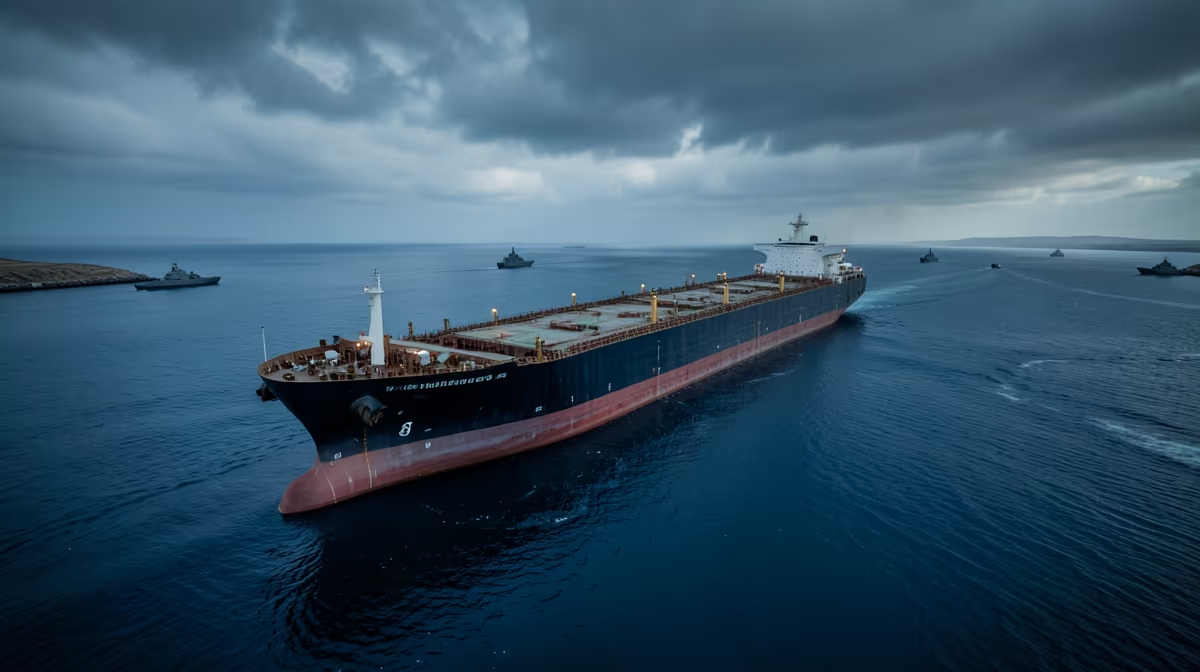
The Strait of Hormuz connects the Persian Gulf to the Gulf of Oman, serving as the essential exit route for crude oil exports from Saudi Arabia, Iraq, the United Arab Emirates, and Kuwait. Recent months have seen a heightened frequency of maritime security incidents, including the detention of tankers and drone surveillance activities, which have prompted the United States and its regional partners to maintain a continuous naval presence to ensure freedom of navigation.
International shipping firms have expressed growing concern regarding rising insurance premiums for vessels traversing the corridor. While trade flows remain largely uninterrupted, the heightened military posturing has led to increased monitoring of regional waters by the International Maritime Security Construct to deter potential escalations. The United States Fifth Fleet, based in Bahrain, has repeatedly addressed the necessity of this presence. Cmdr. Rick Chernitzer has stated that the United States and its partners remain committed to safeguarding the freedom of navigation and the free flow of commerce through this vital maritime corridor. Diplomatic efforts to secure the waterway continue to be challenged by the broader geopolitical standoff between Tehran and Washington.
Key Facts
The Strait of Hormuz is the world's most important oil transit chokepoint. Approximately 20 to 30 percent of the world's total global petroleum consumption passes through this narrow stretch daily, with recent average metrics indicating that 21 million barrels of oil transit the passage every 24 hours. The channel is approximately 21 nautical miles, or 34 kilometers, wide at its narrowest point. Within this passage, the shipping lanes for inbound and outbound vessels are each only two miles wide, creating significant congestion and security risks. Major producers, including Saudi Arabia, Iraq, and the UAE, rely on this route for the bulk of their exports. Naval patrols are currently present in the region to ensure free passage for international shipping.
Why It Matters
If the Strait were closed or severely disrupted, the impact on the global economy would be immediate and severe. Because nearly every modern economy relies on oil and natural gas to function, a shortage would lead to higher costs for fuel, electricity, and consumer goods worldwide. This could trigger a significant global economic slowdown. The situation directly affects global oil importers, energy-producing nations in the Middle East, international shipping companies, and consumers globally who pay for fuel and energy products. The historical context of the 1980s Tanker War serves as a reminder of how conflict in this region can necessitate large-scale naval deployments to protect commercial traffic and stabilize energy prices.
Expert Analysis
The root cause of this instability is the strategic reliance of global energy markets on a single maritime bottleneck where nearly 20 percent of global oil consumption transits. The current situation represents a high-stakes chess match between Iran's projection of regional deterrence and the United States-led coalition's commitment to freedom of navigation. Economically, this creates extreme volatility in global oil and liquefied natural gas pricing, with significant insurance premium spikes and supply chain disruption risks for Asian economies. From a geopolitical perspective, the Strait acts as a flashpoint for potential kinetic conflict that could trigger a global recession by pulling in regional proxies and global superpowers. An interesting hidden angle is the rapid expansion of pipeline bypasses by Saudi Arabia and the UAE, which are intended to decouple oil export capacity from Strait dependency, although these currently remain insufficient to replace the total throughput of the maritime route.
Political And Geopolitical Implications
The geopolitical landscape of the Strait is defined by the ongoing standoff between Iran and Western powers. Control over this waterway is frequently used as leverage in regional diplomatic disputes. While regional actors, including Iran, the United States, the UAE, Saudi Arabia, and Oman, are key players, there is a widespread understanding that a total blockage would have catastrophic economic consequences for all involved. Consequently, current actions are marked by controlled brinkmanship, as all major actors face significant economic and military deterrents against a full-scale kinetic confrontation. The current regional spillover from the Israel-Hamas war has further impacted maritime security corridors, requiring constant monitoring.
What Happens Next
Over the next 24 hours, the region will likely see increased naval posture and surveillance by regional and international forces, with commercial tanker traffic continuing under a heightened alert status. Looking toward the next 72 hours, observers should expect intensified diplomatic messaging and maritime security exercises, alongside potential minor signaling maneuvers by regional actors intended to demonstrate capability without triggering direct conflict. Expert prediction suggests the status quo will likely persist through this controlled brinkmanship. The best-case scenario involves successful de-escalation via backchannel communications, leading to a reduction in naval friction and stable energy markets. The worst-case scenario involves a miscalculation or tactical error leading to a skirmish that triggers a temporary disruption of shipping lanes and a sharp, panic-driven spike in global oil prices.
Frequently Asked Questions
Why is the Strait of Hormuz so important?
The Strait of Hormuz is considered one of the most critical maritime chokepoints in the world because it is the primary oil transit route for the Persian Gulf. Approximately one-fifth of the world's total global oil consumption passes through this narrow passage daily, making it vital for international energy security.
What countries border the Strait of Hormuz?
The Strait of Hormuz is bordered by Iran to the north and the United Arab Emirates and Oman to the south. This geographical positioning gives these nations significant influence over maritime traffic flowing between the Persian Gulf and the Gulf of Oman.
How wide is the Strait of Hormuz at its narrowest point?
At its narrowest point, the Strait of Hormuz is approximately 21 nautical miles, or about 34 kilometers, wide. Within this stretch, the shipping lanes for inbound and outbound vessels are each only two miles wide, which creates significant congestion and security risks.
What happens if the Strait of Hormuz is closed?
If the Strait of Hormuz were closed, it would likely cause a massive spike in global oil prices and disrupt energy supplies worldwide. Because there are very few viable alternative pipeline routes for the vast majority of oil produced in the region, a closure would severely impact the global economy and international trade.
Who controls the Strait of Hormuz?
While the Strait of Hormuz is an international waterway, its waters are shared by several coastal states, with Iran holding the longest coastline along the northern side. International law guarantees the right of transit passage for ships, but geopolitical tensions often lead to disputes over maritime security and navigation rights in the area.
Why is there tension in the Strait of Hormuz?
Tensions in the Strait of Hormuz primarily stem from geopolitical conflicts between Iran and Western powers, particularly the United States. These disputes often involve regional military posturing, the enforcement of economic sanctions, and concerns over the potential for the region's oil flow to be used as a political bargaining chip.
Conclusion
The Strait of Hormuz remains the world's most critical maritime chokepoint, serving as a vital nexus for global energy security. While the waterway currently remains open for commercial shipping, the environment is characterized by intense geopolitical posturing and a high degree of sensitivity to regional volatility. International naval coalitions continue to patrol the area to ensure the freedom of navigation, as both state and non-state actors weigh the severe economic consequences of a full-scale disruption. Moving forward, the situation will likely be defined by a delicate balance of diplomatic engagement and military surveillance, with market analysts monitoring the passage for any sign of escalation that could fundamentally alter the stability of global energy markets.
" } ]


