
Devolution Reforms Are Reshaping the UK in Ways Few Have Anticipated
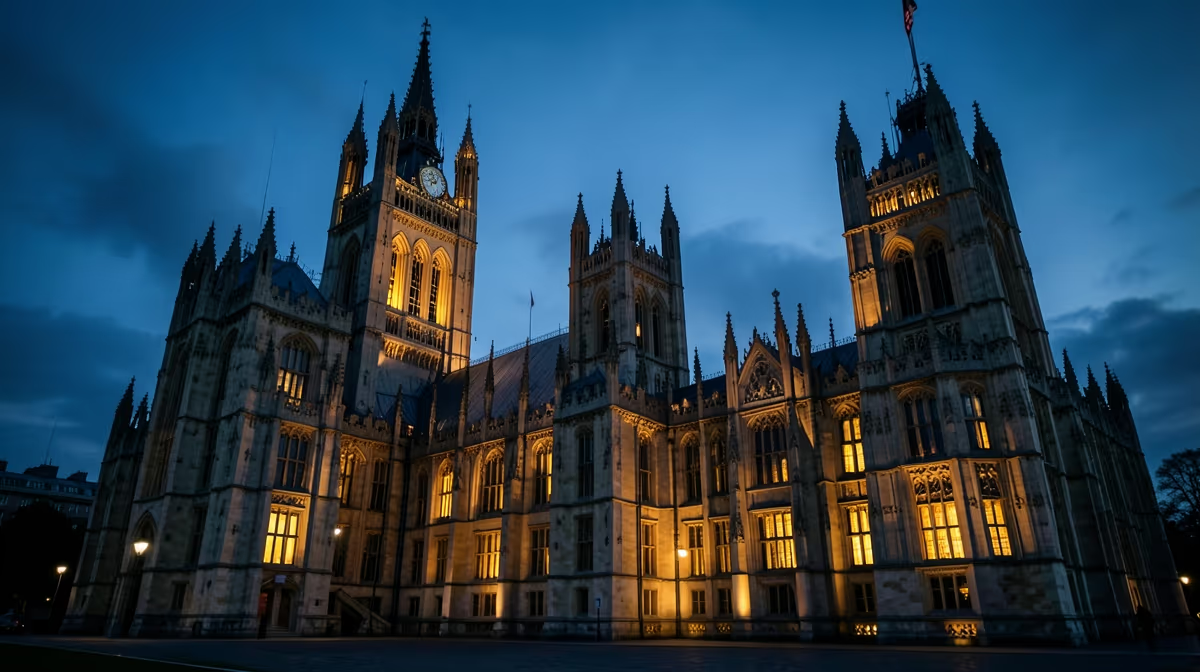
The Westminster tradition of absolute centralized power is undergoing a fundamental transformation as regional governance becomes the new frontier of British policy. Devolution remains a central pillar of modern UK politics, fundamentally reshaping how regional governance operates across Great Britain and forcing a re-evaluation of the relationship between London and the constituent nations.
The UK government has announced a new Take Back Control framework aimed at deepening devolution across England, as ministers seek to hand greater fiscal and planning powers to regional mayors by early 2025. Deputy Prime Minister Angela Rayner confirmed that the government intends to shift decision-making authority away from Whitehall, prioritizing the expansion of combined authorities. This move is designed to empower local leaders to integrate public transport, housing development, and skills training programs under a single unified regional strategy. The policy represents a significant acceleration of existing devolution deals, aiming to address regional economic disparities often described as the North-South divide. While the government positions this as a major transfer of power, critics and some local councils have expressed concerns regarding the strings attached to these new funding settlements. There are ongoing debates about whether regional mayors have sufficient administrative capacity to manage the expanded portfolios without additional central government oversight or sustained financial support beyond the initial transition grants.
Devolution is the process where the central government in London transfers specific powers and responsibilities to local legislatures in Scotland, Wales, and Northern Ireland. Instead of all major decisions being made in the UK Parliament, these nations now have their own elected bodies that can create laws and manage public services. It is crucial to note that devolution is not independence; the UK Parliament remains sovereign. The Scottish Parliament and the Welsh Senedd possess tax-varying powers, though the system is asymmetric, meaning different regions hold varying levels of authority. The UK government maintains control over reserved matters such as defense, foreign policy, and national taxes, while devolved administrations manage local issues like healthcare, education, and transport. Modern devolution began in the late 1990s as part of a constitutional reform program designed to address regional autonomy and support the peace process in Northern Ireland.
This structural shift directly impacts the daily lives of citizens by allowing for localized governance. For example, a student in Scotland may encounter different university tuition fees than one in England, and a patient in Wales might experience different waiting times for surgery compared to someone in Northern Ireland. By allowing regions to experiment with different policy solutions, the system aims to be more responsive to specific cultural and economic priorities. However, this diversity creates administrative friction. The fiscal imbalance caused by the Barnett Formula, which constrains autonomous tax-raising powers while fostering regional dependency, remains a point of contention. As policy diverges, the challenge for the UK government is to maintain national standards for public services while respecting the legislative autonomy granted to regional administrations.
The current political landscape is marked by the tension between the integrity of the Union and the legitimacy of devolved legislatures. The root cause of this movement lies in the systemic failure of the post-WWII centralized Westminster model to accommodate distinct regional cultural identities and socio-economic disparities. We are seeing a transition toward a quasi-federal system, which brings with it the English Question—the internal political vacuum left by the asymmetry of the current arrangement. This creates an existential anxiety about the future of the state. Historically, this mirrors the strain seen in the Austro-Hungarian Empire, where administrative rigidity struggled against rising nationalist aspirations. Today, that pressure manifests in concerns that the fragmentation of the UK state could weaken its singular influence in international forums and NATO, while increasing the complexity of border management in a post-Brexit environment.
In the next 24 hours, we expect intensified negotiations between the UK government and devolved administrations regarding the implementation of new funding frameworks and the clarity of the UK Internal Market Act. Looking toward the next 72 hours, First Ministers in Scotland and Wales are likely to issue public statements regarding the impact of upcoming fiscal events, potentially signaling friction over block grant adjustments. Experts predict that while the UK government will prioritize a reset of intergovernmental relations to mitigate tensions, structural disagreements regarding powers and resources will persist throughout the parliamentary term. The best-case scenario involves the formalization of a Council of Nations and Regions to reduce political friction. Conversely, the worst-case scenario involves a breakdown in collaborative machinery, leading to legal challenges over legislative competence that could fuel increased support for independence or further constitutional fragmentation.
Frequently Asked Questions
What is devolution in the UK?
Devolution is the statutory delegation of powers from the central UK Parliament in Westminster to devolved legislatures in Scotland, Wales, and Northern Ireland. It allows these regions to make their own decisions on specific policy areas such as health, education, and transport while remaining part of the United Kingdom.
What are the main devolved powers in Scotland?
The Scottish Parliament has the power to legislate on a wide range of issues including health, education, local government, and the environment. However, certain areas known as reserved matters, such as defense, foreign policy, and immigration, remain under the authority of the UK Parliament.
How does devolution work in Wales?
Devolution in Wales operates through the Senedd, which has the power to pass laws on devolved matters like public services, economic development, and agriculture. The extent of these powers has evolved over time, moving from an initial model of executive devolution to the current legislative framework.
Does England have a devolved government?
England does not have a single devolved parliament equivalent to those in Scotland, Wales, or Northern Ireland. Instead, it utilizes a system of regional devolution through combined authorities and mayors who oversee specific local issues like transport and infrastructure.
What is the difference between federalism and devolution?
Federalism involves a constitutional division of power where both central and regional governments have authority that cannot be unilaterally revoked. In contrast, devolution is granted by the UK Parliament, which remains sovereign and theoretically retains the legal authority to amend or revoke these powers.
Why was devolution introduced in the UK?
Devolution was introduced in the late 1990s to bring decision-making closer to local communities and address regional political demands. It was designed to strengthen the Union by providing greater autonomy to the constituent nations while maintaining a unified sovereign state.
Conclusion
The expansion of devolution powers represents a significant recalibration of the British state. With the government moving toward a 2025 implementation of new mayoral powers, the focus remains on navigating the delicate balance between local autonomy and the central oversight required for a unified nation. As the Treasury and regional offices continue their negotiations, the success of these reforms will depend on the government's ability to provide sufficient financial backing to ensure that regional mayors can effectively manage their expanded portfolios. Whether this framework can resolve long-standing administrative frictions remains the defining question for the current parliament.


.webp)

.webp)

