
Artificial Intelligence Infrastructure Faces Major Federal Inquiry
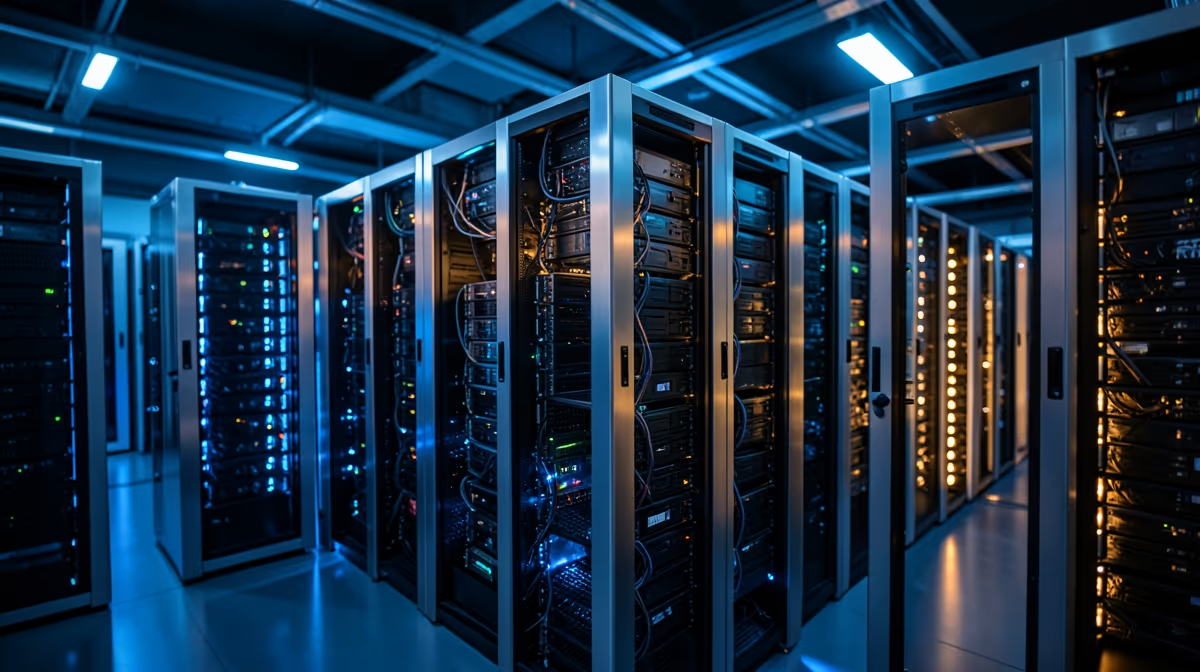
The U.S. Department of Commerce has officially initiated a high-stakes inquiry into the competitive landscape of the technology sector, seeking to uncover whether the foundational hardware powering modern innovation is being throttled by a corporate bottleneck. This investigation into the distribution of compute power marks a pivot point where federal oversight meets the rapid, often opaque, acceleration of artificial intelligence.
The Mechanics of the Modern Gold Rush
At its core, artificial intelligence is a field of computer science that builds machines capable of performing tasks that usually require human intelligence. Instead of just following a strict set of rules, these systems are trained on massive amounts of data to recognize patterns, learn from information, and make decisions or predictions on their own. By using algorithms to process data and reason through problems, machines mimic human cognitive functions in everything from voice assistants to generative text and code creation.
The current landscape is defined by a race for cognitive hegemony, where major firms convert massive proprietary datasets into decision-making architectures. This trend relies on machine learning to improve performance as data volume increases, yet it also introduces significant risks. Models can produce errors or hallucinations when they lack accurate data, and the concentration of these tools in the hands of a few tech giants has raised questions regarding market competition and algorithmic accountability.
The Federal Inquiry into Infrastructure
The U.S. Department of Commerce is investigating the competitive landscape of the sector, focusing specifically on the hardware and cloud computing resources required to train foundation models. Overseen by the Bureau of Industry and Security, the inquiry aims to determine if the current infrastructure is being monopolized. Officials are focusing on identifying potential bottlenecks in the supply chain for high-end graphics processing units and how cloud service providers manage access to their compute clusters for independent research startups.
Commerce Secretary Gina Raimondo stated that the government must ensure the infrastructure driving the next generation of technology is accessible to a diverse range of innovators, not just a select group of incumbent firms. The government has requested information from major firms regarding internal distribution policies and sales data, aiming to identify if discriminatory practices exist. Industry analysts view this as a significant shift, as Washington transitions from observing the rapid industry growth to actively evaluating the plumbing that makes it possible.
Economic and Geopolitical Implications
The economic reality of this technology is the consolidation of global capital and computational resources into a technocratic oligopoly that potentially renders traditional market competition obsolete. This consolidation carries profound geopolitical weight. We are witnessing a strategic arms race for supremacy that necessitates a bifurcated global digital order, forcing non-aligned nations to choose between different technological ecosystems.
Furthermore, there is a hidden element of data colonialism, where advanced nations may leverage these systems to extract and commodify social and behavioral data from the Global South under the guise of developmental assistance. This mirrors historical parallels like the Manhattan Project, where the intersection of state-funded scientific research and existential national security goals fundamentally reshaped the geopolitical landscape. The transition now is moving from legislative oversight to executive-branch reliance on private tech-corporate infrastructure for national security strategy.
Projecting the Near Future
The trajectory for the next 24 hours suggests increased volatility in tech stocks as the market reacts to earnings guidance and new safety benchmarks for large language models. Looking toward the next 72 hours, we expect heightened regulatory scrutiny regarding copyright training data and announcements of new strategic partnerships in enterprise-grade generative AI adoption.
Experts predict an accelerated integration of intelligent agents into workflow automation tools, shifting focus from chatbot novelty to quantifiable business efficiency gains. The best-case scenario involves a breakthrough in energy-efficient computing that lowers operational costs and democratizes access, sparking a wave of scientific discovery. Conversely, the worst-case scenario involves a high-profile cybersecurity breach linked to automated phishing campaigns, which could trigger emergency legislative halts and a significant loss of public trust.
Labor and the Workforce Transformation
The impact on labor markets is one of the most pressing concerns for policy makers and strategic investors. While the technology will automate repetitive and data-heavy tasks, it is widely expected to augment human productivity rather than fully replace most professions. The future of autonomous systems in modern infrastructure will likely phase out specific roles while simultaneously creating entirely new categories of jobs that require human-machine collaboration. This evolution forces a re-evaluation of how workforce stability is maintained as industries integrate these powerful tools into their daily operations.
Frequently Asked Questions
What is artificial intelligence and how does it work?
Artificial intelligence is a branch of computer science focused on building smart machines capable of performing tasks that typically require human intelligence. These systems work by processing large amounts of data using complex algorithms and pattern recognition to make predictions or decisions.
What are the main types of artificial intelligence?
AI is generally categorized into three types based on capability: Narrow AI, which is designed for specific tasks like voice recognition; General AI, which possesses human-like cognitive abilities; and Super AI, which would theoretically surpass human intelligence across all fields.
Is artificial intelligence dangerous to society?
The risks associated with the technology depend largely on how it is developed and regulated. While there are legitimate concerns regarding job displacement, algorithmic bias, and security threats, many experts focus on developing ethical frameworks to ensure the technology remains safe and beneficial.
How is artificial intelligence used in everyday life?
It is integrated into many daily activities, such as personalized recommendations on streaming platforms and social media feeds. It also powers virtual assistants like Siri or Alexa, email spam filters, and navigation apps that calculate the fastest routes in real time.
Will artificial intelligence replace human jobs?
While it will automate repetitive and data-heavy tasks, it is more likely to augment human productivity rather than fully replace most professions. Many experts predict that while some roles may be phased out, the technology will create entirely new categories of jobs that require human collaboration.
What is the difference between machine learning and AI?
Artificial intelligence is the broad concept of creating machines that can simulate human intelligence, while machine learning is a specific subset. Machine learning focuses on the use of data and algorithms to enable computers to learn from experience and improve their accuracy over time without being explicitly programmed.
Conclusion
The investigation by the Department of Commerce underscores a pivotal shift in how the United States approaches the regulation and accessibility of foundational computational resources. With major firms under review for potential supply chain and monopolistic bottlenecks, the findings from this inquiry are expected to inform significant legislative developments later this year. As the integration of these tools into military and government command-and-control systems proceeds, the balance between fostering innovation and ensuring equitable market access remains the central challenge for policy makers. The future of this sector will be dictated by the transparency of these infrastructure policies and the ability of the broader ecosystem to adapt to an increasingly automated economic landscape.


.webp)
