
Artificial Intelligence Oversight Mandates Signal a Massive Tech Shift
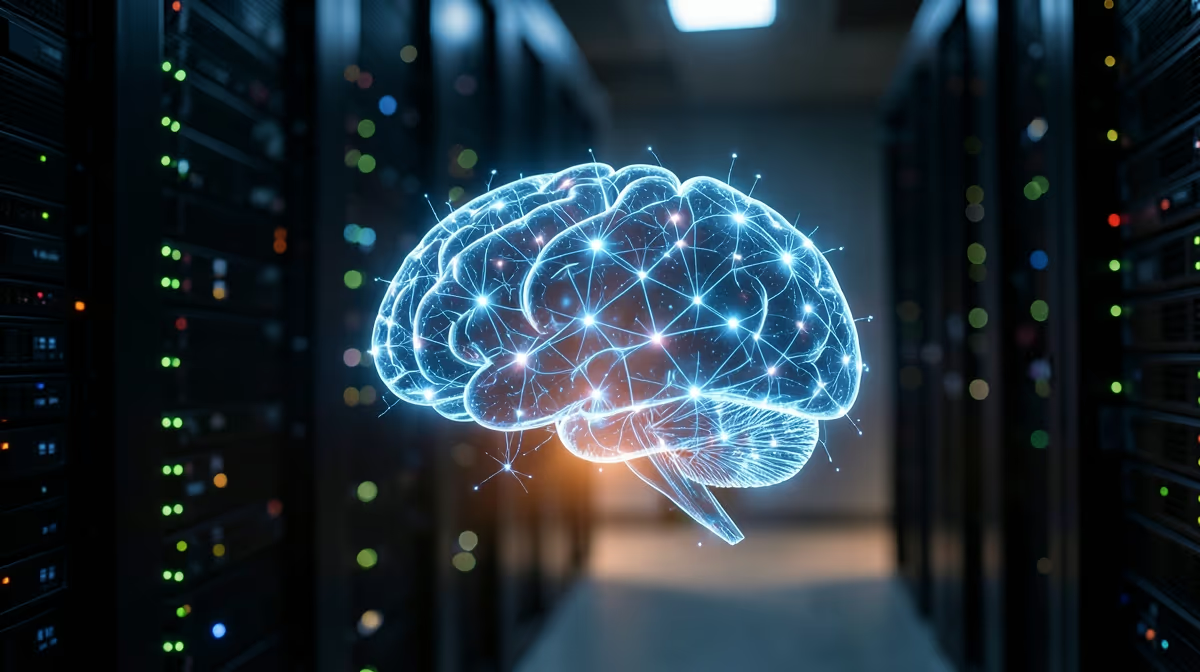
The U.S. Department of Commerce has initiated a decisive new mandate requiring companies to disclose safety testing protocols for their most powerful computational systems, marking a shift toward strict government oversight. As artificial intelligence continues to evolve at an unprecedented pace, the US government is facing mounting pressure to establish comprehensive frameworks to manage the risks inherent in these transformative technologies. This regulatory move, rooted in the October 2023 executive order on artificial intelligence, signals that the era of unfettered development is transitioning into a phase of deep institutional scrutiny.
A New Era of Regulatory Oversight
Commerce Secretary Gina Raimondo confirmed that the new mandate targets firms training models that exceed specific computational thresholds. These organizations are now required to share results from cybersecurity infrastructure assessments and internal safety testing. By housing this analytical process within the AI Safety Institute at the National Institute of Standards and Technology, the government is centralizing its capacity to monitor the most advanced frontier models. The initiative aims to mitigate risks such as public deception, the facilitation of cyberattacks, and the potential misuse of biological weapon research, ensuring that rapid innovation does not outpace national security requirements.
The Mechanics of Machine Intelligence
To understand the scope of these requirements, one must recognize how this technology functions. Artificial intelligence is a branch of computer science that enables machines to perform tasks requiring human-like cognitive abilities, such as pattern recognition, decision-making, and complex problem-solving. Unlike traditional software that follows rigid, pre-programmed rules, modern systems learn from vast datasets. This deep learning breakthrough, which gained momentum around 2012, allows for the creation of generative content, including code, text, and imagery. Today, these systems are becoming deeply integrated into search engines, business operations, and financial infrastructure, making their stability and safety a matter of public concern.
The Economic and Geopolitical Imperative
The rush toward advanced technology is not merely a commercial pursuit but a systemic shift in global power dynamics. The race to achieve artificial general intelligence is driven by an existential need to maintain industrial and cognitive hegemony. In Washington, a bipartisan consensus views this sector as the high ground of modern competition. The current strategy involves weaponizing export controls and subsidies to decouple from adversarial technological ecosystems, effectively forcing international allies to choose between US-led proprietary stacks or alternative spheres. This transition suggests a move toward techno-balkanization, potentially ending the era of open-source global scientific collaboration.
Economic Consequences and Labor Shifts
Beyond the geopolitical theater, the domestic economy faces a profound restructuring. The industry is moving from labor-based productivity to compute-based capital accumulation. This shift risks extreme wealth concentration and the obsolescence of mid-tier service sector roles. While AI promises to accelerate productivity in fields like healthcare and material science, it simultaneously threatens to displace traditional labor. Experts predict a pivot from foundational model development toward integration and return-on-investment verification. This phase will likely trigger a consolidation of smaller startups under the control of major cloud providers, fundamentally altering the competitive landscape of the tech sector.
Anticipating Future Volatility
In the coming 24 hours, market participants should anticipate increased volatility in tech-related stocks following upcoming earnings reports and ongoing legislative debates concerning synthetic media. Looking ahead to the next 72 hours, analysts expect announcements regarding new enterprise partnerships centered on agentic workflows and potential legislative updates focused on model transparency and copyright litigation. The industry’s trajectory suggests a potential best-case scenario where breakthroughs in energy efficiency reduce the environmental impact of compute infrastructure, while the worst-case scenario involves the unchecked escalation of deepfake-driven disinformation campaigns and significant data security breaches.
Security and Defense Integration
The rapid integration of advanced algorithmic tools into US defense intelligence infrastructure is creating a black box environment that challenges traditional concepts of accountability. As these systems become more embedded in sensitive decision-making, they effectively bypass standard congressional oversight mechanisms. This mirrors the historical development of the Manhattan Project, where the convergence of military objectives, state-subsidized industry, and private research created a monopolized strategic advantage. The government's current push for disclosure is an attempt to retain control over these critical systems as they grow in influence, ensuring that they remain aligned with national interests rather than operating as independent, opaque entities.
Frequently Asked Questions
What is artificial intelligence and how does it work?
Artificial intelligence is a branch of computer science that builds smart machines capable of performing tasks typically requiring human intelligence. It uses algorithms and large datasets to identify patterns and improve performance over time through machine learning.
What are the main types of artificial intelligence?
AI is categorized into narrow AI, designed for specific tasks like virtual assistants, and general AI, a theoretical concept possessing the ability to learn any intellectual task a human can perform.
How will artificial intelligence impact the job market?
It is expected to automate routine tasks while creating new roles in tech and data management. While some sectors may face displacement, AI is likely to augment human productivity and foster entirely new industries.
Is artificial intelligence dangerous to society?
Risks include algorithmic bias, privacy concerns, and the potential for autonomous harm. Safety protocols and ethical frameworks are being prioritized to align these systems with human values.
Can artificial intelligence learn on its own?
Through machine learning, systems improve accuracy and performance by analyzing large datasets to identify patterns without needing explicit programming for every scenario.
What are common real-world examples of artificial intelligence?
Examples include virtual assistants like Siri and Alexa, recommendation engines on streaming platforms, and bank fraud detection systems.
Conclusion
The regulatory framework announced by the Department of Commerce represents a critical step in managing the systemic impacts of rapidly evolving technological systems. By enforcing transparency in safety testing and cybersecurity protocols, the government aims to balance innovation with national security. As the industry moves toward consolidation and ROI-focused development, the next phase will likely be defined by intensive legislative scrutiny of model transparency and the management of deepfake threats. Moving forward, the focus remains on calibrating technical compute thresholds while maintaining the balance between domestic competitiveness and public safety.


.webp)
