
Canada Wildfires Air Quality Alerts Trigger Major Shifts Across the US
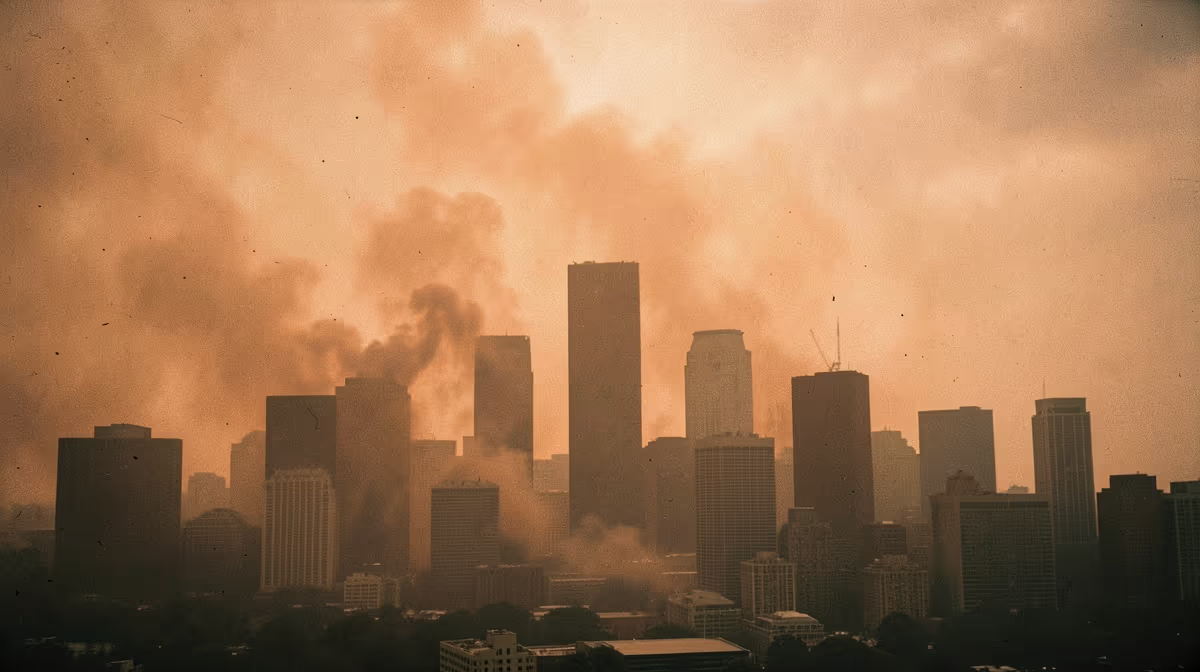
The recurring issue of Canada wildfires air quality is increasingly a primary concern for US residents as transboundary smoke settles over major cities. While climate change impact continues to shift weather patterns, environmental health policy makers are scrambling to address the long-term risks posed by deteriorating atmospheric conditions that turn once-clear skies into thick, hazardous hazes.
Smoke from active Canadian wildfires has triggered widespread air quality alerts across the United States this week, blanketing major metropolitan areas in a thick haze and prompting health officials to issue warnings for vulnerable populations. This persistent flow of fine particulate matter, driven by shifting wind patterns, has significantly impacted air quality readings in the Midwest and the Northeast. Atmospheric conditions have trapped the pollutants near the surface, leading to Unhealthy and Very Unhealthy Air Quality Index levels in several major cities, forcing the cancellation of outdoor events and compelling schools to restrict recess activities.
The Mechanics of Transboundary Pollution
Canada is currently experiencing a record-breaking wildfire season, and the smoke from these massive blazes is drifting south into the United States. Because of wind patterns, this thick, hazy smoke is hanging over many American cities, turning the sky orange and creating poor air quality that can be dangerous to breathe. Think of it like a blanket of pollution covering large parts of the country. Even though the fires are hundreds of miles away, the tiny particles in the smoke travel through the air, making it feel like you are standing near a campfire, even when you are in a major city far from the forest.
The primary culprit is PM2.5, fine particulate matter that is small enough to enter the human bloodstream. When these particles cross the border, they do not discriminate; they settle in high concentrations throughout the Great Lakes, Ohio Valley, Mid-Atlantic, and New England regions. The Environmental Protection Agency and local health departments are currently monitoring these plumes, which have become a systemic feature of the North American environment, rather than an isolated anomaly.
Roots of the Climate Crisis
The root cause of these events lies in anthropogenic climate change exacerbated by long-term forest mismanagement, leading to record-breaking fuel accumulation and atmospheric instability. Canada has vast boreal forests that naturally experience fire cycles, but rising global temperatures have led to hotter and drier springs and summers. This shift has created the perfect conditions for more frequent and larger wildfires than the country has seen in previous decades.
This is not merely an environmental event; it is a catalyst for complex political and economic pressures. The partisan divide over environmental regulation versus industrial extraction is intensifying as wildfire-induced pollution impacts urban centers. State-level political leaders are increasingly pressuring federal agencies to revisit climate policies, arguing that the costs of inaction—manifested in public health expenditure spikes, insurance market instability, and the disruption of cross-border logistical supply chains—are becoming unsustainable. Furthermore, the situation presents a challenge to bilateral US-Canada relations regarding transboundary air quality governance and the international scrutiny of boreal forest carbon sinks.
The Human and Infrastructure Cost
The systemic vulnerability of urban infrastructure, much of which was not designed for sustained particulate matter exposure, is becoming painfully apparent. Disproportionate impacts are being felt by marginalized populations living in localized heat islands, where poor air quality compounds existing respiratory challenges. Historical parallels are often drawn to the 1930s Dust Bowl, where regional ecological collapse created continent-wide economic and social displacement.
Public health agencies, including the National Weather Service, are advising residents in affected regions to limit strenuous outdoor activities, keep windows closed, and utilize high-efficiency air filtration systems. The guidance remains strict: people with heart or lung conditions, children, the elderly, outdoor workers, and pregnant individuals are at the highest risk. The reality is that air quality is a shared resource that can be disrupted by environmental events happening far beyond national borders. The Environmental Protection Agency has been clear in its stance, urging residents to monitor AirNow.gov for real-time updates and follow local guidance on protecting respiratory health.
Predicting the Path of the Smoke
Current atmospheric modeling suggests that over the next 24 hours, increased particulate matter concentrations will move southward into the Great Lakes and Ohio Valley, triggering air quality alerts for sensitive groups as low-level wind patterns transport smoke plumes. Looking further ahead to the next 72 hours, a shift in the jet stream is expected to push smoke eastward toward the Mid-Atlantic and Northeast. This movement could lead to hazy skies and code orange or red Air Quality Index readings in major urban centers.
Expert predictions indicate that atmospheric blocking patterns will likely trap smoke in the northeastern corridor for several days, leading to persistent visibility issues and elevated health risks. A best-case scenario involves increased precipitation over active burn zones in Canada, which would suppress fire intensity, combined with favorable wind shifts that disperse smoke over the Atlantic Ocean rather than inland US territory. Conversely, the worst-case scenario involves erratic wind gusts that accelerate fire growth in uncontained sectors, leading to a massive, dense smoke column that settles across heavily populated East Coast metropolitan areas for an extended period.
A New Reality for North America
We are witnessing the institutionalization of seasonal wildfire smoke as a permanent feature of North American climate risk and resource allocation. The timeline of this phenomenon is stark: following winter 2022-2023, which saw unprecedented low snowpack and drought conditions across the Canadian Boreal region, the ignition of massive, uncontrollable fires in May and June 2023 caused hazardous AQI levels across the US Northeast and Midwest.
The current environment represents a departure from historical norms. Policymakers are now forced to grapple with the reality that forest health in Canada is inextricably linked to the air quality standards in American cities. As government bodies like the Interagency Wildland Fire Coordination Group and Environment and Climate Change Canada continue their work, the public is left to adapt to a landscape where hazy skies and air quality advisories may become a regular occurrence in the summer months.
Frequently Asked Questions
How do Canada wildfires affect air quality in the US?
Canada wildfires release vast amounts of smoke containing fine particulate matter (PM2.5) that travels across the border via atmospheric wind patterns. These particles can settle in various regions across the United States, significantly reducing visibility and creating hazardous breathing conditions for millions of people.
Is it safe to go outside when air quality is poor from wildfires?
When air quality is poor due to wildfire smoke, health officials generally recommend staying indoors with windows and doors closed. Vulnerable groups, including children, the elderly, and those with pre-existing respiratory conditions, should strictly limit or avoid outdoor activities until air quality levels improve.
How can I protect myself from wildfire smoke in the US?
To protect yourself, use an indoor air purifier with a HEPA filter and keep your home's air recirculating. If you must go outside, wear a well-fitted N95 or P100 respirator mask, as standard cloth or surgical masks are ineffective at filtering out harmful fine smoke particles.
What are the health symptoms of breathing wildfire smoke?
Exposure to wildfire smoke can cause immediate symptoms such as coughing, wheezing, shortness of breath, and chest pain. Additionally, individuals may experience itchy eyes, a scratchy throat, headaches, or increased irritation for those with underlying asthma or heart conditions.
How long will the Canadian wildfire smoke last in the US?
The duration of smoke impacts depends entirely on active fire conditions in Canada and the prevailing wind patterns moving air into the United States. While wind shifts can clear the air in a matter of days, persistent fires and stagnant weather patterns can cause smoke to linger or return periodically throughout the wildfire season.
Where can I check the current air quality in my area?
You can monitor real-time air quality data by visiting the official AirNow.gov website or app, which provides the Air Quality Index (AQI) for locations across the United States. Local news outlets and state environmental protection agencies also provide localized alerts and recommendations based on current smoke density.
Conclusion
The persistence of smoke from Canadian wildfires serves as a tangible reminder of the complex interplay between climate change, forest management, and public health. With air quality alerts spreading across the US, the immediate priority for residents remains the adherence to health guidelines and the monitoring of local AQI data. As meteorologists and climate experts track shifting wind currents, the focus for policy makers must expand to address both the immediate atmospheric risks and the long-term infrastructure changes required to support a population increasingly vulnerable to transboundary environmental hazards. The situation remains fluid, with ongoing monitoring by federal agencies serving as the primary line of defense against the health impacts of this evolving environmental challenge.


.webp)


.webp)
