
Erling Haaland Faces a Defining Moment in Norway World Cup Path
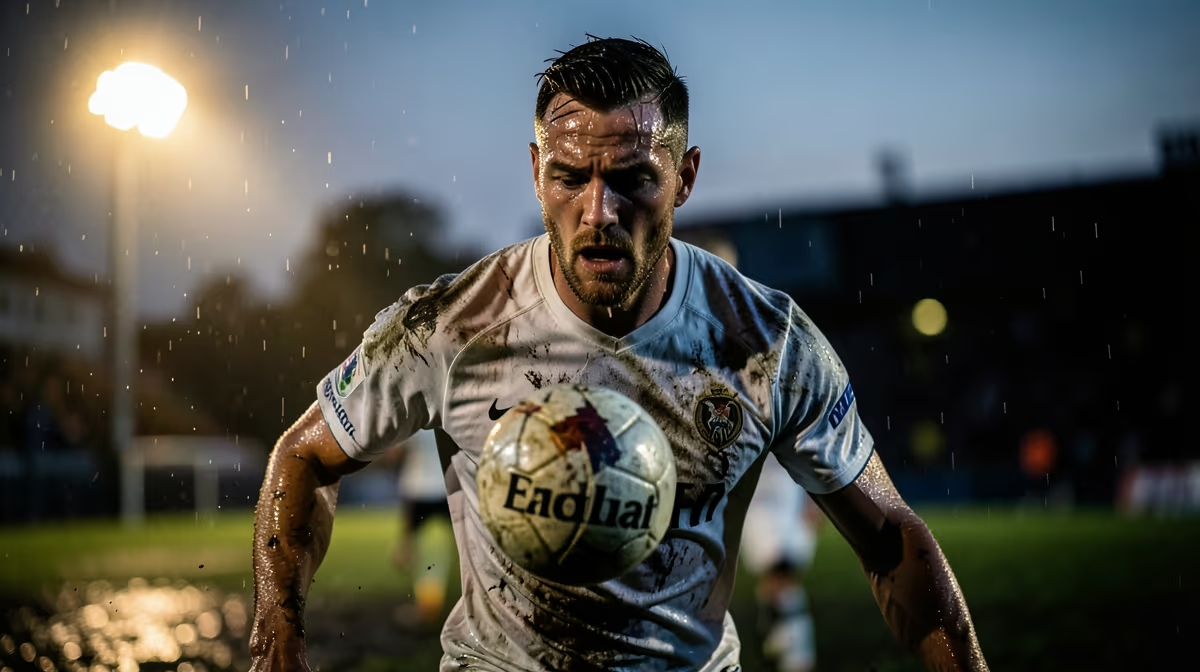
As the qualification cycle for the FIFA World Cup 2026 intensifies, all eyes are on Erling Haaland. The prolific striker remains the focal point for the Norway national football team, with fans and analysts closely monitoring his world cup stats to see if he can carry his club form onto the global stage.
The ascent of the Leeds-born striker has been nothing short of meteoric, transforming him into a cornerstone of the modern football landscape. Currently plying his trade for Manchester City in the English Premier League, Haaland is widely recognized as one of the most formidable strikers in the sport. His playing style, defined by blistering speed, clinical finishing, and immense physical presence, has forced global tactical shifts. Opposing teams have been compelled to redesign their defensive structures specifically to neutralize his influence, a testament to his impact as a singular, overpowering athlete.
The Road to FIFA World Cup 2026
For the Norway national football team, the path to the upcoming tournament is paved with both expectation and pressure. While Haaland has conquered the club level—securing a historic Treble with Manchester City in his debut season—translating that success to the international stage remains the ultimate hurdle. His journey involves navigating the complex landscape of UEFA qualifiers, where the margins for error are razor-thin. Analysts are currently observing his progress with keen interest, evaluating whether he can replicate his record-breaking Premier League form to propel his nation toward qualification. The stakes are immense, as the global sports-industrial complex relies heavily on the presence of such icons to maintain interest and commercial engagement during the world’s most prestigious football event.
The Mechanics of a Modern Icon
At the heart of the Haaland phenomenon is an intersection of raw athleticism and professional rigor. Born to former professional footballer Alf-Inge Haaland, his development has been a masterclass in data-driven physical training. Since his professional beginnings in Norway and subsequent rise through Red Bull Salzburg and Borussia Dortmund, he has evolved into a symbol of modern football efficiency. His record-breaking 36-goal tally in a single Premier League season serves as the primary data point in the ongoing discussion regarding his status as the world's most valuable sports asset. Beyond the statistics, his professional relationship with manager Pep Guardiola and the support of the Manchester City medical staff have been instrumental in maintaining his high athletic output throughout congested winter schedules.
Economic and Geopolitical Dimensions
The influence of Erling Haaland extends far beyond the confines of the football pitch. His career is currently a nexus for multi-billion dollar commercial interests, functioning as a vehicle for the brand recognition of state-backed entities like the City Football Group. This relationship highlights a broader trend in professional sports where player valuation is decoupled from traditional market dynamics. Instead, elite athletes are increasingly viewed as high-yield investment vehicles within a global sports-industrial complex that bridges international diplomacy and cultural integration. By acting as a focal point for Middle Eastern diplomatic strategies, the Premier League and its stars serve as critical conduits for soft power expansion, a phenomenon reminiscent of the 1970s New York Cosmos era which sought to legitimize and expand commercial frontiers through global icons.
Current Trajectory and Tactical Integration
In the immediate term, the focus for the striker is on recovery and tactical alignment. Over the next 24 hours, he is scheduled for routine post-match recovery sessions and tactical briefings with his Manchester City staff. As the next 72 hours approach, industry observers expect an uptick in media speculation regarding his international break participation and physical conditioning status. Expert predictions suggest that he will maintain his prolific scoring rate as he continues to integrate into the club's evolving tactical setup. However, the durability of this asset remains a key variable for investors and stakeholders alike. While the best-case scenario involves a continued streak of individual records and injury-free dominance, the worst-case involves recurring muscle strains that could hinder the collective consistency of the Manchester City squad across multiple high-stakes competitions.
Analyzing Modern Striker Efficiency
The broader shift toward data-optimized physical development in football has reached its pinnacle in Haaland. He represents an era where human labor in sports is increasingly shaped by algorithmic precision and advanced scouting. This shift signals a transition toward human engineering in professional leagues, where the physical demands on a player are matched by the intensity of the commercial scrutiny they face. As teams like Manchester City continue to leverage this technology, the influence of a single striker on global betting markets and fantasy football platforms grows exponentially. This commodification ensures that every touch, every goal, and every match is measured against the backdrop of massive broadcasting revenues, further solidifying the striker's position as a central figure in the economics of world-class football.
Frequently Asked Questions
What team does Erling Haaland play for?
Erling Haaland currently plays as a striker for Manchester City in the English Premier League. He joined the club from Borussia Dortmund in the summer of 2022.
How many goals has Erling Haaland scored in his career?
Erling Haaland has scored well over 250 professional career goals for both his clubs and the Norway national team. His prolific goal-scoring rate continues to set new records in major European leagues.
Is Erling Haaland the best striker in the world?
Many football pundits and fans consider Erling Haaland to be the best striker in the world due to his incredible physicality, finishing ability, and consistent goal production. His impact on Manchester City's success further reinforces his standing among the elite players globally.
What is Erling Haaland's nationality?
Erling Haaland is Norwegian. He represents the Norway national football team in international competitions, having been born in Leeds, England, while his father played for Leeds United.
Has Erling Haaland won the Ballon d'Or?
As of now, Erling Haaland has not won the Ballon d'Or, although he has finished in the top three of the voting. He remains a top contender for the award given his achievements with Manchester City.
How tall is Erling Haaland?
Erling Haaland is approximately 1.95 meters, or 6 feet 5 inches, tall. His impressive height combined with his explosive speed makes him an incredibly difficult forward for defenders to manage.
Conclusion
Erling Haaland stands as the definitive figure in modern football, balancing the immense expectations of the Norway national football team with the relentless demands of the Premier League. While his individual performance continues to break historical records and drive massive global engagement, the reality of his career remains tied to rigorous physical conditioning and the shifting geopolitical interests of the clubs he represents. As he looks toward the qualification for the 2026 World Cup, his fitness and form will remain the ultimate barometers for both his national aspirations and the commercial success of his club. The path ahead remains a high-stakes endeavor, dictated by the intersection of elite human performance and global commercial ambition.


.webp)
