
Trump defense supply chain order signals major US manufacturing pivot
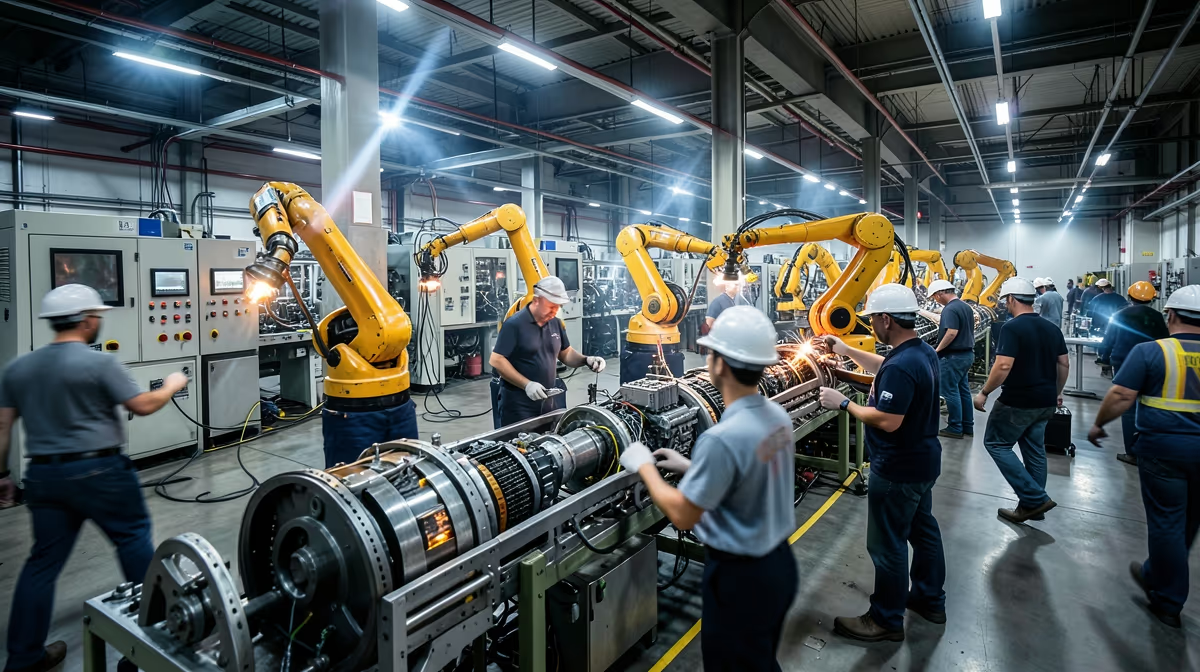
The resilience of the American military-industrial complex hangs in the balance as federal authorities pivot toward a policy of radical self-sufficiency. The proposed Trump defense supply chain order signals a major shift in how the United States manages its national security policy, prioritizing the acceleration of domestic defense manufacturing to mitigate risks associated with US-China decoupling.
The Logic of Strategic Autonomy
At its core, the directive seeks to dismantle the systemic vulnerability inherent in an industrial base that has, for decades, relied on globalized supply chains to minimize costs. By mandating a rigorous audit of dependencies on foreign sources for defense-related materials, the administration is moving to ensure that the U.S. military maintains uninterrupted access to critical components. This strategy is driven by a realization that modern geopolitical instability and trade tensions can effectively weaponize logistics, leaving the nation's defense readiness exposed to the whims of international competitors.
The policy aims to protect the U.S. military from potential supply chain disruptions caused by trade tensions. By prioritizing domestic production, the administration hopes to minimize vulnerabilities where international trade disputes or global instability could cut off access to vital equipment. This is not merely an economic shift; it is a foundational change in how the United States defines military preparedness, moving away from the pursuit of global efficiency toward a model of strategic sovereignty.
Historical Context and Industrial Transformation
To understand the scale of this initiative, one must look at the historical parallels. Much like the 1941 creation of the War Production Board, which compelled civilian industries to convert for state-directed military output, current policies represent a significant consolidation of executive authority over private manufacturing sectors. The journey toward this mandate began as early as 2017 with Section 232 investigations into steel and aluminum, followed by the 2021 Executive Order 14017, which conducted a comprehensive review of critical supply chains.
The current move is a culmination of years of analysis that identified over 300 specific vulnerabilities within the defense industrial base. These range from a reliance on rare earth minerals to acute shortages in the specialized workforce required for high-tech aerospace and semiconductor production. By leveraging federal procurement power and offering targeted incentives, the administration aims to steer private sector capital back toward domestic facilities, effectively building a more resilient network capable of withstanding global market shifts.
Analyzing the Push for Decoupling
The geopolitical angle of this order is centered on the accelerated decoupling of the U.S.-China technology spheres. This policy compels allies to choose between American security standards and access to Chinese markets. Analysts point out that this creates a ripple effect throughout the global procurement landscape, forcing defense contractors like Lockheed Martin and Raytheon Technologies to recalibrate their international logistics.
While the administration characterizes these measures as a national security imperative, industry trade groups, including the National Defense Industrial Association, remain cautiously optimistic. Their primary concern is that the regulatory framework required for reshoring must not inadvertently stifle private sector innovation. The economic reality is that forced reshoring and friend-shoring carry immediate inflationary pressures on military procurement budgets, necessitating a long-term reallocation of capital that will define the budgetary environment for years to come.
Anticipated Operational Challenges
In the next 24 hours, the administration is expected to finalize formal directives and supply chain audits targeting critical weapon components. This will trigger a period of intense adjustment for defense contractors. Over the next 72 hours, these firms will initiate internal reviews to identify potential bottlenecks, particularly regarding the sourcing of rare earth minerals and advanced microchips that are currently subject to foreign-controlled pipelines.
The expert prediction is that while reshoring policies will increase short-term operational costs for firms, they are designed to reduce the long-term risk of reliance on Chinese supply chains. However, there are significant risks. In the worst-case scenario, supply chain disruptions and inflationary pressures on raw materials could lead to project delays and massive cost overruns in flagship defense programs. Conversely, a best-case outcome would see a significant expansion of domestic industrial capacity, fostering high-tech manufacturing jobs across the nation's industrial heartland and enhancing overall security resilience.
Hidden Risks and Dual-Use Technology
One of the more complex aspects of this initiative is the potential impact on the civilian sector. There is a hidden danger that the prioritization of military-industrial profitability could create severe shortages in civilian sectors that are dependent on dual-use technology. As federal agencies tighten their grip on the availability of essential components, the ripple effects may be felt by manufacturers who compete for the same semiconductors and specialized materials currently earmarked for defense readiness. This shift reinforces the administration's "America First" strategy but raises questions about how the broader economy will absorb the friction of such a rapid industrial pivot.
Frequently Asked Questions
What was the Trump executive order on supply chains?
Executive Order 13806, signed by President Trump in 2017, initiated a comprehensive assessment of the manufacturing and defense industrial base. The goal was to identify risks and vulnerabilities that could prevent the U.S. from meeting national security requirements during a crisis.
Why did Trump issue an order regarding the defense supply chain?
The order was issued due to concerns that decades of offshoring, sequestration, and industrial decline had weakened the domestic production capacity. Officials aimed to ensure that the U.S. military could source critical materials and components domestically rather than relying on foreign adversaries.
What did the Trump administration's supply chain report find?
The 2018 report identified over 300 specific vulnerabilities within the defense industrial base, ranging from reliance on rare earth minerals to shortages of skilled labor. It highlighted how globalized supply chains could be weaponized against the United States during times of conflict.
How did the Trump defense supply chain order impact domestic manufacturing?
The order pushed for renewed investment in critical manufacturing sectors and stricter monitoring of foreign ownership in defense-related industries. It set the stage for later policies focused on reshoring high-tech production, such as semiconductors and battery technologies.
What is the current status of the Trump-era supply chain policies?
Many of the priorities established by the Trump administration were integrated into subsequent defense authorization acts and later expanded upon by the Biden administration. The focus on strategic autonomy and securing supply chains remains a central pillar of modern U.S. national security policy.
Did Trump's supply chain order affect foreign reliance for military parts?
Yes, the order specifically directed the Department of Defense to reduce dependence on foreign sources for critical materials. It encouraged the creation of more robust domestic alternatives and prioritized partnerships with allies to diversify the supply chain for essential defense components.
Conclusion
The implementation of this new defense supply chain mandate marks a definitive transition toward industrial sovereignty for the United States. With the signing of the executive order and the launch of a formal federal audit, the government has set a clear course to reduce reliance on foreign-sourced materials and strengthen the domestic defense industrial base. While the administration is focused on securing the supply of critical technologies, the coming months will test the speed at which domestic manufacturing can scale to meet these new requirements. As agencies move from the planning stages to active implementation, the focus remains on balancing national security imperatives with the economic realities of a highly integrated global market.


