.webp)
Ukraine Caspian Sea Strikes Redefine Modern Naval Warfare
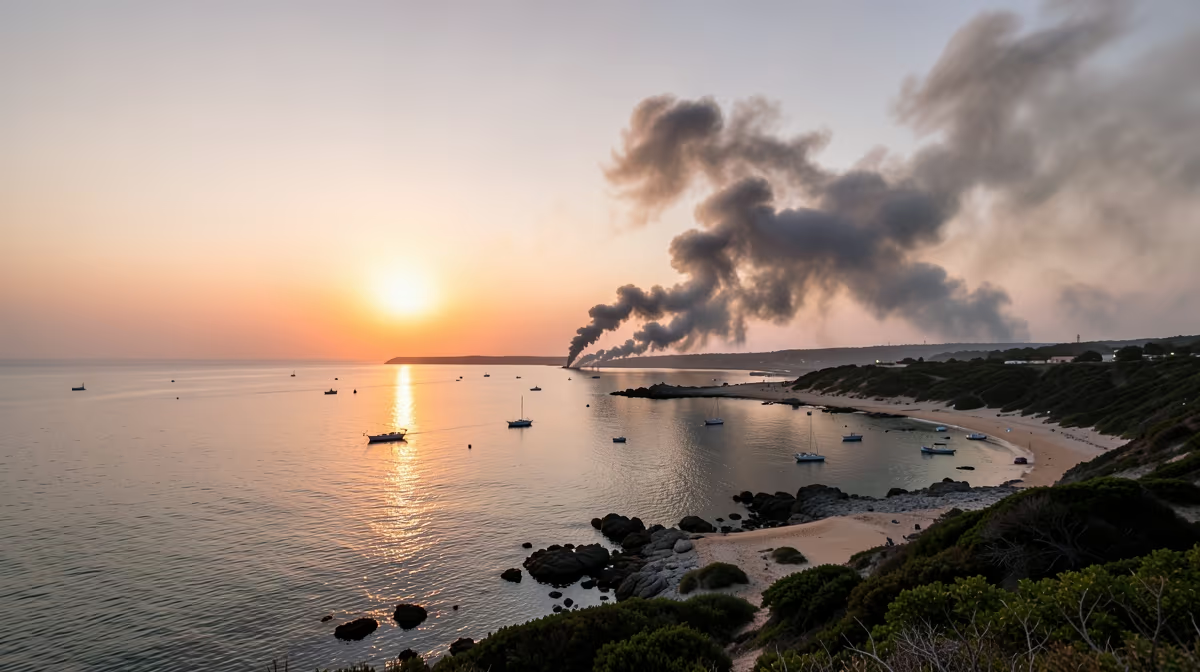
In an unprecedented expansion of military reach, Ukrainian long-range drones struck Russian naval targets in the Caspian Sea region in late 2024, hitting facilities located hundreds of miles away from traditional combat zones. Recent developments show that ukraine caspian sea strikes are reshaping maritime security strategies across the region, challenging long-held assumptions about geographic invulnerability in secondary inland theaters.
Background
Since the full-scale Russian invasion in 2022, Ukraine has primarily focused on defending its territory and striking targets near the front lines or inside occupied regions. Over time, with Western support and domestic innovation, Ukraine has steadily increased its production of long-range drones to strike deep inside Russian territory, moving the war closer to the Russian domestic population and military command centers. The root cause of this expansion stems from Ukraine's systematic targeting of Russian critical infrastructure and military staging grounds, specifically seeking to disrupt long-range cruise missile supply chains and naval assets positioned in adjacent inland seas. Historically, this mirrors Japan's 1942 Doolittle Raid on Tokyo, which had minimal immediate material impact but delivered a profound psychological shock, forced strategic redeployments, and shattered the illusion of homeland sanctuary. Russia initiated this logistical reliance by militarizing the Caspian Flotilla to launch Kalibr cruise missiles against Ukraine starting in 2022. In response, Ukraine invested heavily in indigenous long-range unmanned aerial vehicle development and asymmetrical maritime drone technology, leading to initial tests that successfully evaluated the limits of Russian inland radar and air defense coverage before executing targeted deep-strike operations impacting strategic assets within the Caspian basin nexus.
What Unfolded
The coordinated strikes targeted Russian military infrastructure situated along the Caspian coastline, a strategic body of water previously considered secure from direct Ukrainian kinetic operations. Defense analysts note that the Caspian Sea serves as a crucial transit route for Russian military supplies and a launchpad for cruise missiles targeting Ukrainian critical infrastructure. By pushing deep into Russia's strategic rear, Kyiv aims to disrupt the logistics network that sustains ongoing missile barrages against Ukrainian cities. Military officials have increasingly emphasized domestic drone production as a viable asymmetric countermeasure to Russia's vast conventional superiority. While air defenses in the region attempted to intercept the incoming unmanned aerial vehicles, satellite imagery and local reports confirmed multiple impacts on targeted port and industrial infrastructure. The operation marks a significant psychological and tactical milestone in the ongoing conflict. Ukrainian defense intelligence sources emphasized the necessity of targeting military logistics at their source, stating that any facility used to facilitate the aggression against Ukraine is a legitimate military target, regardless of its geographic distance from the frontline. Independent military experts noted that the strike demonstrates a profound evolution in Ukraine's long-range targeting capabilities. Verified facts confirm that Ukrainian long-range drones executed strikes targeting Russian military infrastructure near the Caspian Sea, that the Caspian Sea region is a key transit corridor for Russian military logistics and missile operations, that the attacks occurred hundreds of miles outside the immediate combat zone in Ukraine, and that satellite data and regional reports corroborated damage to targeted facilities. While the full extent of structural damage, the specific types of drones utilized, and the long-term impact on Russian naval logistics remain under assessment, the event underscores a permanent shift in operational boundaries.
Why This Matters
This development matters because it shatters the illusion of safety for Russian military operations far from the border, forcing Moscow to rethink how it protects its supply chains and strategic assets. It also proves that the war's geography is expanding, potentially altering the strategic calculus for both sides as Ukraine develops more advanced domestic weaponry. The vulnerability of the Caspian basin highlights the severe depletion of Russia's integrated air defense umbrella, revealing that even heavily guarded inland waters crucial to trans-Eurasian trade are exposed to low-cost, long-range drone saturation attacks. This directly affects Russian military planners who must now redeploy air defenses to protect distant bases, Ukrainian civilians who face the ongoing war but see strategic counter-offensives, and the global community observing the shifting technological and tactical limits of the conflict.
Political Dimension And Geopolitical Angle
The strikes challenge the narrative of Russian invulnerability and project Ukrainian reach deep into strategic zones previously considered safe, forcing Moscow to weigh the political costs of redeploying scarce air defense assets from the frontlines to protect secondary waters. Geopolitically, the operations test the strategic patience and security architectures of Central Asian nations and Iran, which serve as key partners in Russia's North-South Transport Corridor, while signaling to Western backers that Kyiv can successfully innovate asymmetric strike capabilities at extended ranges. Economically, these developments impact critical energy export routes and maritime logistics shared by Russia, Kazakhstan, and Azerbaijan, potentially driving up regional insurance rates, altering Caspian hydrocarbon transit dynamics, and imposing massive capital replacement costs on Russia's military-industrial complex. Key players involved across these dimensions include Ukraine, Russia, Kazakhstan, Azerbaijan, and Iran, with impact areas centered on Caspian Sea maritime routes, energy export corridors, and regional air defense networks.
Outlook And Expert Assessment
According to near-term projections, the immediate window anticipates increased surveillance and intelligence sharing among regional states regarding long-range drone capabilities targeting critical maritime infrastructure, followed by diplomatic demarches and security consultations between littoral states of the Caspian Sea and international actors to assess navigation safety over the subsequent seventy-two hours. Expert prediction indicates that the expansion of asymmetric strike capabilities into the Caspian basin marks a significant escalation in the spatial reach of the conflict, compelling neutral littoral states to bolster their airspace monitoring and maritime security protocols. Best-case scenarios suggest strikes remain isolated test events with no physical damage to critical energy infrastructure, leading to rapid diplomatic engagement and enhanced regional security agreements without broader escalation. Conversely, worst-case scenarios warn that successful strikes on Caspian energy facilities could disrupt critical oil and gas supply chains, prompting retaliatory actions, increased militarization of the inland sea, and severe diplomatic friction between Russia and its southern neighbors.
Frequently Asked Questions
Has Ukraine struck targets in the Caspian Sea region?
Ukraine has increasingly utilized long-range asymmetric capabilities, including modified drones and advanced tech, to project power far beyond its borders. While direct naval engagements in the Caspian Sea remain logistically complex, military analysts monitor potential threats to Russian infrastructure and supply lines in adjacent strategic zones. These operations reflect Kyiv's growing capacity to disrupt Russian logistics deep inside undisputed rear areas.
Why is the Caspian Sea region strategically important for Russia's war in Ukraine?
The Caspian Sea basin serves as a vital maritime and logistical corridor for Moscow, connecting Russia to Iran and other Central Asian partners. Russia utilizes these waters to transport military hardware, drone components, and other critical supplies largely shielded from direct Western surveillance. Disrupting or threatening this transport route would significantly complicate Russian military replenishment and strategic partnerships.
Can Ukrainian drones reach the Caspian Sea?
With the rapid development of long-range loitering munitions and modified light aircraft, Ukraine has demonstrated the capability to strike targets thousands of kilometers away inside Russian territory. Reaching the Caspian basin would require navigating extensive Russian air defense networks over vast distances. However, successful strikes on Engels air base and other distant locations prove that extreme-range operations are technically feasible for Ukrainian forces.
How does Russia protect its Caspian Sea military assets?
Moscow maintains a dedicated Caspian Flotilla equipped with naval infantry, surface combatants capable of launching Kalibr cruise missiles, and robust air defense systems. These forces are tasked with securing energy infrastructure, transport routes, and naval bases along the Russian coastline. Following asymmetric threats in the Black Sea, security measures around all Russian maritime assets have been heightened.
What role does Iran play in Caspian Sea security regarding the Ukraine war?
Iran shares the Caspian Sea coastline with Russia and has established a deepening military-industrial partnership with Moscow during the conflict. Tehran reportedly supplies suicide drones and ballistic missile technology, often transported via Caspian shipping routes. Consequently, any military escalation or intelligence operations in the region inevitably involve geopolitical dynamics concerning Iranian-Russian cooperation.
What would be the strategic impact of a successful strike near the Caspian Sea?
A successful long-range strike near the Caspian Sea would shatter the perception of invulnerability for Russia's rear logistics and supply chains. It would force Moscow to redeploy critical air defense systems away from the frontlines to protect distant maritime and industrial hubs. Furthermore, it would demonstrate an unprecedented operational reach, altering the strategic calculus of the conflict.
Conclusion
The expansion of Ukrainian long-range drone operations into the Caspian Sea basin marks a definitive milestone in the evolution of modern naval warfare and strategic reach. Verified developments confirm that military infrastructure situated hundreds of miles from traditional frontlines has been successfully targeted, altering the logistical security calculations of the conflict. As regional states navigate these emerging maritime and air defense challenges, heightened surveillance and diplomatic consultations remain the immediate next steps in addressing the changing security dynamics of the Caspian basin.


.webp)
.webp)
