.webp)
El Nino Weather Impacts and Economic Outlook Signal Major Shifts Ahead
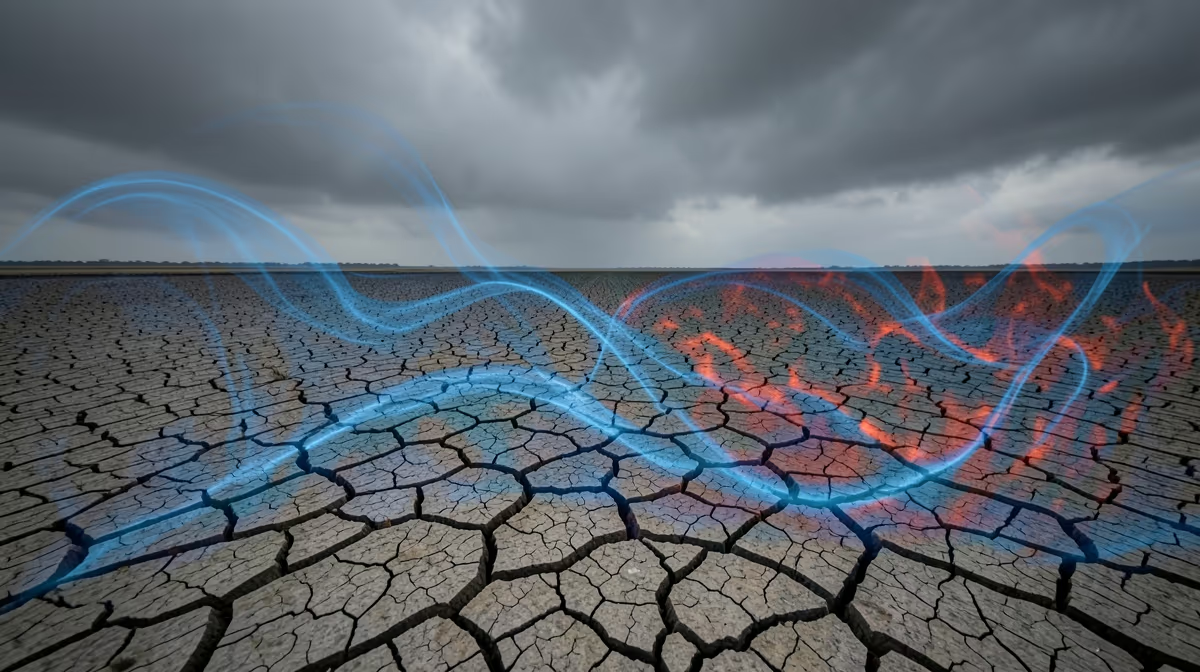
Pacific Ocean temperatures are once again capturing global attention as meteorologists track shifting ocean conditions that threaten to destabilize international trade and agricultural yields. Beneath the surface of international commodity markets, subtle oceanic oscillations are quietly orchestrating widespread economic ripples that will test the resilience of governments across the global south.
Imagine the vast Pacific Ocean as a giant bathtub. Normally, strong winds push warm water toward Australia and Asia, keeping the waters near South America cool. During an El Nino event, these winds weaken or reverse, allowing a massive pool of warm water to slosh back toward the Americas. This warm water acts like a giant heater in the sky, changing wind patterns and storm tracks all over the planet. For India, this phenomenon plays a massive role in our weather, specifically the southwest monsoon. When El Nino is active, it tends to suppress the monsoon rains that India heavily relies on for agriculture. This can lead to drier conditions, delayed planting seasons, and warmer-than-average summers across the subcontinent.
The India Meteorological Department confirmed that prevailing El Nino conditions across the equatorial Pacific Ocean are weakening, raising expectations for a transition to neutral conditions and subsequently La Nina ahead of the upcoming monsoon season. El Nino, a climate pattern characterized by the warming of surface waters in the eastern tropical Pacific Ocean, has significantly impacted India's agricultural sector over the past year by suppressing monsoon rainfall and driving up summer temperatures. The weather agency noted that while remnants of the current weather pattern continue to influence regional temperatures, oceanic indicators show a distinct cooling trend in the central and eastern Pacific. Agricultural planners and policymakers are closely monitoring the shift, as a transition to La Nina typically correlates with above-average rainfall and favorable conditions for Kharif crop production across the subcontinent. However, experts caution that residual atmospheric effects may linger during the transition phase, causing erratic pre-monsoon shower patterns in southern and eastern states. State governments have been advised to maintain contingency plans for water management as reservoirs in key river basins report depleted storage levels following the prolonged dry spells induced by the recent El Nino cycle. The India Meteorological Department is scheduled to release its initial long-range forecast for the southwest monsoon by mid-April. According to Dr. M. Ravichandran, Secretary of the Ministry of Earth Sciences, current numerical models suggest a high probability of transitioning from El Nino to ENSO-neutral conditions during the early part of the monsoon season, followed by a potential shift to La Nina by August or September.
The root cause of these disruptions lies in the weakening of the Walker circulation leading to anomalous warming of sea surface temperatures in the central and eastern equatorial Pacific. This oceanic shift disrupts the Indian Ocean Dipole and the normal progression of South-West monsoon winds over the Indian subcontinent. Peruvian fishermen first noticed unusually warm waters off their coast around Christmas centuries ago, naming the phenomenon El Nino, which translates to the Christ child in Spanish. Scientists later connected these Pacific Ocean temperature shifts to worldwide weather patterns, including the Indian monsoon. El Nino is fundamentally a climate pattern characterized by the warming of surface waters in the eastern Pacific Ocean. It typically occurs every two to seven years and can last anywhere from nine to twelve months. In India, El Nino is historically linked to below-average monsoon rainfall and drought-like conditions. The phenomenon also impacts global temperatures, often pushing global average temperatures to historic highs while altering jet streams globally, causing extreme weather ranging from severe droughts to devastating floods in different parts of the world. The ongoing El Nino event is currently weakening in the equatorial Pacific Ocean, and sea surface temperatures in the Nino 3.4 region are returning toward average levels, confirming the gradual decay of the current phase and the onset of ENSO-neutral conditions by the mid-year period.
The economic and political fallout from these climatic shifts presents immediate challenges for policymakers. Severe contraction in agricultural output spikes retail food inflation, squeezing consumer discretionary spending, dampening rural demand for fast-moving consumer goods and automobiles, and forcing the Reserve Bank of India into a delicate balancing act between managing inflation and supporting growth. From a political standpoint, rural agrarian distress directly threatens the electoral legitimacy of the ruling government, forcing costly welfare interventions like free food grain distribution, expanded rural employment guarantee allocations, and politically sensitive export bans on agricultural commodities to control domestic food inflation. Geopolitically, as a dominant global exporter of rice and sugar, India's export restrictions create food security vulnerabilities and diplomatic friction across import-dependent nations in South Asia, Africa, and the Middle East, while altering global commodity trade routes. A hidden consequence of these disruptions is accelerated rural-to-urban migration driven by repeated climate shocks and agrarian failure, silently straining urban infrastructure, depressing rural land values, and exacerbating regional water table depletion through aggressive groundwater extraction during dry spells. These dynamics mirror historical parallels from the severe El Nino events of 2009 and 2015 to 2016, which triggered widespread monsoon failures, crippling agricultural droughts, sharp spikes in domestic food inflation, and subsequent agrarian policy shifts.
The practical impact of these patterns falls heavily on specific segments of society. Farmers, rural communities, agricultural workers, and everyday consumers in India face higher food prices and potential water scarcity when climate anomalies strike. El Nino matters because it directly threatens India's food security and economy. Since a vast majority of Indian farmland depends on the monsoon rains for irrigation, a weak monsoon caused by El Nino can cause crop failures, soaring food prices, and severe water shortages, ultimately impacting the livelihoods of millions of families. Meteorological departments will issue updated advisories on sea surface temperature anomalies in the equatorial Pacific, monitoring the transition phases closely over the immediate term. Agricultural and water resource ministries will review contingency plans for potential monsoon irregularities and pre-season dry spells as agencies like the India Meteorological Department, Ministry of Agriculture and Farmers Welfare, and the National Oceanic and Atmospheric Administration coordinate observations. Expert predictions indicate a neutral-to-weak El Nino phase that may gradually influence the later stages of the upcoming monsoon season, requiring close monitoring of regional rainfall distribution. In the best-case scenario, El Nino effects remain weak and delayed, allowing for timely and well-distributed monsoon rains that support bumper crop yields and stabilize food inflation. Conversely, the worst-case scenario involves a rapid intensification leading to significant rainfall deficits, severe droughts in key agricultural belts, and subsequent rural distress and economic slowdown.
Frequently Asked Questions
What is El Nino and how does it affect India?
El Nino is a climate pattern defined by the warming of sea surface temperatures in the central and eastern tropical Pacific Ocean. In India, it is generally associated with suppressed monsoon rainfall and drier conditions, often leading to drought-like situations and agricultural stress.
How does El Nino impact the Indian monsoon?
During an El Nino year, the normal pressure conditions over the Pacific and Indian oceans get distorted. This weakens the monsoon winds blowing toward the Indian subcontinent, resulting in below-average rainfall across many parts of the country.
Is El Nino always bad for Indian agriculture?
While El Nino typically brings deficient rainfall that can severely impact kharif crops like rice, soybeans, and pulses, the actual impact varies. Advanced irrigation systems and timely contingency planning by the government help mitigate some of the agricultural losses.
When was the last major El Nino year in India?
India experienced significant El Nino conditions recently during 2023, which influenced the southwest monsoon season. These conditions led to erratic rainfall distributions across various states, prompting heightened monitoring by meteorological agencies.
How long does an El Nino event typically last?
An El Nino event usually develops between April and June, peaks in strength from November to January, and can last anywhere from 9 to 12 months. In some cases, these weather patterns can persist for up to two years with varying intensity.
What is the opposite of El Nino in India?
The opposite phase of El Nino is La Nina, which involves the cooling of ocean temperatures in the central and eastern tropical Pacific. For India, La Nina generally brings above-average rainfall, robust monsoon performance, and favorable conditions for agriculture.
Conclusion
The gradual decay of the current El Nino phase and the expected transition to ENSO-neutral conditions mark a critical turning point for regional weather systems and agricultural planning. While scientific models confirm the cooling of sea surface temperatures in the equatorial Pacific, the exact timing and intensity of subsequent La Nina developments remain under continuous observation by national and international meteorological authorities. Policymakers, agricultural ministries, and economic planners will maintain heightened vigilance through the upcoming transition phases, ensuring contingency frameworks remain active as preliminary long-range monsoon forecasts are finalized in the coming weeks.


.webp)
.webp)
