.webp)
Ukraine Caspian Sea Strikes Redefine Military Limits
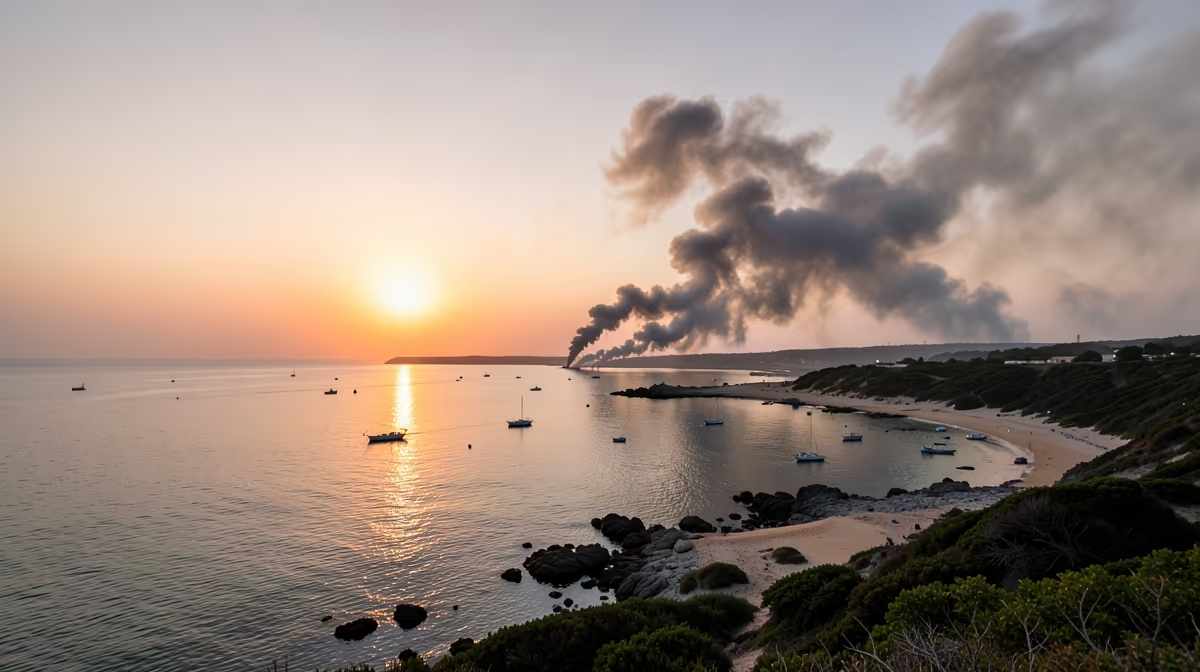
Geographic borders that once guaranteed absolute tactical insulation are dissolving under the weight of advancing unmanned technology, proving that distance no longer equals safety in modern warfare. Recent developments reveal that ukraine caspian sea strikes are expanding the geographical scope of the ongoing conflict, pushing the boundaries of strategic depth far beyond traditional frontlines. In an unprecedented expansion of military reach, Ukrainian long-range strike drones targeted Russian naval infrastructure in the Caspian Sea region, successfully hitting strategic targets located hundreds of miles beyond the traditional combat zone.
The strikes mark a significant escalation in Kyiv's asymmetric warfare strategy, demonstrating an enhanced capability to project power into previously secure rear areas utilized by the Russian military. According to regional intelligence assessments, the operation utilized modified unmanned aerial vehicles capable of navigating complex terrain and electronic warfare countermeasures over vast distances. Ukraine has recently expanded its military reach by launching drone strikes targeting Russian military assets far away in the Caspian Sea region. This area, located hundreds of miles from the front lines, was previously considered a safe zone for Russia to launch missiles against Ukraine without fear of retaliation. By hitting targets this far east, Ukraine is showing that it can strike deep inside Russian supply lines and strategic command areas.
These long-range attacks rely on advanced, domestically produced drones capable of flying massive distances. While the strikes may not immediately end the war, they disrupt Russia's ability to safely coordinate attacks and force Moscow to rethink how it defends its most critical military infrastructure far from the border. Defense analysts note that the Caspian Sea basin serves as a crucial logistical corridor for Russia, facilitating the transfer of military equipment, supplies, and weaponry. By striking targets in this sector, Ukraine aims to disrupt supply chains that directly support ongoing combat operations in mainland Ukraine, forcing Moscow to reevaluate the security of its southern and eastern maritime flanks.
Strategic Importance and Logistical Impact
The Caspian Sea region serves as a vital logistical hub for Russian military logistics, functioning as a relatively safe maritime zone to launch Kalibr cruise missiles against Ukrainian infrastructure. Because these warships are sheltered far from the direct combat zone in the Black Sea, they provide a secure platform for continuous missile barrages. Disrupting or monitoring these distant naval operations is of strategic interest to Ukraine's defense planning. The western shores of the Caspian Sea are roughly 500 to 700 miles away from the current frontlines and Ukrainian-controlled territory, meaning any aerial assault requires long-range drones capable of bypassing advanced Russian air defense systems across southern Russia.
While the immediate physical damage to the targeted facilities is still being assessed through commercial satellite imagery and intelligence reports, the psychological and strategic impact is already evident. Russian military bloggers and regional authorities have expressed concern over the vulnerability of infrastructure previously deemed safe from the direct consequences of the conflict. Military strategists have described the operation as a watershed moment in modern drone warfare. When you can project kinetic effects into the Caspian basin, you fundamentally alter the calculus of strategic depth for the aggressor, noted a defense official speaking on the condition of anonymity due to the sensitivity of the intelligence.
This development matters because it shatters the illusion of safety for Russian military assets deep within its own borders, forcing Moscow to divert precious air defense systems away from the front lines to protect far-flung facilities. For the global community, it signals that the war's technological tactics are rapidly evolving, with long-range drones reshaping how distant targets can be successfully engaged. Those affected include the Russian military, which must now spend resources defending distant regions; Ukrainian civilians, who hope these disruptions will reduce incoming missile attacks; and international observers monitoring the evolution of modern drone warfare.
Geopolitical and Economic Dimensions
The expansion of the theater of war into Central Asia's periphery challenges Moscow's security monopoly in its near abroad and sends a strong deterrent signal to key Russian allies like Iran and Turkmenistan. This creates a complex political angle, testing the boundaries of Washington's escalation management doctrine and forcing the Biden administration to recalibrate its restrictions on long-range strikes against targets deep within the Russian operational rear. The Caspian Sea is bordered by Russia, Kazakhstan, Turkmenistan, Iran, and Azerbaijan, none of which are direct combatants in the war. While some regional countries maintain close economic or military ties with Moscow, they generally seek to avoid direct involvement in the conflict, making military escalations directly involving the waters of the Caspian a sensitive geopolitical issue for all surrounding nations.
Economically, these developments risk the disruption of critical Eurasian transit corridors, maritime trade routes in the Caspian Sea, and energy infrastructure shared by Russia, Kazakhstan, and Iran, heightening risk premiums for regional investors. The root cause of these maneuvers lies in Ukraine's strategic imperative to degrade Russian military logistics, command-and-control nodes, and cruise-missile launch platforms operating in the Caspian basin beyond traditional drone range. The covert intelligence-sharing and technological adaptations required for Ukraine to project power thousands of kilometers away potentially utilize asymmetric launch platforms or indigenous sabotage networks within neutral littoral states, recalling historical parallels such as Japan's 1942 Doolittle Raid on Tokyo, which was militarily modest in immediate physical damage but profoundly disruptive to the psychological and strategic calculus of the defending superpower.
Intelligence Forecast and Future Outlook
Looking ahead over the next 24 hours, intelligence sharing and satellite reconnaissance updates regarding potential long-range drone launch sites near the Caspian basin will intensify. Moving into the next 72 hours, diplomatic consultations between Caspian littoral states and Western intelligence agencies regarding regional security and maritime monitoring are expected to take place. Key players in this evolving scenario include the Ukraine Ministry of Defense, Russian Armed Forces, Iran, and the United States Intelligence Community, all monitoring impact areas spanning Caspian maritime security, energy supply routes, and Black Sea-Caspian logistics corridors.
Expert predictions indicate that strikes or demonstrations of long-range capability targeting regions far from the immediate frontline are designed to disrupt logistics, strain air defense networks, and signal vulnerability in Russia's deep rear. In the best-case scenario, kinetic actions remain limited, resulting in heightened deterrence without expanding the geographic scope of the conflict into broader regional escalation. Conversely, the worst-case scenario involves a miscalculation regarding third-party airspace over the Caspian leading to direct diplomatic crises or military friction involving regional states such as Iran or Kazakhstan.
Frequently Asked Questions
Can Ukraine strike targets in the Caspian Sea region?
Ukraine has demonstrated the capability to conduct long-range drone strikes far beyond its immediate borders, targeting strategic military infrastructure deep inside Russian territory. While the Caspian Sea is hundreds of miles from the frontline, naval assets and facilities in that region could potentially be within the extended operational range of advanced Ukrainian unmanned aerial vehicles. However, direct strikes in the Caspian itself remain rare and pose significant logistical and geopolitical challenges.
Why are Russian naval assets in the Caspian Sea significant to the war in Ukraine?
Russia utilizes the Caspian Sea as a relatively safe maritime zone to launch Kalibr cruise missiles against Ukrainian infrastructure. Because these warships are sheltered far from the direct combat zone in the Black Sea, they provide a secure platform for continuous missile barrages. Disrupting or monitoring these distant naval operations is of strategic interest to Ukraine's defense planning.
Has Ukraine attacked Russian ships in the Caspian Sea?
There have been no widely verified reports of direct Ukrainian surface drone or missile attacks against Russian warships operating specifically within the Caspian Sea. Most of Ukraine's successful naval drone operations have been concentrated in the Black Sea and the Sea of Azov. The unique geography of the Caspian, being an enclosed inland sea surrounded mostly by Russia and friendly or neutral states, makes direct kinetic strikes extremely difficult.
How far is the Caspian Sea from Ukrainian territory?
The western shores of the Caspian Sea are roughly 500 to 700 miles away from the current frontlines and Ukrainian-controlled territory. This vast distance means that any aerial assault would require long-range drones capable of bypassing advanced Russian air defense systems across southern Russia. Despite the distance, the evolution of drone technology has steadily increased the radius of potential deep-strike operations.
What military capabilities does Ukraine use for long-range strikes?
Ukraine relies heavily on domestically produced long-range loitering munitions and modified aircraft-style drones to strike targets far from the frontlines. These unmanned systems are designed to fly hundreds of miles using pre-programmed coordinates or GPS-denied navigation systems. Defense innovators continuously upgrade these platforms to increase their payload capacity and operational range.
Do Caspian Sea nations get involved in the Russia-Ukraine conflict?
The Caspian Sea is bordered by Russia, Kazakhstan, Turkmenistan, Iran, and Azerbaijan, none of which are direct combatants in the war. While some regional countries maintain close economic or military ties with Moscow, they generally seek to avoid direct involvement in the conflict. Consequently, military escalations directly involving the waters of the Caspian remain a sensitive geopolitical issue for all surrounding nations.
Conclusion
The execution of long-range drone strikes reaching the Caspian Sea basin marks a verified paradigm shift in the geographic scope of the conflict. As Ukraine continues to develop its domestic long-range drone program and target vital logistical corridors hundreds of miles beyond the frontline, Moscow faces mounting pressure to secure its deep rear and reroute critical air defense resources. With intelligence sharing, satellite reconnaissance, and diplomatic consultations intensifying among littoral states and international partners, regional actors will continue to navigate the escalating complexities of modern asymmetric warfare and maritime security in the Caspian basin.


.webp)
.webp)
