
US Strikes Iran-Linked Facilities as Middle East Tensions Ignite
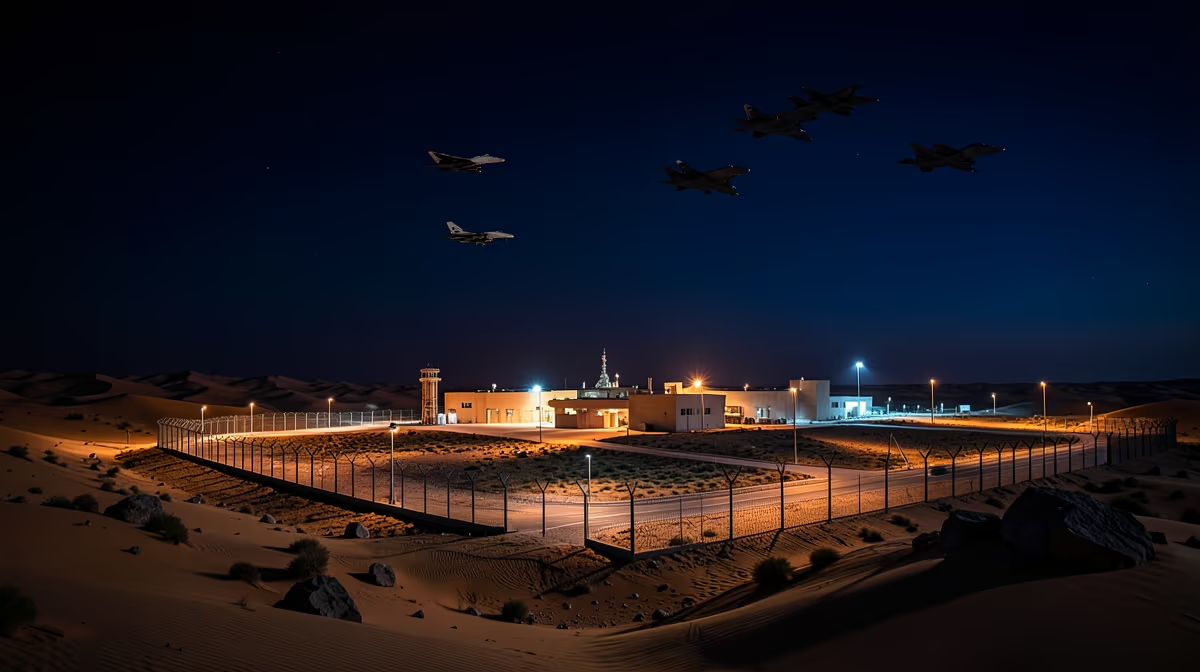
The delicate security architecture of the Middle East faces an uncertain future following a sharp shift in Pentagon strategy aimed at containing regional threats. The US strikes Iran linked facilities late Thursday, intensifying the geopolitical crisis and signaling a decisive move to protect American personnel from an evolving wave of proxy warfare.
What Unfolded
The United States military launched targeted airstrikes against multiple facilities in eastern Syria linked to Iran’s Islamic Revolutionary Guard Corps (IRGC). Pentagon officials confirmed that two F-16 fighter jets executed precision strikes against a weapons storage facility and an ammunition depot. These sites were reportedly utilized by the IRGC and associated militias to coordinate and sustain attacks against American service members.
Local reports from the Deir ez-Zor province confirmed that several explosions shook the area shortly before midnight. While damage assessments are ongoing, U.S. officials maintain that the sites were selected to maximize the degradation of logistical capabilities while minimizing civilian casualties. This military action serves as a direct response to at least 12 separate attacks on U.S. bases in Iraq and Syria over the past two weeks, which resulted in minor injuries to several service members. Defense Secretary Lloyd Austin stated that the operation was intended as a defensive measure to deter further aggression.
Root Causes and Geopolitical Context
The current friction represents the structural breakdown of the 2015 JCPOA and the transition of Iran from a regional proxy-manager to a direct nuclear-threshold state seeking to disrupt the U.S.-led regional security architecture. For decades, the U.S. and Iran have remained geopolitical adversaries, with relations strained by nuclear policy, economic sanctions, and Iran’s support for various regional groups.
Following the 2018 U.S. withdrawal from the nuclear deal, the region has witnessed a steady escalation. The period from 2023 to 2024 saw a significant expansion of proxy conflicts across the Levant and Red Sea, which has tested U.S. military readiness. Analysts point to a strategic shift toward Great Power containment, where the U.S. risks pushing Tehran into a deeper formal military alliance with Russia and China, effectively deepening the divide between the Global South and the Western bloc.
The Shift in Military Doctrine
A critical aspect of this escalation is the rapid advancement of localized autonomous drone and AI-driven anti-access and area-denial capabilities in Iran. These developments render traditional carrier-strike-group dominance increasingly vulnerable and costly to maintain. Historically, the 1988 Operation Praying Mantis provided a blueprint for how limited naval engagements could curb Iranian aggression without expanding into total war. However, the modern intelligence environment makes containment significantly more volatile, requiring a precise calibration of force.
The U.S. administration is currently navigating bipartisan pressure to project strength ahead of domestic election cycles while simultaneously attempting to restore deterrence against the so-called Axis of Resistance. The goal remains to prevent the conflict from spiraling into a full-scale, unpopular ground war, forcing the Pentagon to rely on high-intensity, precision-focused kinetic operations.
Economic Fallout and Market Stability
The immediate impact of these strikes is a heightened risk of instability in the Middle East, a critical hub for global energy supplies. The threat to maritime shipping lanes in the Strait of Hormuz remains a primary concern for investors and energy analysts. Any sustained conflict could trigger a surge in global crude oil prices, further destabilizing inflationary pressures and energy security for European allies.
Markets are currently bracing for economic uncertainty as diplomatic efforts struggle to find a path toward de-escalation. The potential for retaliatory cyber-attacks targeting critical infrastructure represents a secondary but equally significant risk to global economic stability. Investors are watching closely as shipping premiums fluctuate in response to the increased risk of regional military engagement.
Future Outlook and Risk Assessment
Predictive modeling for the next 24 hours suggests intensified diplomatic emergency sessions at the UN Security Council, alongside the rapid deployment of U.S. naval assets in the Persian Gulf. In the next 72 hours, analysts anticipate increased volatility in global oil markets and heightened rhetoric from both Tehran and Washington.
Experts foresee a tit-for-tat phase of asymmetric conflict rather than full-scale conventional war, with a focus on shadow warfare and economic sanctions to contain the escalation. The best-case scenario involves backchannel diplomacy facilitating a temporary de-escalation. Conversely, the worst-case involves miscalculation leading to a direct, sustained conventional military engagement, which would cause significant disruption to energy supplies and trigger a broader regional conflict.
Frequently Asked Questions
Why did the US conduct strikes against Iran?
The US has conducted strikes against Iran-linked targets in response to attacks on American personnel and military bases in the region. These actions are typically framed by the US government as defensive measures intended to deter further aggression from Iran-backed proxy groups.
What are the potential consequences of US strikes on Iran?
US strikes on Iran or its proxies carry the risk of escalation, potentially leading to a wider regional conflict in the Middle East. They may also disrupt global oil markets, strain diplomatic relations, and provoke retaliatory cyber or military actions against US interests.
Does the US have the authority to strike Iran without congressional approval?
The executive branch often argues that its authority to conduct limited military strikes comes from existing authorizations for the use of military force or the president's constitutional role as Commander-in-Chief. However, this remains a subject of intense debate in Congress regarding the limits of war powers and the necessity of legislative oversight.
How does Iran typically respond to US military strikes?
Iran often responds through asymmetric warfare, utilizing its network of regional proxies to conduct attacks on US bases or allies. Additionally, Iran may engage in cyber warfare, maritime harassment in the Persian Gulf, or increase its uranium enrichment activities as a form of diplomatic leverage.
Are US strikes on Iran considered an act of war?
Whether a strike constitutes an act of war is a complex legal and political determination that depends on the scale, intensity, and duration of the military action. While the US government typically characterizes these operations as targeted self-defense, international actors may interpret them as escalatory maneuvers that challenge national sovereignty.
What is the primary goal of US military policy toward Iran?
The primary goal of US policy is to contain Iran's influence in the Middle East, limit its ballistic missile development, and prevent it from acquiring nuclear weapons. The US seeks to achieve these objectives through a combination of severe economic sanctions, diplomatic pressure, and strategic military posturing.
Conclusion
The military engagement in eastern Syria marks a transition from a covert shadow-war to an era of overt, high-intensity escalation. While the Pentagon maintains that these strikes are defensive in nature, aimed specifically at degrading the capabilities of Iranian-backed proxies, the risk of regional contagion remains elevated. The coming days will be defined by a delicate balance between active military deterrence and the pursuit of diplomatic channels to prevent a broader conflict. As intelligence agencies monitor for potential retaliatory cyber-attacks and militia movements, the focus remains on the stability of energy markets and the containment of the current, volatile geopolitical crisis.


.webp)

.webp)
