
Airbus A320neo Production Rate Increase Sparks Massive Industry Shift
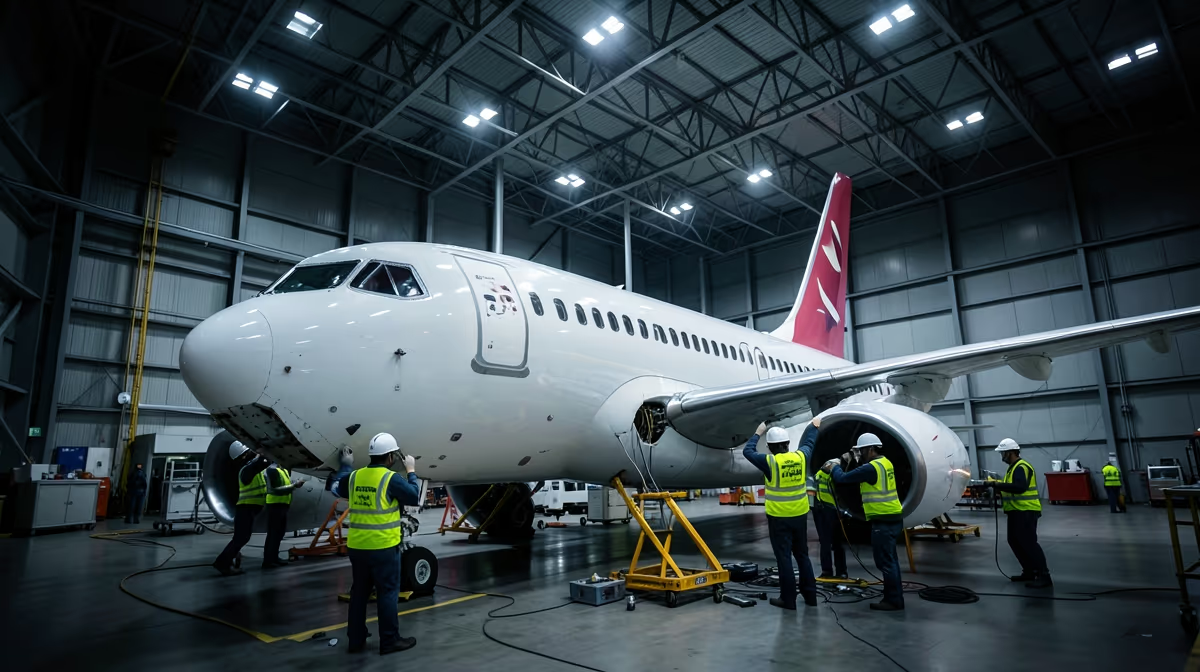
The latest **Airbus A320neo production rate increase** marks a major milestone for commercial aviation as manufacturers scale up operations to meet surging global demand. European aerospace giant Airbus is reportedly pushing to accelerate its monthly manufacturing output sooner than originally planned, even as the company faces the challenge of a significant delivery jump in the second half of the year. Industry analysts and market observers are closely evaluating the operational adjustments and supply chain implications required to support these aggressive targets.
Driving Factors Behind the A320neo Production Rate Increase
Persistent supply chain bottlenecks, engine availability constraints, and surging post-pandemic commercial aviation demand have created immense pressure on Airbus to accelerate A320neo production rates. The Airbus A320neo family is one of the most widely used single-aisle aircraft lines in commercial aviation, prized for its fuel efficiency. Aircraft manufacturing involves complex, highly regulated global supply chains where increasing production speed safely requires careful coordination between assembly lines, parts suppliers, and regulatory authorities.
According to recent reports from Leeham News and Analysis, Airbus is actively looking into moving up its timeline for ramping up the production of its popular single-aisle aircraft. This comes at a time when the planemaker faces substantial output targets to meet ongoing airline demand, which includes navigating a reported 48% second-half delivery jump to meet annual goals.
Manufacturing Infrastructure and Assembly Expansion
The push for higher production aligns with broader developments across Airbus's manufacturing footprint. Earlier this year, the company inaugurated a new A320 Family final assembly line in Toulouse, France, designed to bolster overall production capacity and streamline assembly processes for the single-aisle jets.
- Airbus is actively pushing to increase its monthly A320neo production rate sooner than initially expected.
- Meeting the current output targets requires a significant 48% jump in second-half deliveries.
- Airbus recently inaugurated a new A320 Family final assembly line located in Toulouse.
Governments in European manufacturing hubs, particularly France and Germany, maintain vested industrial policy interests in Airbus assembly capacity expansion, viewing aerospace dominance as critical for high-wage employment and strategic technological sovereignty. Meanwhile, the duopoly of global narrowbody aircraft manufacturing positions Airbus and Boeing as critical instruments of trade diplomacy, where delivery schedules influence bilateral economic ties with major airline markets in Asia, the Middle East, and the Americas.
Balancing Current Output With Future Fleet Replacements
While managing immediate production ramps, Airbus leadership is concurrently looking far ahead into the future of aviation. The company has expressed a strong commitment to launching a brand-new A320 family replacement aircraft by the year 2030, balancing immediate production capacity constraints with long-term technological development strategies.
Major airlines continue to manage fleet and engine maintenance agreements for their A320neo aircraft alongside these production updates. For instance, recent agreements involving carriers like American Airlines highlight the ongoing coordination required for engine selection and maintenance. At the same time, network integration continues to evolve, as seen with carriers introducing advanced connectivity services like Starlink-equipped flights across single-aisle operations.
Achieving aggressive delivery targets requires an unprecedented second-half delivery surge, directly impacting short-term cash flow, supply chain financing, and investor sentiment as reflected in fluctuating share prices. The rush to accelerate production timelines may quietly exacerbate tier-2 and tier-3 supplier stress, potentially shifting the primary bottleneck from final assembly lines to specialized component and engine sub-assemblies.
Market Impact and Outlook
Market watchers and investors continue to monitor these operational adjustments closely, as reflected by recent market reactions to the steep delivery ramps required in the coming months. Supply chain stability and assembly line efficiency remain critical factors in determining whether the accelerated production goals can be successfully achieved.
Industry analysts expect that while increasing the A320neo production rate presents logistical and delivery hurdles for the second half of the year, newly established assembly lines will eventually support higher output goals.
Accelerating production rates helps address the heavy backlog of commercial aircraft orders requested by airlines worldwide. For travelers and carriers alike, smoother and faster delivery timelines help airlines modernize their fleets, improve fuel efficiency, and meet growing global passenger demand.
Frequently Asked Questions
What is driving the need for higher Airbus A320neo production rates?
Persistent supply chain bottlenecks, engine availability constraints, and surging post-pandemic commercial aviation demand are driving the push to increase production rates.
What delivery challenge does Airbus face in the second half of the year?
Meeting current output targets requires a significant 48% jump in second-half deliveries.
How is Airbus expanding its manufacturing capacity?
Airbus recently inaugurated a new A320 Family final assembly line in Toulouse, France, to bolster overall production capacity.
What are Airbus's long-term plans regarding the A320 family?
Airbus leadership has expressed a strong commitment to launching an A320 family replacement aircraft by the year 2030.
Conclusion
The push to accelerate the Airbus A320neo production rate underscores the complex balance between meeting immediate commercial aviation demand and managing intricate global supply chains. With newly established assembly infrastructure in Toulouse and ambitious delivery targets for the second half of the year, stakeholders across the aerospace industry will continue to monitor how Airbus executes its manufacturing goals while planning for long-term technological replacements by 2030.
Sources
- Airbus pushing to increase monthly A320neo production rate sooner than later — Leeham News and Analysis
- Airbus Shares Edge Down as A320 Output Targets Demand 48% H2 Delivery Jump — TechStock²
- Airbus inaugurates new A320 Family final assembly line in Toulouse — Airbus
- Lufthansa operates first Starlink-equipped flight — Air Data News
- Airbus Is “Very Committed” To Launching An A320 Family Replacement In 2030, CEO Says — Simple Flying
- Husch Blackwell Represents American Airlines in Engine Selection and Maintenance Agreements with CFM for Airbus A320 Family NEO Aircraft — Husch Blackwell


.webp)
