
Black Hole Star Discovered by JWST Defies Physics Models
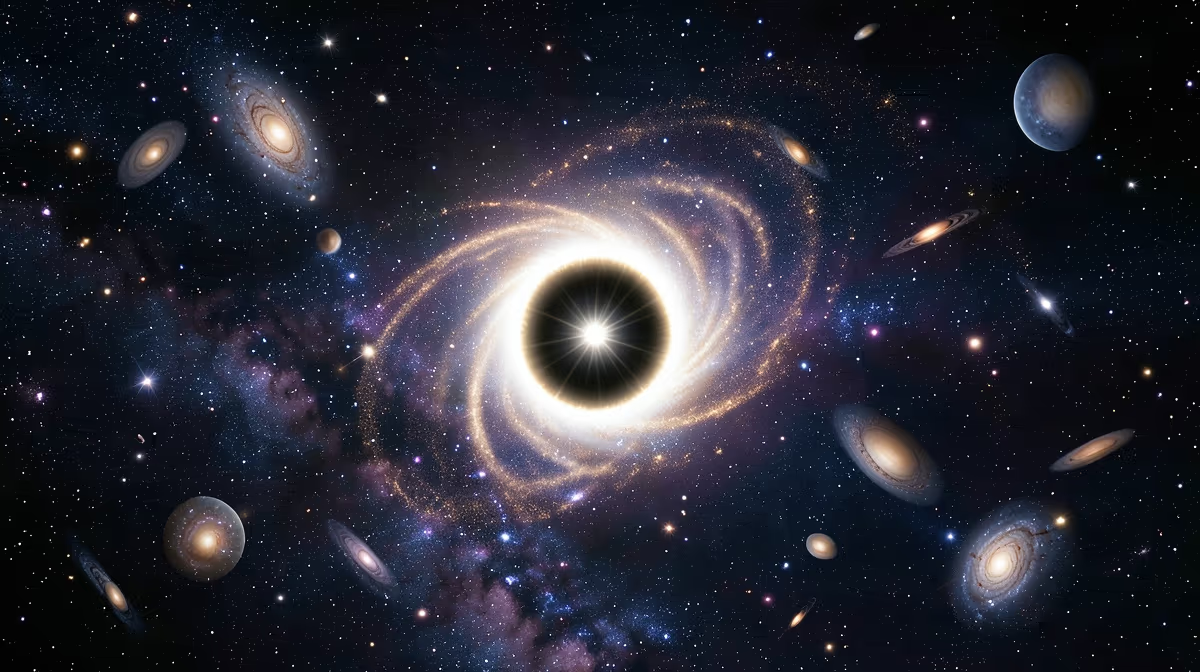
In a groundbreaking astronomy discovery, scientists using the James Webb Space Telescope (JWST) have identified a brand-new black hole star astrophysical object that challenges our current understanding of the universe. This bizarre cosmic entity is astonishingly bright—measuring about 100 billion times brighter than a standard star—defying previous expectations of what deep space can produce.
What Unfolded in Deep Space
Advancements in deep-space observation technology, specifically the James Webb Space Telescope, have allowed astronomers to detect anomalous high-energy celestial bodies that bridge the theoretical gap between massive black holes and luminous stellar objects. Observations made by instruments like the JWST revealed the bizarre object shining with immense brilliance, challenging existing models of stellar evolution and black hole dynamics.
Among the researchers behind the finding is Hyderabad-born MIT astronomer Rohan Naidu, whose involvement in the discovery has brought significant attention to the project. The object's unique properties, bridging the gap between stellar brightness and black hole mechanics, have stunned astrophysicists worldwide.
- Astronomers discovered a brand-new type of astrophysical object called a 'black hole star'
- The JWST spotted the bizarre object, which is noted to be 100 billion times brighter than a standard star
- Hyderabad-born MIT astronomer Rohan Naidu is behind the discovery
- Institutions like the Institute of Science and Technology Austria (ISTA) are discussing whether the object is a mirage or a miracle
The Scientific Debate: Mirage or Miracle
Institutions such as the Institute of Science and Technology Austria (ISTA) and various international research bodies are actively examining the data to understand the nature of this entity. Researchers from these institutions are carefully scrutinizing the data to separate theoretical models from actual space phenomena.
| Research Body / Contributor | Key Role / Affiliation | Focus of Contribution |
|---|---|---|
| Rohan Naidu | MIT (Hyderabad-born astronomer) | Leading researcher behind the black hole star discovery |
| ISTA | Institute of Science and Technology Austria | Analyzing data on whether the object is a mirage or miracle |
| JWST Teams | Observational Astronomy | Capturing deep-space imaging and luminosity data |
Historically, astronomers have classified celestial bodies into distinct categories such as normal stars, neutron stars, and black holes. Finding an object that blurs these definitions challenges established models of stellar evolution and galaxy formation, pushing researchers to reevaluate how light and gravity interact in the deepest reaches of space.
Why This Matters for Modern Astronomy
Discoveries of entirely new classes of astrophysical objects fundamentally expand our understanding of physics and the universe. By observing anomalies like the black hole star, scientists can test and refine theories about how extreme matter behaves, opening up uncharted frontiers in astronomy and space exploration.
Finding an object that blurs the definitions of black holes and stellar bodies challenges established models of stellar evolution and galaxy formation.
Scientific prestige and funding allocation among global space agencies will likely shift as researchers leverage this landmark discovery to lobby for increased budgets for deep-space astronomy infrastructure. The discovery of unprecedented cosmic phenomena also drives commercial interest in advanced optics, aerospace engineering, and data processing technologies required to analyze massive astronomical datasets.
Discovering a brand-new type of astrophysical object fundamentally expands our understanding of physics, pushing researchers to reevaluate how light and gravity interact in the deepest reaches of space.
Future Outlook and Expert Predictions
Increased scientific discussion, media coverage, and public interest are expected following the announcement by astronomers regarding the discovery of the black hole star object observed via the JWST. Further peer commentary, institutional breakdowns from organizations like ISTA, ScienceDaily, and Phys.org, and deeper analysis into the astrophysical implications of this brand-new cosmic object will follow over the next 72 hours.
Analysts expect further telescopic observations and theoretical modeling to confirm the exact nature and formation mechanics of this unprecedented celestial object. In the best-case scenario, the discovery opens up a groundbreaking new chapter in astrophysics, providing definitive insights into previously unknown stages of cosmic evolution and stellar mechanics. In the worst-case scenario, subsequent data analysis could reveal that the phenomenon is an optical illusion or a specialized transient mirage rather than an entirely new class of astrophysical object.
Frequently Asked Questions
What is a black hole star?
A black hole star is a brand-new type of astrophysical object recently discovered by astronomers using advanced equipment like the JWST. This bizarre cosmic entity is reported to be an unprecedented phenomenon, shining 100 billion times brighter than a typical star.
Who discovered the black hole star?
The groundbreaking discovery has brought attention to notable researchers in the field, including Hyderabad-born MIT astronomer Rohan Naidu. The finding represents a significant milestone in modern observational astronomy.
Why does the discovery of a black hole star matter?
Finding a brand-new type of astrophysical object challenges existing theories about stellar evolution and black hole formation. It opens up new avenues for understanding extreme physics and the early universe.
How bright is the newly discovered black hole star?
Observations, notably by the JWST, indicate that this bizarre cosmic object is staggering—roughly 100 billion times brighter than a standard star. This extreme luminosity is one of the key factors that initially drew astronomers' attention.
What happens next in the research of black hole stars?
Astronomers and research institutes are continuing to analyze data to determine whether this object is a lasting physical reality or a unique optical phenomenon. Further telescope observations will help verify its true nature and origins.
Is the black hole star a mirage or a real miracle?
Researchers from institutions like the Institute of Science and Technology Austria are actively debating whether the object is a true physical miracle or an observational mirage. Scientists are carefully scrutinizing the data to separate theoretical models from actual space phenomena.
Conclusion
Astronomers have successfully identified and documented a brand-new type of astrophysical object, termed a black hole star, utilizing the unprecedented capabilities of the James Webb Space Telescope. Led by researchers including MIT's Rohan Naidu and analyzed by institutions such as the Institute of Science and Technology Austria, this discovery has ignited intense global interest and debate across the scientific community. As researchers continue to evaluate whether this 100-billion-times-brighter-than-a-star phenomenon represents a physical miracle or an observational mirage, further telescopic observations and theoretical modeling will provide definitive clarity on the evolution of extreme cosmic structures.
Sources
- Black hole star: Astronomers discover a brand-new type of astrophysical object — Phys.org
- Astronomers Discover the Existence of a Black Hole Star — wired.com
- Astronomers Discover 'Black Hole Star', A Cosmic Object Never Seen Before — NDTV
- JWST spots a bizarre “black hole star” 100 billion times brighter than a star — ScienceDaily
- Hyderabad-born MIT astronomer Rohan Naidu, who dropped out of engineering at 18 & loves Test cricket, is behind the 'Black Hole Star' discovery — The Economic Times
- Black Hole Star: Mirage or Miracle? — Institute of Science and Technology Austria (ISTA)


.webp)

