
Black Hole Star Discovery by JWST Shatters Astrophysics Models
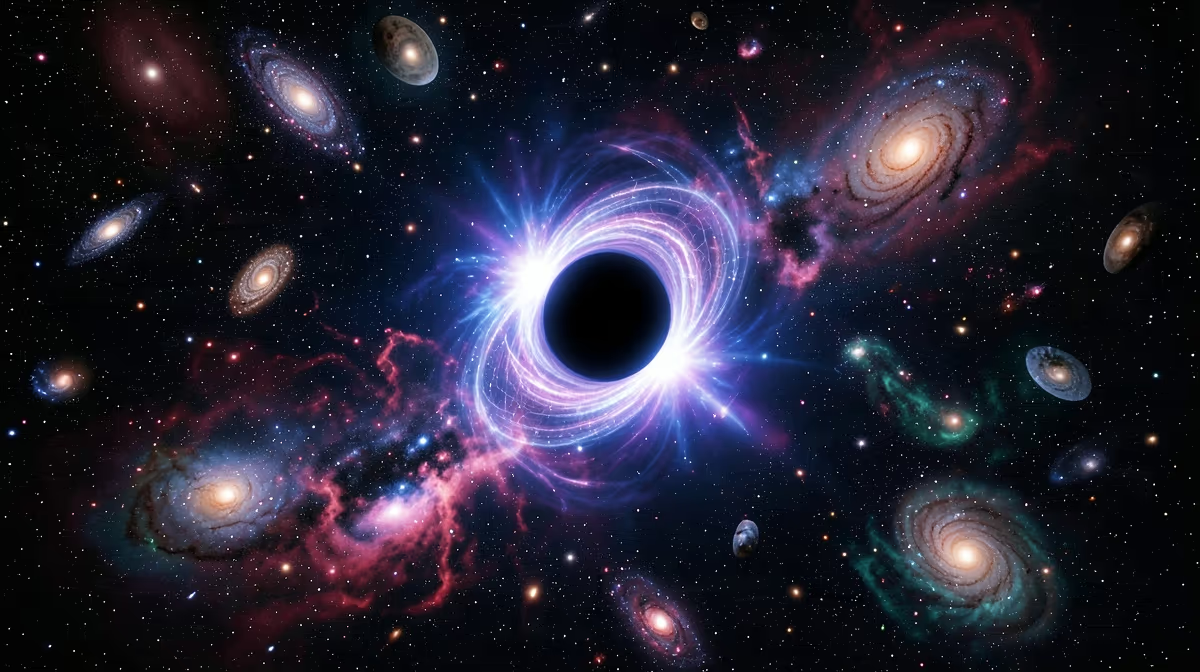
Astronomers using the James Webb Space Telescope have discovered a brand-new type of astrophysical object known as a "black hole star," an unprecedented cosmic phenomenon that is reportedly 100 billion times brighter than a standard star. In a groundbreaking astronomy breakthrough, scientists have identified this mysterious entity that challenges our current understanding of the universe.
Unprecedented Cosmic Discovery
The groundbreaking discovery has captured the attention of the global scientific community, with institutions such as Phys.org, WIRED, NDTV, and ScienceDaily reporting on the bizarre object. While research and analysis are still ongoing, observations highlight the unique characteristics of this entity, which bridges the gap between massive black holes and stellar bodies. For decades, astronomy has neatly categorized celestial objects into distinct groups like stars, planets, and black holes. Traditionally, black holes are formed from the collapse of massive stars, making the idea of a hybrid object an unexpected puzzle that challenges established stellar models.
Astronomers have discovered a brand-new type of astrophysical object that defies conventional understanding. Detected using advanced technology, this bizarre phenomenon behaves like a hybrid between a massive star and a black hole, shining with incredible intensity. Researchers are calling this entity a "black hole star." It challenges what scientists previously thought was possible regarding how stars and black holes form and interact in the vast expanse of the universe.
The findings, further explored by organizations like the Institute of Science and Technology Austria (ISTA), have sparked intense academic discussions regarding how such objects form and evolve in the universe. Researchers are currently evaluating the precise mechanics behind its extreme luminosity and how it interacts with its surrounding space. Research involving this cosmic phenomenon features contributions from international scientists, including MIT astronomers like Rohan Naidu.
Discoveries like the black hole star push the boundaries of modern astrophysics, forcing scientists to rethink the life cycles of stars and the fundamental laws governing the universe.
The Theoretical Intersection
The root cause of this breakthrough lies in the theoretical intersection of stellar evolution and black hole accretion physics, recently illuminated by high-resolution infrared data from the James Webb Space Telescope (JWST), allowing astronomers to observe previously undetectable cosmic objects. Scientific funding and prestige are heavily influenced by major observational breakthroughs. The discovery of a black hole star elevates space agencies and research institutions involved with JWST data, potentially shifting national priorities toward deep-space astronomy funding.
While not directly impacting commercial markets, fundamental astrophysical discoveries drive long-term investments in advanced optics, data processing, and aerospace engineering, while inspiring high-tech talent pipelines. Astrophysical discoveries continue to serve as a domain of soft power and international scientific collaboration, particularly as space agencies pool resources and data from instruments like the James Webb Space Telescope across borders.
However, the rapid classification and intense media spotlight on novel cosmic phenomena like black hole stars may pressure the scientific community to prematurely categorize ambiguous data before long-term peer validation is fully complete. This mirrors the historical parallel of the initial discovery of quasars and pulsars in the 1960s, which completely revolutionized our understanding of high-energy astrophysics and forced a revision of stellar physics models.
Scientific Observations and Outlook
As data from the James Webb Space Telescope continues to be analyzed, astrophysicists worldwide are expected to release more comprehensive studies to classify this brand-new class of celestial body and understand its implications for modern cosmology. Astronomical institutions and media outlets will continue publishing analyses regarding the newly discovered object, focusing on its extreme brightness and unique properties.
- Astronomical institutions and media outlets continue publishing analyses regarding the object
- The broader scientific community releases preliminary theoretical models and peer discussions
- International teams debate whether the object is a true black hole star or an optical illusion
The broader scientific community will begin releasing preliminary theoretical models and peer discussions attempting to explain the formation and nature of this brand-new astrophysical object. Key players in this ongoing scientific endeavor include astronomers, astrophysical research institutions, JWST research teams, and the Institute of Science and Technology Austria (ISTA). Impact areas span astrophysics, cosmology, and space telescope research.
Analysts would likely expect that the discovery of this brand-new type of astrophysical object will prompt a re-evaluation of early universe formation models and drive increased observation time requests for space telescopes.
In the best-case scenario, further data analysis confirms a groundbreaking new class of stellar object, providing revolutionary insights into black hole formation and early universe physics. In the worst-case scenario, subsequent observations reveal the object to be an unusual optical illusion, mirage, or previously known phenomenon rather than a genuinely new astrophysical class.
Frequently Asked Questions
What is a black hole star?
A black hole star is a brand-new type of astrophysical object recently discovered by astronomers using advanced equipment like the JWST. This bizarre cosmic phenomenon combines characteristics of both black holes and traditional stars, presenting an entirely unprecedented class of celestial body.
Why is the discovery of the black hole star important?
This discovery matters because it challenges our current understanding of stellar evolution and cosmic formation. Observing an object that is an incredible 100 billion times brighter than a standard star opens up new avenues for astrophysical research.
Who was involved in studying these objects?
Astronomers and researchers from prominent institutions, including groups like the Institute of Science and Technology Austria (ISTA) and MIT-associated scientists, have been examining these findings. Their collaborative research helps decipher whether these mysterious entities are a miracle of physics or a cosmic mirage.
What happens next in black hole star research?
Researchers will continue utilizing powerful space telescopes like the JWST to capture deeper imagery and spectral data of these objects. Further observations aim to confirm their exact formation mechanics and determine how common they are in the universe.
What is the background of this astrophysical discovery?
The object was brought to light through recent astronomical observations highlighted by various scientific publications in August 2026. It represents a breakthrough in identifying previously undetected structures in deep space that do not fit standard astrophysical classifications.
How bright is the newly discovered black hole star?
Observations from the James Webb Space Telescope indicate that this bizarre object is roughly 100 billion times brighter than a standard star. This immense luminosity is one of the key factors that initially drew astronomers' attention to the phenomenon.
Conclusion
Astronomers have confirmed the discovery of a brand-new type of astrophysical object known as a black hole star through observations made by the James Webb Space Telescope. While institutions and research teams analyze the extreme brightness and theoretical implications of this celestial body, further studies and peer-reviewed findings will determine its definitive classification and reshape our understanding of early universe physics.
Sources
- Black hole star: Astronomers discover a brand-new type of astrophysical object — Phys.org
- Hyderabad-born MIT astronomer Rohan Naidu, who dropped out of engineering at 18 & loves Test cricket, is b — The Economic Times
- Astronomers Discover the Existence of a Black Hole Star — WIRED
- Astronomers Discover 'Black Hole Star', A Cosmic Object Never Seen Before — NDTV
- JWST spots a bizarre “black hole star” 100 billion times brighter than a star — ScienceDaily
- Black Hole Star: Mirage or Miracle? — Institute of Science and Technology Austria (ISTA)


.webp)

